POSCO Targeting India, Betting on Growth
Consistent Steel Plant Construction Project Worth 10 Trillion Won
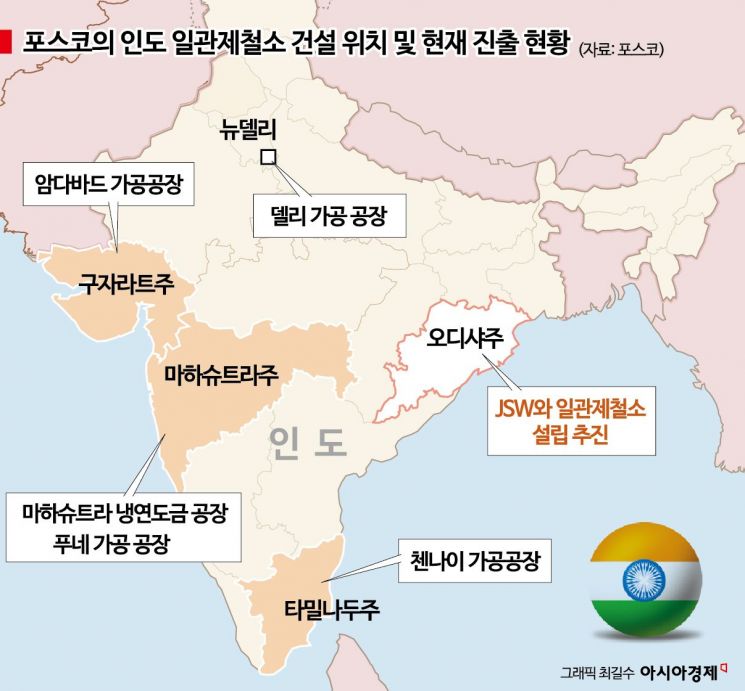
POSCO Group is actively targeting the Indian market, which has high entry barriers, through cooperation with the local number one steelmaker. Based on business and technological collaboration with JSW, which dreams of global market expansion, the group plans to establish a stable foothold in the Indian steel market and then expand into the battery materials market.
According to industry sources on the 30th, POSCO is promoting the construction of an integrated steel mill with an annual capacity of 5 million tons in Odisha state in eastern India. This integrated steel mill construction will be carried out in cooperation with JSW Steel, India’s top steelmaker, and additional expansion plans are also being considered. Considering the annual production capacity of 5 million tons, the investment scale of this project is expected to exceed 10 trillion won. POSCO plans to invest on a 50-50 basis with JSW, and accordingly, POSCO’s investment amount is estimated to be over 5 trillion won.
India’s No.1 JSW... Operating 4 Integrated Steel Mills
POSCO has previously attempted to establish integrated steel mills in India four times. However, it failed each time due to unsuccessful negotiations with residents and local governments and coordination failures with local joint ventures. JSW is a leading Indian company operating various businesses such as steel, energy, and infrastructure across India. In the steel industry, it is recognized alongside Tata Group’s Tata Steel as a representative company of the Indian steel industry. JSW operates four integrated steel mills in India and secured a crude steel production capacity of about 29 million tons last year, surpassing Tata Steel’s production capacity. JSW plans to build and expand additional steel mills in Odisha and Andhra Pradesh states by 2030, increasing production capacity to 50 million tons to target the growing domestic demand in India as well as the global steel market.
This cooperation is said to have been significantly influenced by the damage caused by Typhoon Hinnamnor in 2022. At that time, JSW provided POSCO with urgently needed “drivers” (key devices controlling factory equipment), helping with recovery efforts. Following this, former POSCO Group Chairman Choi Jeong-woo visited India and presented a plaque of appreciation to JSW Chairman Sajjan Jindal, which reportedly advanced discussions on cooperation.
Future cooperation in battery materials is also anticipated. JSW has recently actively entered the electric vehicle and battery business, including acquiring shares of MG Motors India from China’s SAIC Motor. According to market research firm Counterpoint Research, electric vehicle sales in India are expected to increase by 66% this year compared to last year, raising their share of total vehicle sales to 4%.
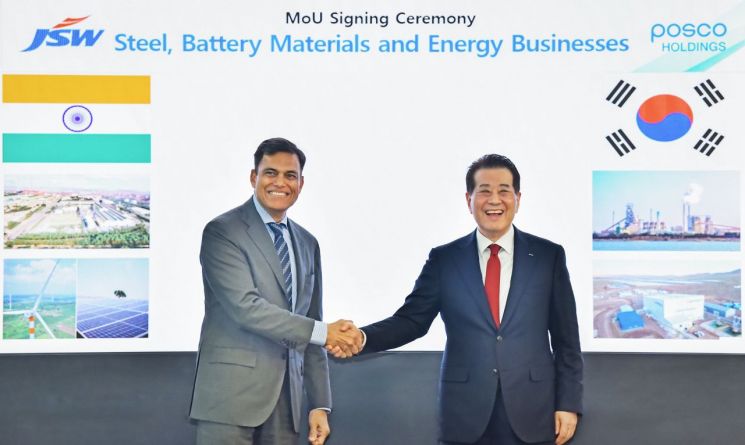 On the 21st, POSCO Group and JSW Group signed an MOU on business cooperation in the fields of steel, secondary battery materials, and renewable energy. Jang In-hwa, Chairman of POSCO Group (right), and Sajjan Jindal, Chairman of JSW Group (left), are taking a commemorative photo. Photo by POSCO Holdings [Image source=Yonhap News]
POSCO Picks India... The Reason is ‘Growth Potential’
India is often called a graveyard for multinational companies. Many companies recognized for their global competitiveness have failed to settle locally and had to pack up. Representative cases include U.S. automakers General Motors (GM) and Ford, Swiss cement giant Holcim, and convenience food brand Kellogg’s. According to an Indian government report, from 2014 to 2021, about 11,000 foreign companies entered India, but 2,783 companies had to leave the Indian industrial sector. Poor logistics and communication infrastructure, along with national and local government policies still centered on domestic companies, made competition with local firms difficult.
Despite these local conditions, POSCO chose India for its growth potential, emphasizing the “rebuilding of steel competitiveness.” India is the world’s largest growth market, with an expected average annual economic growth rate of 6.7% through 2030. According to WSD, India’s steel demand is expected to increase by 7% annually, reaching 190 million tons by 2030.
© The Asia Business Daily(www.asiae.co.kr). All rights reserved.


















