Reenactment Experiment of 'Sicheong Station Accident' at National Forensic Service Wonju Headquarters
Vehicle Braking System Functions Normally Even When Disabled
83% of National Forensic Service Sudden Acceleration Assessments Attribute to 'Pedal Misoperation'
"Even when the vehicle braking system is disabled, pressing the brake pedal by about 1 cm activates the brake lights, and the braking functions normally."
On the 29th, a 're-enactment experiment' was conducted at the Traffic Division of the National Forensic Service (NFS). The experiment examined whether the braking function operates when the driver presses the brake pedal while the electronic braking system of a GV80 vehicle lifted on a lift was disabled. Kim Jong-hyeok, head of the Vehicle Safety Division at NFS, explained, "(The test vehicle) has its brake controller disabled, so it has no function to amplify pressure when the brake pedal is pressed. In a way, it can feel 'stiff'." When the driver stepped on the accelerator pedal atop the vehicle, the wheels began spinning rapidly with acceleration noise. Then, when the brake pedal was pressed about 1.3 cm, the wheels stopped, and the rear brake lights lit up red.
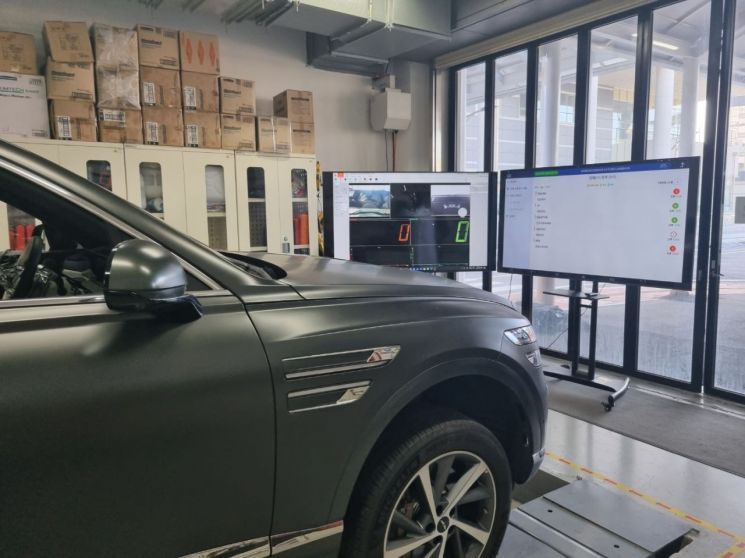 On the 29th, a vehicle for the reenactment experiment of the 'Sicheong Station reverse driving accident' is lifted at the National Forensic Service in Wonju, Gangwon Province.
 Photo by Kim Young-won
The NFS set up this scenario based on the driver’s claim in the so-called 'Sicheong Station sudden acceleration case.' The driver, Mr. Cha, has consistently claimed during investigations and trials that "the brake pedal was stiff and did not work" and that the accident was caused by sudden unintended acceleration.
However, Director Kim emphasized that, as shown in this experiment, even when the brake pedal is stiff, pressing it results in normal braking. Due to the vehicle’s design, even if a problem occurs in the drive system causing so-called 'sudden acceleration,' the braking system operates independently. Kim said, "Even if sudden acceleration occurs for unknown reasons, pressing the brake pedal will always stop the vehicle," adding, "The drive and brake systems are completely independent."
He continued, "The braking system is the last line of defense in the vehicle system," and "Engineers have designed the vehicle so that pressing the brake pedal stops the car under any circumstances. If the accelerator and brake pedals are pressed simultaneously, the accelerator pedal signal is completely disabled, and braking is prioritized."
The NFS also conducted similar experiments using the actual accident vehicle from the Sicheong Station case. According to Kim, the experiments were conducted under the supervision of the Seoul Central District Prosecutors’ Office, and no braking issues were found.
So why do 'sudden acceleration misperception incidents' occur? The NFS believes most are caused by driver 'pedal misoperation.' Reviewing the results of sudden acceleration claim investigations over the past five years up to June this year, out of 334 actual accident cases, 83% (277 cases) were determined to be caused by 'accelerator pedal misoperation.' The remainder involved vehicles too severely damaged for analysis or cases where Event Data Recorder (EDR) data could not be obtained. Videos of sudden acceleration misperception accidents that occurred this year show drivers mistaking the accelerator pedal for the brake, pressing the accelerator firmly even as the vehicle rapidly moves, leading to accidents.
Jeon Woo-jung, head of the Traffic Division at NFS, said, "People have become accustomed to incorrect information. They mistakenly believe that sudden acceleration vehicles have problems, that they themselves are perfect, and that what they are pressing is the brake, not the accelerator?this is a cognitive error." He added, "If you just lift your foot, the car stops. When the car moves against your will, you should suspect yourself, not the car; lift your foot, confirm exactly what you are pressing, and press the brake. Doing so can sufficiently prevent accidents like the Sicheong Station case."
© The Asia Business Daily(www.asiae.co.kr). All rights reserved.


















