Martial Arts and AmCham 'US Investment and Market Entry Seminar'
"Increased Pressure on Trade, Immigration, and Fiscal Policies"
Former U.S. President Donald Trump’s victory in the presidential election scheduled for one week later could lead to a decline in the U.S. economic growth rate by up to 0.8 percentage points, potentially keeping it in the low 2% range, according to an analysis. With increased intensity in trade, immigration, and fiscal policies, along with strengthened sanctions against China, business uncertainty is expected to rise and investment sentiment toward the U.S. is likely to weaken.
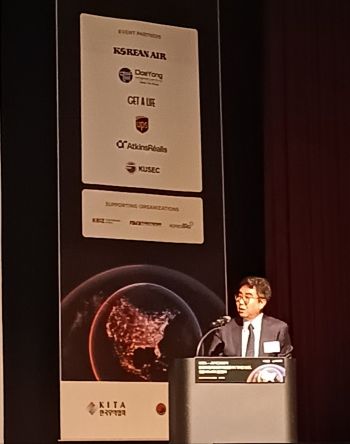 Yoon In-gu, Head of the International Finance Center, is delivering the keynote speech at the "U.S. Investment and Market Entry Seminar" jointly hosted by the Korea International Trade Association and the American Chamber of Commerce in Korea (AMCHAM) at COEX, Samseong-dong, Gangnam-gu, Seoul, on the 29th.
 [Photo by Moon Chae-seok]
Yoon In-gu, head of the International Finance Center, made this forecast on the 29th at COEX in Samseong-dong, Gangnam-gu, Seoul, during the 'U.S. Investment and Market Entry Seminar' jointly hosted by the Korea International Trade Association and the American Chamber of Commerce in Korea (AMCHAM).
In his keynote speech, Yoon said, "Oxford Economics estimates a 45% chance that candidate Trump will sweep the presidential election and the Republican Party will sweep both the House and Senate elections." He added, "If candidate Trump is elected and retaliatory policies are implemented against trade partners with trade surpluses, stagflation (high inflation with economic stagnation) will inevitably occur, lowering the growth rate by 0.5 to 0.8 percentage points."
The U.S. Department of Commerce announced last month that the finalized economic growth rate for the second quarter was 3%. This suggests that if candidate Trump wins, the growth rate could drop to the low 2% range.
He forecasted that after the U.S. presidential election, the intensity of trade policies with neighboring countries, including sanctions against China, would increase. In particular, if candidate Trump is elected, tariffs on China and in the automotive sector are expected to rise. He said, "Goldman Sachs projects that if Trump is elected, tariffs on China will increase from 0-25% per item to 5-85%, and the overall effective tariff rate will rise by about 20%." He added, "Increasing the intensity of trade and immigration policies and raising tariff rates will significantly expand the fiscal deficit."
Yoon advised that attention should be paid to how much uncertainty will increase regarding tax policies such as corporate tax, and whether the Tax Cuts and Jobs Act (TJCA), scheduled to expire next year, will be extended. He said, "Increased tax uncertainty could delay or weaken corporate investment. In such a case, the Federal Reserve might lower policy interest rates by up to 100 basis points (1bp = 0.01 percentage points) next year, which would affect the accommodative monetary policy stance."
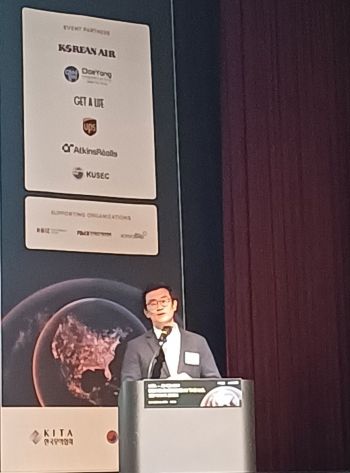 Associate Professor Kang Woo-chang of the Department of Political Science and International Relations at Korea University is giving a presentation on the 29th at COEX in Samseong-dong, Gangnam-gu, Seoul, at the "U.S. Investment and Market Entry Seminar" jointly hosted by the Korea International Trade Association and the American Chamber of Commerce in Korea (AMCHAM).
 [Photo by Moon Chae-seok]
There is also a forecast that candidate Trump could have an advantage over Democratic candidate Kamala Harris in seven battleground states, including Pennsylvania. Polls show that Harris is not overwhelmingly leading Trump in these battleground states. Considering the 'grassroots sentiment' of voters who rarely participate in polls, Trump is seen as having an advantage. If Trump wins the presidential election, a 'halo effect' could occur, giving the Republican Party an advantage in the House elections as well. The consensus is that the Republican Party already holds an advantage in the Senate elections.
Kang Woo-chang, associate professor of political science and diplomacy at Korea University, said in his presentation on 'U.S. Election Trends and Key Points to Watch' that "While it is impossible to predict the outcome, various circumstances leave open the possibility of a Trump victory." He added, "If both the presidential and congressional elections are won by the Republicans, the U.S. executive branch (president), Congress, and even the already conservative-leaning Supreme Court could be controlled by the Republican Party."
During the corporate mentoring session held alongside the seminar, presentations were given on visa issuance guidance, supply chain and logistics management know-how, site selection for factories in the U.S., and equipment investment strategies.
Nam Ji-young, an American attorney at the immigration law firm Daeyang, advised, "Visas must be legally secured through L-1 intracompany transferee visas, E-2 treaty investor employee visas, and others." She warned, "Companies earning money in the U.S. attempting entry and exit with electronic travel authorization (ESTA) or visitor visas (B-1, B-2) is illegal, which could lead to forced deportation of related individuals as well as visa refusals for the companies and Korean nationals involved."
Jin Jeong-hwan, head of sales for UPS Korea, the largest logistics company in the U.S., reported that American companies criticize Korean companies for slow delivery of goods. Jin said, "U.S. sourcing companies send goods within two days at the latest, but Korean companies sometimes take up to two weeks." He added, "In a recent conversation with a General Motors (GM) supply chain manager, it was pointed out that the most important issue Korean companies need to improve is this delay in delivery."
Kim Yoon-hee, senior managing director of strategic business development at the U.S. construction firm Akins Realize, said, "Assuming a foreign company invests $100 million (about 138.5 billion KRW) in the U.S., more than half is spent on construction." She advised, "To make massive construction investments effectively, it is essential to establish a close communication system with local communities and state government agencies." She added, "In the U.S. equipment investment process, semiconductor and solar panel companies are receiving water management consulting, while chemical and energy companies are getting environment management consulting to reduce costs, which is the recent trend."
© The Asia Business Daily(www.asiae.co.kr). All rights reserved.
!["The Woman Who Threw Herself into the Water Clutching a Stolen Dior Bag"...A Grotesque Success Story That Shakes the Korean Psyche [Slate]](https://cwcontent.asiae.co.kr/asiaresize/183/2026021902243444107_1771435474.jpg)

















