Ministry of Environment Designates ‘2024 Priority Sewerage Maintenance Areas’... Oncheoncheon Drainage Zone Included
Following Seoul, Feasibility of Installing ‘Rainwater Tunnel’ as Fundamental Urban Flood Solution
Feasibility and Basic Plan Study to Start Next Year - Construction Begins 2027 - Completion Targeted for 2032
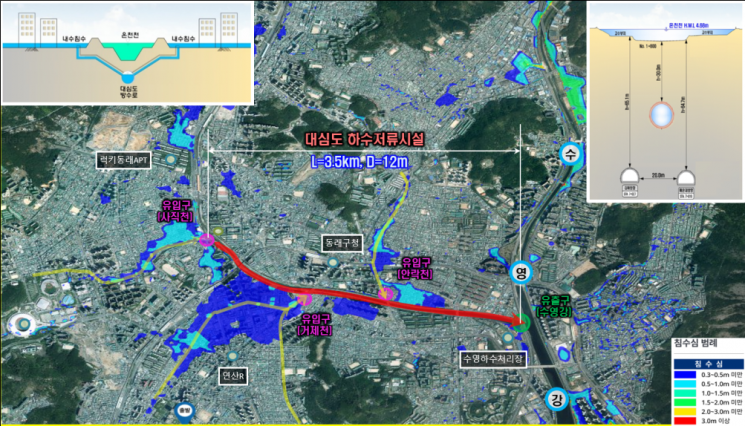
Busan City will actively promote the "Oncheoncheon Deep-Level Stormwater Storage Tunnel Project" following the designation of the Oncheoncheon drainage area as a "2024 Priority Sewerage Maintenance Area" by the Ministry of Environment.
The Oncheoncheon area in Busan has been a frequent flooding zone, experiencing flood damage 14 times over the past decade.
Until now, government policies to prevent urban flooding involved installing pumping stations in flood-prone areas to discharge rainwater into rivers. However, Oncheoncheon is a river affected by tidal currents from the sea, making discharge difficult during high tide. Additionally, recent abnormal weather patterns and extreme heavy rainfall have exceeded pump capacity limits, making it challenging to prevent urban flooding.
Accordingly, the city has continuously persuaded central government agencies with the argument that a fundamental solution is needed by installing a "deep-level stormwater tunnel" rather than relying on pump station-centered flood relief measures. As a result, Oncheoncheon was successfully designated as a priority sewerage maintenance area.
From June to December last year, a preliminary feasibility study was conducted, concluding that a fundamental solution requires installing a "deep-level stormwater tunnel" rather than relying on pump stations. Until September, the city visited central government agencies such as the Ministry of Environment and the Ministry of Economy and Finance 12 times to explain the necessity of the project.
With this designation, the city will receive approximately 120 billion KRW in national funding out of the total 400 billion KRW project cost for the "stormwater storage tunnel construction," laying the groundwork for fundamentally preventing urban flooding in the Oncheoncheon area.
The Ministry of Environment’s Priority Sewerage Maintenance Areas are designated after comprehensive evaluation of flood damage severity and urgency by a selection committee composed of relevant experts, targeting 30 projects in 21 local governments nationwide where flooding has occurred or is likely to occur.
The city applied for the designation on August 7, underwent an on-site inspection on October 7, a selection committee review on October 18, and the final designation was announced on October 29.
The Oncheoncheon stormwater storage tunnel project is the largest among the applicant local governments (total project cost of 400 billion KRW). Upon completion, it is expected to be recognized as the second deep-level stormwater storage tunnel installed nationwide, following Seoul.
The city secured 2 billion KRW in municipal funds in next year’s main budget to start feasibility and basic planning studies, aiming to complete the studies by the end of 2026, begin construction in 2027, and complete the project by 2032 without delay.
Once the Oncheoncheon stormwater storage tunnel is completed, non-point pollutants such as dust and tire particles that flow into the river during rainfall from June to August, causing annual fish deaths, will be diverted into the stormwater tunnel. After treatment at the Suyeong sewage treatment plant, the water will be discharged into the river, significantly improving river and coastal water quality as well as reducing urban odors.
Mayor Park Hyung-jun emphasized, "With the installation of the deep-level stormwater storage tunnel 40 meters deep in Oncheoncheon, habitual flooding in Yeonje-gu and Dongnae-gu areas will be fundamentally resolved. Moreover, the river water quality will be dramatically improved, preventing fish deaths during the rainy season, resulting in a safe, odor-free, and clean Oncheoncheon."
© The Asia Business Daily(www.asiae.co.kr). All rights reserved.
![Clutching a Stolen Dior Bag, Saying "I Hate Being Poor but Real"... The Grotesque Con of a "Human Knockoff" [Slate]](https://cwcontent.asiae.co.kr/asiaresize/183/2026021902243444107_1771435474.jpg)
















