Concerns Rise Over 'Sangsaeng Finance Season 2'
Major domestic financial holding companies recorded a record high net income of approximately 5 trillion won in the third quarter. Although the quality of earnings deteriorated somewhat due to the decline in market interest rates, this was offset by the quantity effect of increased loans from the real estate market recovery and high interest rates aimed at stabilizing household debt.
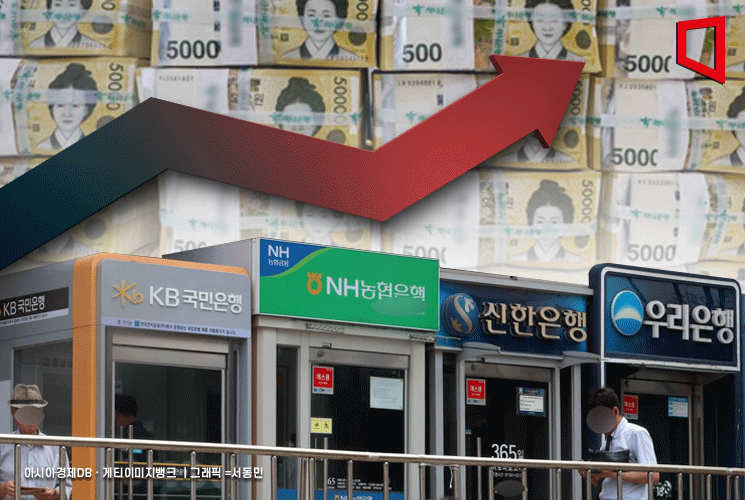
According to the financial sector on the 30th, the combined net income attributable to owners of the parent company of the four major domestic financial holding companies (KB, Shinhan, Hana, Woori) was 4.9127 trillion won, an 11.22% increase compared to the same period last year (4.4172 trillion won). This surpassed the previous record for the third quarter set in 2022 (4.8876 trillion won).
By company, KB Financial maintained its 'leading bank' status with net income of 1.6139 trillion won, up 17.91% year-on-year. Shinhan Financial followed with 1.2386 trillion won, a 3.90% increase. Hana Financial recorded the highest net income growth rate among the big four with a 20.86% increase to 1.1566 trillion won. Woori Financial also posted net income of 903.6 billion won, up 0.48%.
Initially, there were analyses suggesting that profitability could deteriorate in the third quarter due to the decline in market interest rates amid expectations of a base rate cut. Indeed, the net interest margin (NIM) of each company declined. For KB Financial, the group NIM was 1.95% and the bank NIM was 1.71% in the third quarter, each down 0.13 percentage points from the previous quarter. Shinhan Financial also saw declines of 0.05 and 0.04 percentage points to 1.90% and 1.56%, respectively.
Despite the decline in the quality of profitability, the record-high performance was attributed to the 'quantity' factor. While corporate loans showed a moderate increase, the government postponed the second phase of the stress Debt Service Ratio (DSR) regulation to September, leading to a surge in household loans in July and August. For example, Shinhan Financial's total won-denominated loans increased by 3.5% in the third quarter, with household loans rising by 6.3%. Woori Financial's quarterly won-denominated loans grew by 5.0%, with household loans increasing by 6.2%.
Shinhan Financial explained, "Household loans grew 6.3%, mainly in mortgage loans, due to the housing market recovery following the decline in market interest rates and increased loans such as policy mortgages," adding, "In the fourth quarter, we will minimize growth considering the group's risk-weighted assets (RWA) limits and focus on improving profitability and managing asset soundness."
The adjustment of additional interest rates by authorities and banks to curb loan demand, which raised loan interest rates, is also seen as influencing these results. Although the benchmark rate for fixed-rate mortgage loans, the 5-year bank bond yield, fell from 3.7% at the end of June to about 3.3% as of the 25th of this month, the fixed-rate mortgage loan interest rates at the four major banks have been rising, with the lower bound exceeding 4% and the upper bound surpassing 6.5%.
Despite these record-breaking results, the banking sector appears to be managing its expressions carefully. The four major financial groups are likely to break the existing annual record (15.6503 trillion won in 2022). The cumulative net income attributable to controlling shareholders of the four major financial groups up to the third quarter was 14.1126 trillion won, only about 2.5 trillion won short of the previous record. However, a banking sector official noted, "We need to watch closely as each bank may write off non-performing assets at the end of the year."
There are also considerable concerns in the financial sector about 'Win-Win Finance Season 2.' A financial sector official said, "Fifteen years ago, banks’ annual net income was only around 1 trillion won, but now the profit base has strengthened to the point where quarterly net income exceeds 1 trillion won," adding, "As a licensed industry, social contribution demands considering the recent economic situation are inevitable to some extent."
© The Asia Business Daily(www.asiae.co.kr). All rights reserved.
!["The Woman Who Threw Herself into the Water Clutching a Stolen Dior Bag"...A Grotesque Success Story That Shakes the Korean Psyche [Slate]](https://cwcontent.asiae.co.kr/asiaresize/183/2026021902243444107_1771435474.jpg)
















