National Assembly Steering Subcommittee to Overhaul National Assembly Act on 28th
Automatic Referral of Budget Bills Effectively Abolished
National Assembly Testimony and Appraisal Act Introduces Online Attendance
With the opposition party unilaterally amending the National Assembly Act and the Act on Testimony and Appraisal in the National Assembly (National Assembly Testimony and Appraisal Act) on the 28th, the National Assembly has gained virtually unlimited authority. Thanks to the automatic referral clause in the National Assembly Advancement Act, the government and ruling party had negotiation leverage regarding tax laws and related matters, but with the amendment of the related laws, authority has largely shifted to the National Assembly dominated by the opposition party. The National Assembly's power to summon witnesses and request materials has been significantly strengthened, and the amendment also includes provisions for criminal penalties if witnesses refuse to take an oath or fail to submit materials.

According to the National Assembly on the 29th, after long deliberations the previous day, the National Assembly Steering Subcommittee unilaterally approved amendments to the National Assembly Act, the National Assembly Testimony and Appraisal Act, and the Rules on the Composition and Operation of the Special Prosecutor Candidate Recommendation Committee (National Assembly Rules) by the opposition party. In addition to rules that strip the ruling party of the right to recommend special prosecutors in permanent special investigations involving the president and their family, the Steering Subcommittee also greatly strengthened the National Assembly’s powers, opening the way for a ‘super National Assembly.’
First, regarding budget review, the ‘automatic referral’ clause established through the past National Assembly Advancement Act is now at risk of disappearing. According to the amendments to the National Assembly Act, the review of the budget bill and supplementary revenue bills must be completed by November 30, but if the Budget and Accounts Committee and the standing committees related to tax laws continue their review, they are not obliged to comply. Previously, if the legal deadline passed, the budget bill and supplementary revenue bills were automatically submitted to the plenary session of the National Assembly. Im Kwang-hyun, a member of the Democratic Party who proposed the amendment, pointed out, "The government and ruling party, mindful of automatic referral, consistently took a defensive and passive stance during the tax law review process, and due to the expedited procedures, the review tended to proceed according to the government's intentions."
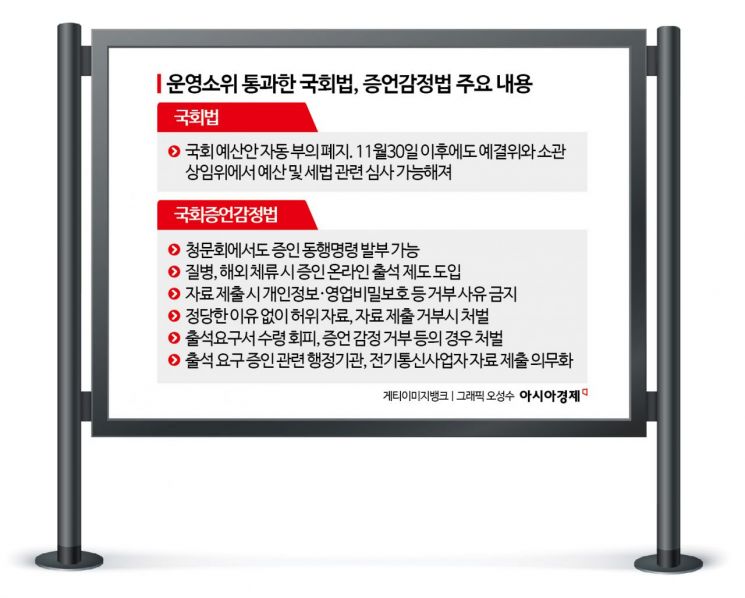
If the bill is amended, it will be possible to review tax laws in the Budget and Accounts Special Committee or the Planning and Finance Committee even after the legal deadline. If passed, secret deals between the ruling and opposition party leadership over the budget and tax laws, as in the past, could decrease. In fact, since the Advancement Act, the Budget and Accounts Committee has never been able to approve the budget review and had to pass the budget bill to the plenary session, with the budget being handled through negotiations among the leadership. However, a concern is that if the automatic referral clause disappears, budget review could continue until the end of the year or early next year amid brinkmanship between the ruling and opposition parties, increasing the risk of a ‘quasi-budget’ being formed. In this case, not only will fiscal forecasting become impossible, but local government budget formation will inevitably face a series of setbacks.
Regarding the National Assembly Testimony and Appraisal Act, the National Assembly’s authority to summon witnesses and request materials during audits or investigations has been greatly strengthened. Furthermore, hearings at the standing committee level can now issue accompanying orders just like national investigations or audits. Until now, there were frequent cases of refusal to attend due to overseas business trips or health reasons, but the amended National Assembly Testimony and Appraisal Act introduces online attendance, allowing testimony to be given remotely.
Additionally, if a witness evades receipt of a summons or refuses to take an oath or testify, it will be considered ‘non-attendance’ and subject to punishment. Moreover, administrative agencies and telecommunications service providers are now obligated to cooperate regarding witness attendance. Refusal to provide requested information about witnesses will result in penalties.
Regarding the submission of materials, the obligation to submit has been strengthened by including provisions that refusal on grounds of ‘personal information protection or trade secret protection’ is not allowed. Furthermore, refusal to submit materials, destruction, or concealment can result in the maximum prison sentence.
The ruling party strongly opposed the opposition party’s amendment moves. Choo Kyung-ho, floor leader of the People Power Party, said, "The Democratic Party’s true colors of parliamentary dictatorship, wielding extralegal power by leveraging majority strength, have been fully revealed," and added, "The Democratic Party’s parliamentary dictatorship that is driving South Korea into chaos must stop here."
The National Assembly plans to hold an Operations Committee meeting on the 30th to review the bills and rules deliberated and approved by the Steering Subcommittee.
© The Asia Business Daily(www.asiae.co.kr). All rights reserved.
![Clutching a Stolen Dior Bag, Saying "I Hate Being Poor but Real"... The Grotesque Con of a "Human Knockoff" [Slate]](https://cwcontent.asiae.co.kr/asiaresize/183/2026021902243444107_1771435474.jpg)

















