[US Election 2024]
Strengthening Checks on China in Cutting-Edge Technology Sector
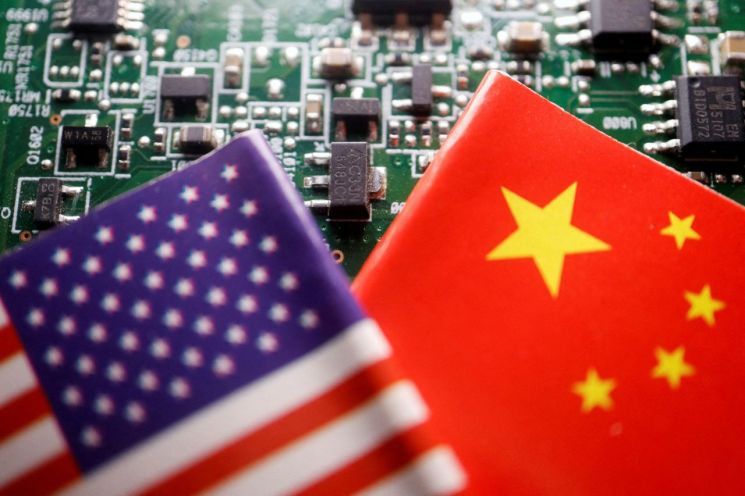
The U.S. government announced measures to control American capital investments in China in cutting-edge technology sectors such as semiconductors, quantum computing, and artificial intelligence (AI) starting next year. This move is interpreted as an effort to increase pressure on China and target undecided voters with less than ten days remaining before the presidential election.
On the 28th (local time), the U.S. Department of the Treasury released the "Final Rule for Implementing the Executive Order on Certain National Security Technologies and Products Investments in Concerned Countries."
This is pursuant to Executive Order 14105 signed by President Joe Biden last August and will take effect on January 2 next year.
The U.S. defines "concerned countries" as China, Hong Kong, and Macau in the final rule. Essentially, this blocks American capital investments in China's advanced technology sectors.
Companies intending to invest in China’s cutting-edge technology sectors must report their investment plans to the U.S. Department of the Treasury in advance. The Treasury has established a Global Transactions Office within the Office of Investment Security to oversee investment controls. The Treasury stated that violations could result in civil and criminal penalties under the International Emergency Economic Powers Act (IEEPA).
The purpose of these regulations is to prevent the inflow of U.S. tangible and intangible capital into China’s advanced technology sectors, which China could use to strengthen its military capabilities and dominate global markets.
The White House pointed out, "While cross-border investment flows and America’s open investment policy contribute to the vitality of the U.S. economy, concerned countries are abusing certain overseas investments to accelerate the development of sensitive technologies and products that undermine U.S. national security interests."
Paul Rosen, Deputy Assistant Secretary for Investment Security at the Treasury, stated, "Investments come with intangible benefits such as management support, investment, and access to talent networks, which should not be used by concerned countries to develop military, intelligence, or cyber capabilities."
According to a report published last year by the U.S. think tank Center for Security and New Technology, about 17% of global investment deals in Chinese AI companies from 2015 to 2021 involved Americans. Nine out of ten of these deals were at the venture capital stage.
This rule applies to various transactions including equity acquisitions, certain debt financings, greenfield investments, corporate expansions, and joint ventures. The South China Morning Post (SCMP) cited sources saying, for example, Tesla’s plan to develop a data center in China for AI learning related to autonomous driving technology could also fall under this rule.
Specifically, in the semiconductor sector, transactions involving certain electronic design automation software, specific manufacturing or advanced packaging tools, design or manufacturing of certain advanced integrated circuits, advanced packaging technologies for integrated circuits, and transactions related to supercomputers are prohibited. Transactions related to integrated circuit design, manufacturing, or packaging require reporting.
In the quantum computing sector, transactions involving the production of key components necessary for development or manufacturing, development or production of certain quantum sensing platforms, and development or production of certain quantum networks or quantum communication systems are prohibited. In the AI sector, all transactions related to AI system development are prohibited.
Exceptionally, investments in publicly traded securities are allowed. However, foreign media reported that the U.S. already has authority under previous executive orders to ban trading of securities of Chinese companies.
Strong backlash from China is expected. However, since the rule targets American capital, it is assessed that Korean companies will not be significantly affected.
As increased pressure on China has emerged as a key point in the U.S. presidential election campaign, this new regulation announced in the final stretch of the race is seen as a move to target undecided voters. Earlier, the Biden administration imposed up to 100% tariffs on strategic technologies such as electric vehicles in May and implemented export controls to block China’s access to advanced semiconductor equipment. Former President Donald Trump, the Republican presidential candidate, has repeatedly stated that he would impose a 60% tariff on all Chinese imports if re-elected.
© The Asia Business Daily(www.asiae.co.kr). All rights reserved.

















