"Chinese-origin e-commerce platforms like Ali and Temu have even changed the daily routine of customs officers. Watching the flood of incoming shipments, I often think this place resembles a 'battlefield,'" said Lee Seung-hee, head of the Special Express Clearance Division (hereafter Special Express Division) at Pyeongtaek Customs Direct Control Office, on the 24th.
The Special Express Division is a mandatory gateway that overseas direct purchase goods must pass through before entering the country. Due to its geographical characteristics, Pyeongtaek Customs mainly handles maritime special express shipments coming from China. A significant portion of Chinese-origin e-commerce shipments such as Ali and Temu pass through here.
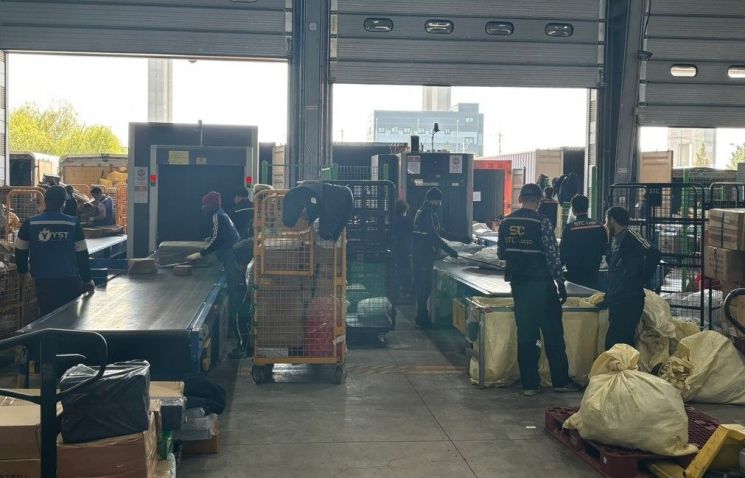 On the 24th, overseas direct purchase items from China were brought in through the X-ray inspection at the Pyeongtaek Customs express delivery center. Photo by Korea Customs Service
At the Special Express Division site, about 100 people including customs officers, special transport company staff, and courier company personnel were busily working together. Some were unloading goods from containers, while others sorted items moving along conveyor belts (rails) by destination. The sorted goods were then continuously loaded onto regular courier vehicles.
The scene was no different from the loading and unloading processes at typical courier logistics sites. However, what set it apart was that all items passing through the Special Express Division had to go through X-ray inspection stations. Pyeongtaek Customs currently inspects all shipments using a total of seven X-ray machines. This procedure checks whether the declared items match the actual goods being imported and whether any illegal or harmful items are included.
Items that seem suspicious are opened and visually inspected by customs officers. On that day, it was possible to observe over the shoulder a customs officer opening a package containing plastic model firearms (pistols, bullets, etc.) to verify its contents.
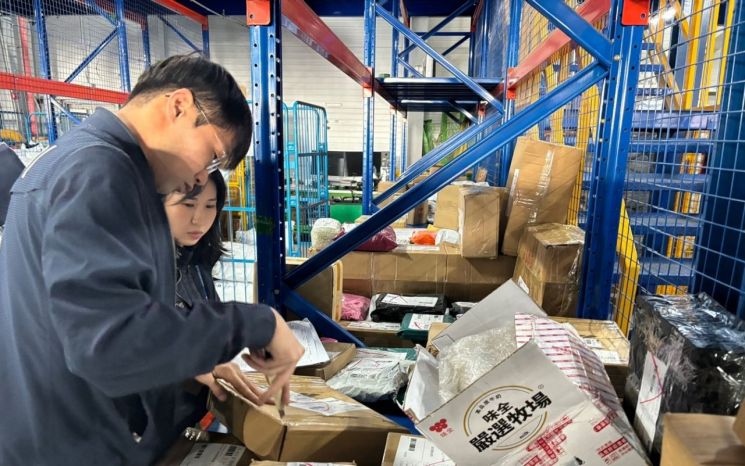 At the Pyeongtaek Customs express office, a customs officer is opening and inspecting overseas direct purchase items through a conveyor. Photo by Korea Customs Service
This procedure is carried out when deemed necessary during document-based clearance or when a specialized X-ray reading expert detects anomalies at the inspection station and requests a customs officer on site to open the package. The role of specialized experts is particularly significant at the Special Express Division. Typically, one expert reads about 13,000 to 14,000 items daily via X-ray, acting as a filter to detect suspicious signs.
Specialized experts can apply only if they have worked at a public institution for more than two years. Verified qualifications are required to be immediately deployed in field operations. When combined with what is commonly called 'intuition' or 'sense,' the abilities of these experts truly shine.
Jang Jae-eun (31, female), who has been working as a specialized expert at Pyeongtaek Customs Special Express Division for five years, said, "During the pandemic, we caught a case where COVID-19 treatments were secretly imported by mixing them with other items in a combined shipment," adding, "Even a small dot that might be easily overlooked by the eye cannot be missed in the work of a specialized expert."
She added, "Since the Special Express Division serves as a gateway to prevent illegal or harmful items from being mixed into overseas direct purchase goods, all specialized experts find both responsibility and fulfillment in their work."
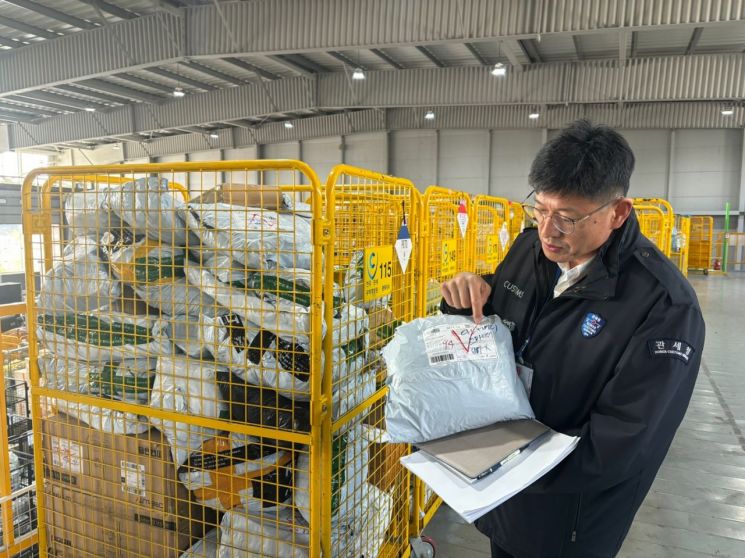 Lee Seung-hee, Head of the Customs Clearance Division, is pointing to and explaining the code used to distinguish e-commerce overseas direct purchase items originating from China. All the items packed in the container are e-commerce overseas direct purchase goods from China. Photo by Korea Customs Service
Recently, there has been a clear sense of workload overload at the Special Express Division due to the rapidly increasing volume of maritime special express shipments (Chinese-origin e-commerce). The annual volume of overseas direct purchase goods passing through Pyeongtaek Customs Special Express Division over the past five years was 13,263,000 cases in 2020, 23,068,000 in 2021, 31,643,000 in 2022, and 39,752,000 last year. This means the volume handled last year was about three times that of 2020.
The situation this year is not much different. From January to September, 28,150,000 overseas direct purchase cases passed through the Special Express Division in Pyeongtaek. Considering upcoming large-scale overseas discount events such as China's Guanggun Festival and the U.S. Black Friday next month, the annual cumulative volume is expected to set a new record.
Lee said, "Pyeongtaek Customs Special Express Division is the main entry route for maritime special express shipments departing from places like Yantai, Weihai, and Longyan in China," adding, "The workload at the Special Express Division has recently increased significantly due to the direct impact of Ali and Temu shipments."
The increase in Chinese-origin e-commerce shipments has made night shifts a daily routine for Special Express Division staff. Lee said, "Reflecting the surge in maritime special express shipments, we introduced a shift work system in August last year, extending working hours at the Special Express Division from 6 p.m. to midnight," adding, "It was an unavoidable decision tailored to the field situation."
Pyeongtaek Customs has steadily expanded the scope of the Special Express Division. As of April 2019, the number of X-ray machines increased from just one to seven, and during the same period, the first to third rebuilding phases enhanced the division's capacity (space expansion) and processing ability (additional conveyor installations).
Recently, voices advocating for upgrading Pyeongtaek Customs to a headquarters customs office have grown stronger, especially within the local community. In May, Won Yu-cheol, chairman of the Pyeongtaek Citizens' Association, personally delivered a petition to Lee Sang-min, Minister of the Ministry of the Interior and Safety, requesting the upgrade of Pyeongtaek Customs from a direct control office to a headquarters customs office.
Lee said, "Although we have steadily expanded the scope of the Special Express Division, it is still insufficient to handle the rapidly increasing volume of overseas direct purchase goods," emphasizing, "Upgrading to a headquarters customs office is not an easy issue, but it is certainly a task that must be addressed from a long-term perspective."
© The Asia Business Daily(www.asiae.co.kr). All rights reserved.



















