In the Japanese House of Representatives election (general election), the ruling Liberal Democratic Party (LDP) suffered a crushing defeat, causing the value of the yen to fall to its lowest level in three months. Political uncertainty has intensified, leading to forecasts that the yen could reach 155 per dollar. Prime Minister Ishiba Shigeru is scheduled to hold a press conference from 2 p.m. on the 28th.
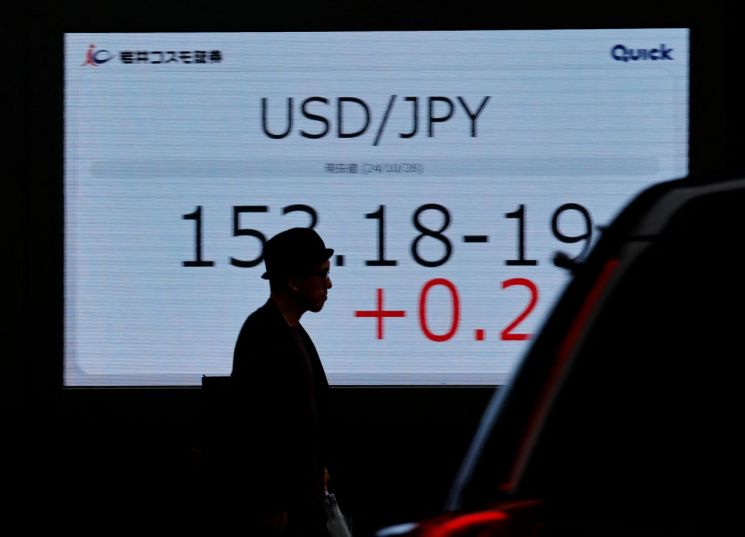
On the morning of the same day, the dollar-yen exchange rate in the Tokyo foreign exchange market surpassed 153.3 yen, marking the highest level since July 31. This represents an increase of more than 1 yen compared to the previous weekend. As a result, the yen's value dropped to its lowest level in about three months. A rise in the dollar-yen exchange rate indicates a decline in the yen's value.
The Nihon Keizai Shimbun reported, "Following the election, the yen is weakening amid growing speculation that the Bank of Japan (BOJ) will find it difficult to implement further interest rate hikes due to domestic political uncertainty." In the House of Representatives election held the previous day, the ruling LDP secured 191 seats, and the Komeito Party obtained 24 seats, failing to achieve a majority of 233 seats either alone or as a coalition.
The yen's weakness due to political uncertainty is expected to continue for the time being. Suzuki Hirofumi, Chief Foreign Exchange Strategist at Sumitomo Mitsui Banking Corporation, told Bloomberg News, "The 155 yen per dollar level will serve as a psychological support line." He added, "Ongoing political uncertainty inevitably puts downward pressure on asset prices. The foreign exchange market is facing a difficult situation. The yen will continue to weaken."
BNY also predicted that political uncertainty following this House of Representatives election could push the dollar-yen exchange rate back into the 155 yen range (yen depreciation). Additionally, with the U.S. presidential election just nine days away, there is speculation that if former President Donald Trump, the Republican candidate, wins, it could lead to a strong dollar trend, further supporting yen weakness.
The Tokyo stock market also experienced volatility. The Nikkei 225 average, Japan's representative stock index, showed a downward trend immediately after opening at 9 a.m. that day. However, it soon reversed to an upward trend and, as of 10:20 a.m., was showing a rise of around 1.6%. Given that reports had already indicated difficulty in securing a majority locally ahead of the election, it is assessed that the market did not plunge sharply on the day. The Nikkei index had fallen by about 1,000 points just last week. CLSA Asset Management noted that since the ruling LDP failed to secure a majority, the tax increase initiatives promoted by Prime Minister Ishiba have been stalled, which is seen as a positive factor for the market.
Prime Minister Ishiba is scheduled to hold a press conference at 2 p.m. local time. Local media are focusing on the possibility that the LDP, having maintained its position as the largest party, might form a coalition government by partnering with some opposition parties. However, there are expectations that Prime Minister Ishiba will not be able to escape responsibility for the election defeat. Bloomberg News reported, "When Ishiba succeeded in the LDP presidential election in September after four attempts, he probably did not anticipate this outcome. He expressed a desire to rebuild the LDP, which had been embroiled in slush fund scandals, but it is uncertain whether he will have the opportunity to do so."
© The Asia Business Daily(www.asiae.co.kr). All rights reserved.
![Clutching a Stolen Dior Bag, Saying "I Hate Being Poor but Real"... The Grotesque Con of a "Human Knockoff" [Slate]](https://cwcontent.asiae.co.kr/asiaresize/183/2026021902243444107_1771435474.jpg)
















