Graduate School of Semiconductor Materials and Components Discusses Latest Non-Volatile Memory Technologies
Over 250 Global Experts from 20th to 23rd... Debating Next-Generation Technologies
UNIST (President Jongrae Park) collaborated with IEEE, EDS, and the Korean Semiconductor Display Technology Society to bring together domestic and international experts for the advancement of next-generation semiconductor technology.
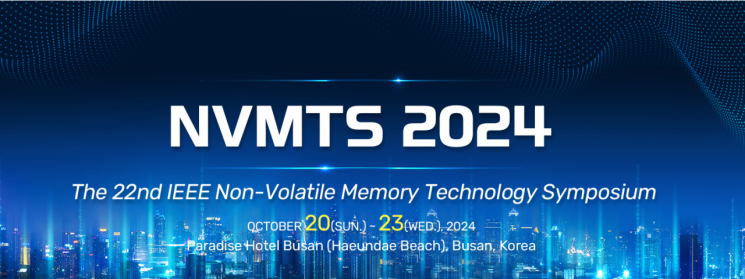
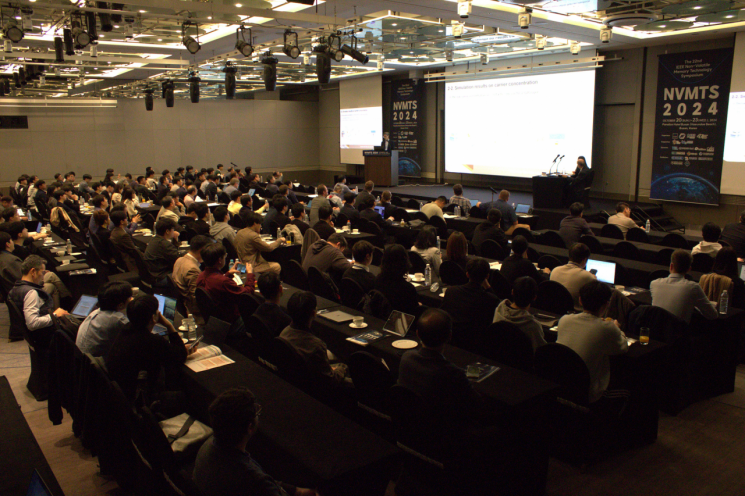
The 22nd Non-Volatile Memory Technology Symposium (hereafter ‘NVMTS 2024’), organized by the UNIST Graduate School of Semiconductor Materials and Components, was held from the 20th to the 23rd at the Paradise Hotel in Busan. This event gathered experts from home and abroad to explore the future of new semiconductor technologies.
The symposium featured about 250 domestic and international scholars and 35 international speakers from major companies such as Samsung Electronics, SK Hynix, and Micron in the United States. They presented on next-generation semiconductor devices including Flash, MRAM, PCRAM, RRAM, and FeRAM. New processes and system application methods were proposed to develop faster and more efficient memory.
Participants of ‘NVMTS 2024’ experienced the latest semiconductor technologies firsthand at corporate booths. A ‘poster session’ showcasing research results from students in related majors was also held. Future leaders shared ideas and engaged in passionate discussions.
Professor Hongsik Jung of the UNIST Graduate School of Semiconductor Materials and Components emphasized the technical limitations faced by the memory industry in his welcoming remarks. He stated, “Today, Moore’s Law, which states that semiconductor performance doubles every certain period, has reached its limit in the memory industry,” adding, “This symposium offers an opportunity to overcome these challenges through cutting-edge research from academia and industry based on new non-volatile memory technologies.”
© The Asia Business Daily(www.asiae.co.kr). All rights reserved.


















