Team KAIST Wins Second Consecutive Cybathlon Wearable Robot Event
Aiming for Wearable Robot Popularization
Researchers at the Korea Advanced Institute of Science and Technology (KAIST) have defended their title as champions at the 2024 Cybathlon, the 3rd edition of the international competition aimed at overcoming disabilities through robotic technology. Following a bronze medal in the inaugural 2016 event and a gold medal in the 2020 competition, they confirmed their promise to maintain a significant lead over their competitors.
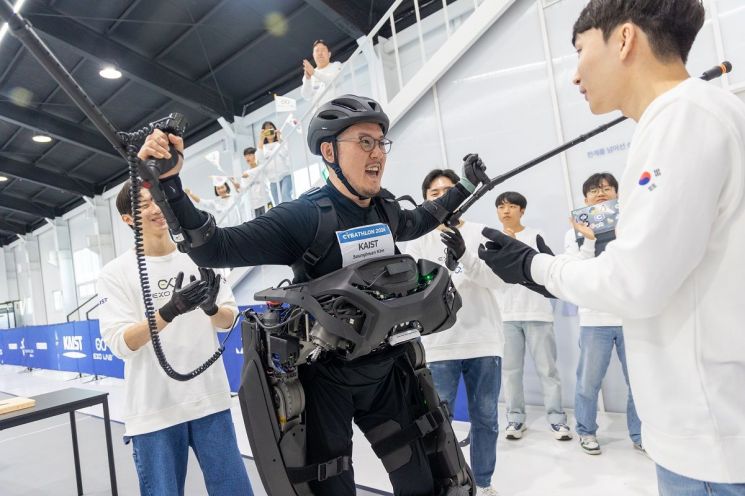 After passing the wearable robot mission in the 2024 Cybathlon competition, Seunghwan Kim from Team KAIST cheers. Photo by KAIST
According to KAIST on the 28th, the joint research team led by Professor Kyungchul Kong of the Department of Mechanical Engineering, including EXO-Lab, Move Lab, and Angel Robotics, developed the wearable robot ‘WalkOnSuit F1’ for individuals with lower limb paralysis, which won first place at the 3rd Cybathlon held on the 27th.
The Cybathlon is an international competition first held in Switzerland with the purpose of overcoming disabilities through robotic technology. It features eight categories including wearable robots, robotic prosthetic arms, robotic prosthetic legs, and robotic wheelchairs. A total of 71 teams from 26 countries participated in this 3rd Cybathlon. Professor Kong’s team competed in the wearable robot category, as in the previous competition.
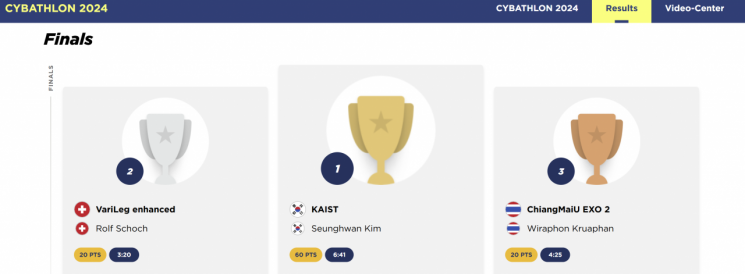 2024 Cybathlon Competition Wearable Robot Category Results. Team KAIST took first place by a wide margin.
This year’s competition featured particularly challenging missions. Most research teams possess technology barely sufficient to help individuals with lower limb paralysis stand and walk, but the missions included demanding tasks such as walking without a cane and cutting food using both hands.
To successfully complete these missions, Professor Kong’s team developed the significantly enhanced ‘WalkOnSuit F1.’ The number of motorized joints increased from six to twelve, and the motor output was more than doubled compared to the previous competition. The six-channel ground reaction force sensors on the feet measured the robot’s balance a thousand times per second to maintain stability. Cameras were installed to detect obstacles, and an AI board was equipped to implement artificial neural networks. Independently of the competition missions, the suit was also designed to allow the wearer to put it on by themselves, walk over, and dock from a wheelchair.
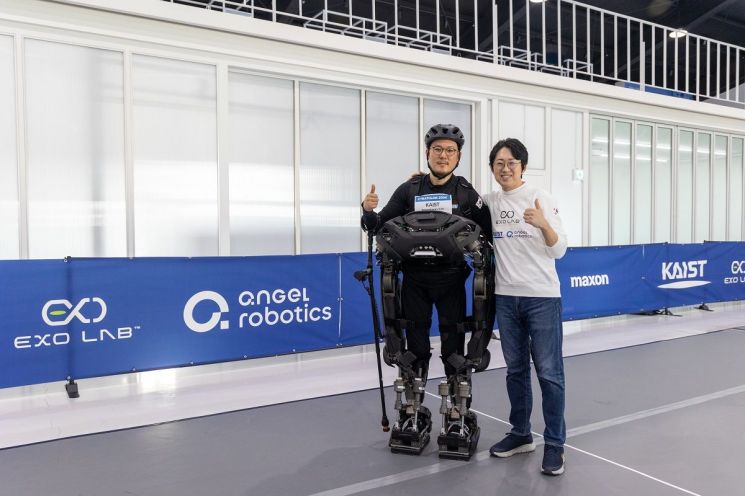
Professor Kong’s team overcame all obstacles designed to stop the reigning champions. They successfully completed missions such as side-stepping between narrow chairs, moving boxes, walking freely without a cane, passing through doors, and handling food in the kitchen, recording a time of 6 minutes and 41 seconds. The first-place KAIST team scored 60 points, while the second-place team scored 20 points, showing an overwhelming gap.
Team captain Researcher Jungsoo Park said, “We initially viewed this as a competition against ourselves and focused on demonstrating a technological super-gap, so we are very pleased and proud that such good results followed.” He added, “We will continue to reveal various undisclosed features of the WalkOnSuit F1.”
Researcher Seunghwan Kim, the team’s athlete with lower limb paralysis, expressed his feelings, saying, “I am deeply moved to be able to showcase South Korea’s world-class wearable robot technology through my own body.”
© The Asia Business Daily(www.asiae.co.kr). All rights reserved.
![Clutching a Stolen Dior Bag, Saying "I Hate Being Poor but Real"... The Grotesque Con of a "Human Knockoff" [Slate]](https://cwcontent.asiae.co.kr/asiaresize/183/2026021902243444107_1771435474.jpg)


















