Assemblyman Park Heeseung: Vaccination Reduces Cervical Cancer in Females Under 12 Years Old
As the incidence of oropharyngeal cancers such as tonsil cancer caused by human papillomavirus (HPV) infection rapidly increases among men, there are calls for urgent support for HPV vaccination not only for women but also for men.
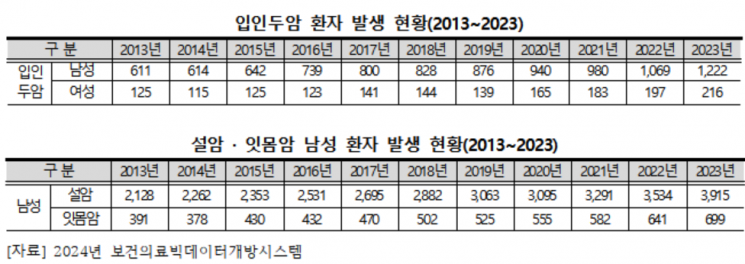
On the 28th, Park Heeseung, a member of the National Assembly's Health and Welfare Committee from the Democratic Party of Korea, analyzed data from the Health Insurance Review and Assessment Service's medical big data open system and found that the number of male oropharyngeal cancer patients in South Korea more than doubled from 611 in 2013 to 1,222 in 2023. Last year, the number of male oropharyngeal cancer patients was 5.7 times higher than that of female patients (216).
HPV infection causes various diseases including cervical cancer, cervical precancerous lesions, vaginal and vulvar cancers, anal cancer, head and neck cancers such as oropharyngeal, tongue, and tonsil cancers, as well as genital warts and respiratory papillomas. While cervical cancer in women is generally the most common, recently, male patients have significantly increased, especially in head and neck cancers such as oropharyngeal cancer.
In particular, the number of male patients with tongue cancer (tongue, tongue base) and gum cancer, which are types of head and neck cancers, has surged. Male tongue cancer patients increased from 2,128 in 2013 to 3,915 in 2023, and male gum cancer patients rose from 391 in 2013 to 699 in 2023, nearly doubling in both cases.
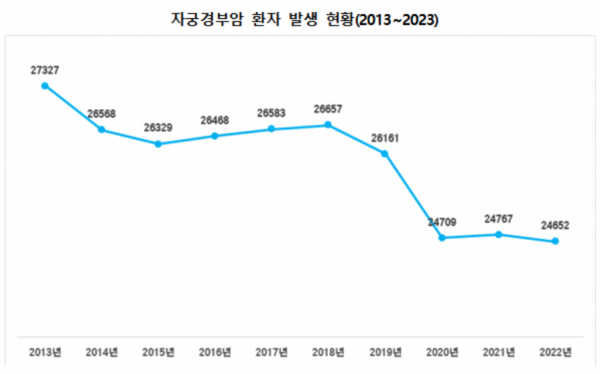
On the other hand, the number of cervical cancer patients has been decreasing from 27,327 in 2013 to 24,652 in 2022, which is attributed to about 80% of females aged 12 and under currently receiving free HPV vaccination.
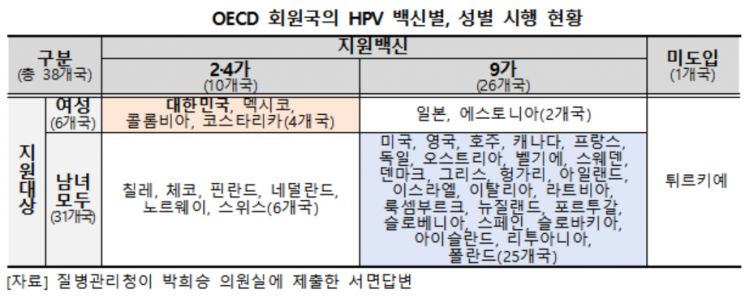
According to Assemblyman Park, among the 38 OECD countries, 31 provide HPV vaccination support to both men and women. Of these, 25 countries use the 9-valent vaccine, which offers the broadest protection, and 6 countries use the 2-valent or 4-valent vaccines. The majority of OECD countries support vaccination for both genders. In contrast, only six countries, including South Korea, provide vaccination support exclusively for women (four countries with 2-valent or 4-valent vaccines and two countries with 9-valent vaccines).
In South Korea, cost-effectiveness analyses have already established the basis for introducing free HPV vaccination for men, and priority evaluations have confirmed its feasibility. However, it has not yet been implemented due to the need for large-scale budget allocation. President Yoon Seok-yeol also pledged free HPV vaccination for boys during his presidential campaign.
Assemblyman Park stated, "The increasing trend of male patients caused by HPV virus is alarming, and there are reports of increased male infertility rates due to HPV infection," adding, "HPV vaccination support for both men and women, which most OECD countries have implemented, is now a necessity rather than a choice."
© The Asia Business Daily(www.asiae.co.kr). All rights reserved.
![A Woman Who Jumps Holding a Stolen Dior Bag... The Mind-Shaking, Bizarre Con of a "Human Knockoff" [Slate]](https://cwcontent.asiae.co.kr/asiaresize/183/2026021902243444107_1771435474.jpg)


















