A domestic research team has identified genetic differences related to autism by gender. Autism is known to have a prevalence rate four times higher in males than in females. However, the cause has not been clearly elucidated until now.
The National Research Foundation of Korea announced on the 28th that a research team led by Professor An Jun-yong of Korea University, Professor Yoo Hee-jung of Seoul National University Bundang Hospital, Director Kim Eun-jun of the Synapse Brain Disease Research Group at the Institute for Basic Science, and Professor Donna Welling of the University of Wisconsin-Madison in the United States analyzed whole-genome sequencing data from the largest East Asian autism family cohort to identify genetic differences in autism by gender and discovered specific autism-related genes.
A cohort refers to a group sharing statistical factors such as people born or married during a specific period, and whole-genome sequencing refers to the complete set of DNA bases storing the genetic information of a species.
Research on gender differences in autism has mainly been conducted on European populations. Studies targeting East Asians are rare, which highlights the significance of this joint research team's study.
Although autism encompasses a complex spectrum with various clinical characteristics, genetic analysis of how autism manifests according to clinical traits accompanied by gender differences remains in its early stages.
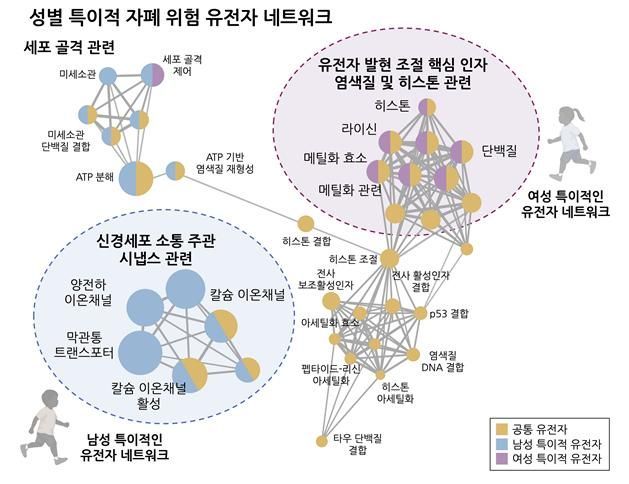
Accordingly, the joint research team analyzed whole-genome sequencing data from an East Asian autism family cohort and identified 40 female-specific autism genes and 403 male-specific autism genes, suggesting that different pathogenic mechanisms may exist between females and males.
The analysis revealed that female autism genes primarily affect chromatin and histones, which are key elements in gene expression regulation. In contrast, male autism genes influenced synapses, which govern communication between nerve cells.
During the study, it was also observed that de novo mutations and polygenic scores, major genetic causes of autism, differ by gender.
De novo mutations refer to very rare genetic mutations that do not appear in the parental generation but occur in the parents' germ cells and are transmitted to offspring. Polygenic scores are comprehensive scores calculated based on thousands of genetic variants that occur frequently, estimating the probability of developing a specific disease.
The joint research team found that these gender differences in genetic composition vary depending on the presence of intellectual disability and the severity of core autism symptoms.
Furthermore, by comprehensively collecting family clinical phenotype data from the Korean cohort and investigating the genetic composition of parents and siblings, they confirmed that females have higher polygenic scores than males but exhibit higher cognitive abilities and lower autism severity.
Professor An stated, "For precise diagnosis of neurodevelopmental disorders such as autism, a comprehensive approach considering both gender and clinical characteristics is necessary. This study will play an important role in establishing the foundation for gender-specific medicine in Koreans based on whole-genome sequencing data."
© The Asia Business Daily(www.asiae.co.kr). All rights reserved.

















