Implementation of Insurance Claim Rights Trust from the 12th
Insurance Companies Hiring Experts and Restructuring Trust Organizations
Preparing to Launch New Products Linked to Whole Life Insurance
From now on, death insurance benefits can be managed as trust assets. Insurance companies are actively pursuing the trust business by recently obtaining licenses and reorganizing their organizations to increase their low 2% market share in the trust sector.
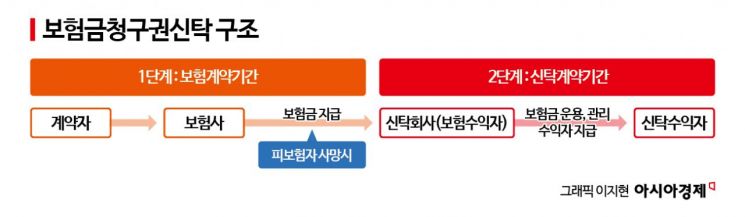
The Financial Services Commission announced that starting from the 12th, it will implement amendments to the 'Enforcement Decree of the Capital Markets and Financial Investment Business Act' and the 'Financial Investment Business Regulations' to introduce insurance claim rights trusts. Through this amendment, for general death coverage over 30 million KRW, the insurance beneficiary can be changed to a trustee, and the trust beneficiary can be set as a spouse or direct ascendants/descendants, thereby opening the door to insurance claim rights trusts. However, claim rights for special contracts such as accident or disease death are not eligible for trusts. Due to the nature of the contract, insurance policy loans are also not subject to trusts.
Among domestic insurers, five life insurance companies?Samsung Life, Hanwha Life, Kyobo Life, Heungkuk Life, and Mirae Asset Life?have acquired comprehensive property trust qualifications. Comprehensive property trusts allow for integrated management and operation of various types of assets such as cash, real estate, securities, and special properties under a single contract. Services such as substitute wills trusts, gift trusts, trusts for the disabled, and guardianship trusts can be provided. Two non-life insurers, Samsung Fire & Marine Insurance and KB Insurance, only offer cash trusts. According to statistics from the Korea Financial Investment Association as of August, the trust assets managed by these insurers amounted to 24.99 trillion KRW, about 1.8% of the total 1,361 trillion KRW.
Until now, the trust market was not an attractive field for insurers because the fees were significantly lower compared to insurance. Although fees vary by company and product, trust fees are generally around 1% per annum of the trust assets. Compared to banks, insurers have fewer sales networks, and it was more profitable to sell an additional insurance product than to spend time selling a trust product, so interest was low. Generally, insurers have heavily relied on retirement pension trusts rather than general trusts. However, with the full allowance of insurance claim rights trusts, this atmosphere is expected to change.
Insurance claim rights trusts are services where the insurance benefits received by customers are managed and operated by a trust company and paid to designated beneficiaries. Currently, only seven types of trust assets are permitted under the Capital Markets Act, but now insurance claim rights trusts are possible for general death insurance contracts that meet specific requirements such as coverage targets, contract characteristics, and beneficiaries. Insurers view this as an attractive market because they can secure a solid revenue source at low cost by linking with previously secured insurance contracts. As of the first half of this year, the outstanding death coverage contracts of 22 life insurers amounted to approximately 883 trillion KRW. This means about 900 trillion KRW of market is newly opened for the trust business.
By using insurance claim rights trusts, one can design their assets to be used according to their will in unexpected situations and prevent inheritance disputes in advance. For example, a whole life insurance policyholder can leave the death benefit to their children rather than a spouse who neglects child-rearing duties. Instead of inheriting the assets all at once to children who lack financial sense, the assets can be distributed annually on anniversaries. In Korea, inherited assets amounted to 39 trillion KRW last year, an 89.3% increase compared to 20.6 trillion KRW in 2018.
Currently, Samsung Life is the top insurer in the trust business, accounting for about 42% (9.7 trillion KRW) of insurers' trust assets last year. Samsung Life obtained comprehensive trust qualifications in 2007 and has entered substitute wills, trusts for the disabled, gift trusts, and dementia trusts. Samsung Life has been developing related capabilities early on within the trust department of its WM division (Comprehensive Asset Management Center). On the day of the insurance claim rights trust launch, the first contract was signed by a female CEO in her 50s with minor children. Regarding her 2 billion KRW death benefit, interest will be paid until her children reach 35 years old, and then 50% of the insurance money will be paid when the children turn 35 and 40 years old, respectively. A Samsung Life official said, "Insurance claim rights trusts represent the completion of life insurance by linking the core insurance business of death coverage with customized insurance benefit payment design through trusts," adding, "We will provide optimal solutions through expert groups going forward."
Kyobo Life received approval for property trust business from the Financial Services Commission in June. Following its entry into cash trusts in 2007, it has succeeded in entering property trusts and can now offer comprehensive property trusts. It has also established a separate organization consisting of about 14 trust specialists, lawyers, and tax accountants. Kyobo Life has been preparing to launch products in line with the implementation of insurance claim rights trusts. Kim Gye-wan, head of Kyobo Life's comprehensive asset management team, said, "As we approach a super-aged society, demand for inheritance, gifts, and guardianship is expected to surge," adding, "We will introduce services considering the connection with life insurance in terms of stable asset management and intergenerational asset transfer."
Hanwha, Mirae Asset, and Heungkuk Life, which have qualifications to operate insurance claim rights trusts, are also preparing related services and reviewing business feasibility. Some financial holding company-affiliated insurers without trust licenses are seeking footholds for entering the trust business by collaborating with other financial affiliates such as banks and securities firms.
Experts suggest that in the long term, claim rights for not only death insurance but also accident and disease insurance should be allowed as trust assets. Kang Sung-ho, senior research fellow at the Korea Insurance Research Institute, said, "In preparation for a super-aged society, the scope of trusts should be expanded to include accident and disease insurance as well as death insurance," adding, "The trust system should also be reorganized so that the trust business can lead to comprehensive asset management for dementia patients and the elderly."
© The Asia Business Daily(www.asiae.co.kr). All rights reserved.
!["The Woman Who Threw Herself into the Water Clutching a Stolen Dior Bag"...A Grotesque Success Story That Shakes the Korean Psyche [Slate]](https://cwcontent.asiae.co.kr/asiaresize/183/2026021902243444107_1771435474.jpg)
















