"Relatively Small Stature and Build... Reflecting North Korean Malnutrition"
Not Yet Participating in Combat, Role Unclear
As North Korean troops dispatched to Russia gather in Kursk, a major battleground on the Russian mainland, analysis suggests that the combat capabilities of these North Korean soldiers may not correspond to elite units.
On the 27th (local time), the US daily The Wall Street Journal (WSJ) published an article titled "North Korean Soldiers Have Arrived on Russia’s Frontline. How Ready Are They to Fight?" which assessed that the North Korean soldiers assembling on the Russian front may not be the "best and most outstanding" troops as described by North Korean State Affairs Commission Chairman Kim Jong-un.
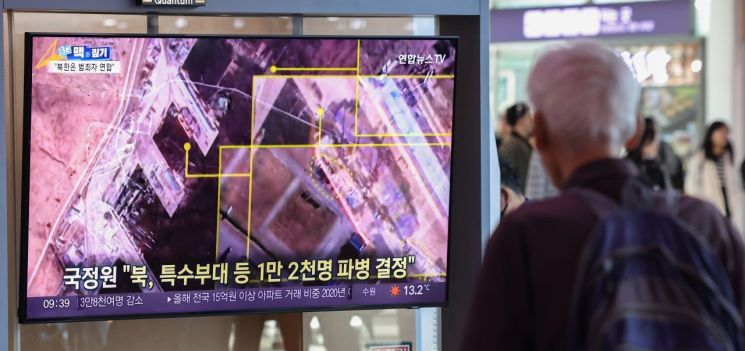 Amid reports that North Korea is dispatching large-scale special forces to the Ukraine war to assist Russia, related news is being broadcast on the TV in the Seoul Station waiting room on the morning of the 20th.
 [Image source=Yonhap News]
WSJ, citing publicly released North Korean military footage and government officials, reported that the soldiers gathered in Kursk are estimated to be young conscripts in their teens to early twenties who have been drafted only recently. They appear to be relatively short and small in stature, which military experts attribute to widespread malnutrition throughout North Korea. Previously, South Korean and Ukrainian authorities predicted that North Korea would dispatch approximately 12,000 troops, including forces from the 11th Corps, a special operations unit, to assist Russia in its war in Ukraine. The 11th Corps, deployed by North Korea, is known as the elite special forces unit also called the 'Storm Corps.'
However, WSJ noted that North Korea’s special forces training primarily focuses on infiltration into South Korea’s mountainous terrain to conduct assassinations and sabotage infrastructure, which is quite different from the trench warfare unfolding across the vast plains of the Ukraine conflict.
Regarding this, some interpret that Kim Jong-un may be sending relatively weak so-called 'cannon fodder' troops as an advance party to Russia in order to gauge domestic and international, especially Russian government, reactions to the deployment. James JB Park, a researcher at the US think tank Pacific Forum, told WSJ that Kim might initially want to send relatively 'expendable' troops to observe reactions at home and abroad, adding, "They will pave the way for more skilled soldiers later."
Experts predict that if North Korean troops directly engage in combat, it could significantly escalate the conflict that has lasted over two and a half years. Currently, North Korean forces have not yet participated in combat, and their future roles remain unclear.
© The Asia Business Daily(www.asiae.co.kr). All rights reserved.
![Clutching a Stolen Dior Bag, Saying "I Hate Being Poor but Real"... The Grotesque Con of a "Human Knockoff" [Slate]](https://cwcontent.asiae.co.kr/asiaresize/183/2026021902243444107_1771435474.jpg)
















