Hankyung Research... "Implementation Next Year Regardless of US Presidential Election"
"Transition to Carbon-Free Energy... Must Reduce Carbon Intensity"
It has been claimed that if the U.S. Clean Competition Act is implemented from next year, the domestic industry could bear a cost of 2.7 trillion won over 10 years. Experts advise accelerating the transition to carbon-free energy such as nuclear power plants and renewable energy to reduce carbon intensity.

According to the report "Domestic Impact and Policy Implications of the U.S. Clean Competition Act" released by the Korea Economic Association on the 28th, the domestic industry is expected to bear carbon tax costs of 2.7 trillion won over 10 years from next year until 2034 if the bill is introduced. Both the Democratic and Republican parties support the bill, making it highly likely that the law will be enforced from next year regardless of the presidential election outcome.
The Korea Economic Association analyzed that costs of 1.8 trillion won for raw materials and 900 billion won for finished products will arise depending on the scope of the Clean Competition Act. By industry, petroleum and coal products (1.1 trillion won) and chemical manufacturing (600 billion won) are expected to be significantly affected.
The bill was first introduced by the Democratic Party in June 2022. Democratic Senators Sheldon Whitehouse and Representative Susan DelBene reintroduced the bill in December last year. The Republican Party also introduced a similar Foreign Pollution Fee (FPF) bill in November last year.
Once the law is enforced, a carbon tax will be imposed by multiplying the carbon price by the carbon intensity gap between the U.S. and the country of origin. The carbon price will increase annually considering the consumer price inflation rate. For example, if a Korean company exports raw materials to the U.S., the U.S. importer must pay the carbon tax according to the law. The importer then passes this cost on to the domestic company.
The carbon tax is determined by multiplying the carbon intensity gap between the U.S. and Korea, the carbon price, and the applicable rate by the export weight. For example, if the carbon intensity gap is 1, the carbon price is $55 per ton (about 76,500 won), and the applicable rate is 1, a domestic export company exporting 100 tons to the U.S. will incur an additional cost of $5,500 (about 7.65 million won). The carbon tax will initially apply to raw materials produced by 26 energy-intensive industries next year and will expand to finished products by 2027.
The slower the improvement in carbon intensity, the more money must be paid. Korea’s improvement speed is slower than major countries. The Korea Economic Association reported that from 2016 to 2020, Korea’s carbon intensity improvement rate was 2.4%, slower than the U.S. (4.9%), the U.K. (5.9%), Germany (5.5%), France (4.6%), Italy (3.7%), and Japan (2.7%). The national carbon intensity used in the Clean Competition Act’s carbon tax formula was about 1.2 times higher in Korea (0.14) than in the U.S. (0.11) as of 2020. The improvement speed was 2.5 percentage points lower.
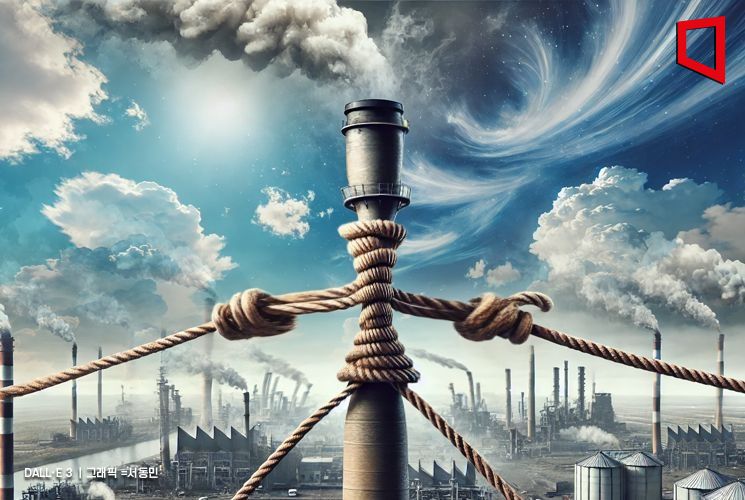
The Korea Economic Association argued that to reduce corporate cost burdens when the law is introduced, efforts should be made to lower carbon intensity through the transition to carbon-free energy (nuclear, renewable energy, etc.) in the power generation sector. The carbon tax in the law is calculated based on the national-level (general economy) carbon intensity gap, which is the amount of greenhouse gas emissions divided by gross domestic product (GDP).
The Korea Economic Association estimated that lowering the annual carbon intensity by 1% would reduce the U.S. Clean Competition Act costs (carbon tax) by 4.9% (about 8.8 billion won). It also stated that accelerating the transition to carbon-free energy in the power sector could speed up decarbonization in other sectors such as industry, buildings, and transportation through "electrification." Electrification refers to switching fuel and raw energy sources from coal and other traditional energy sources to electricity through hydrogen reduction steelmaking, building heat pumps, electric vehicles in transportation, and so on.
The Korea Economic Association urged the government to take a leading role in international forums. The law specifies the possibility of calculating carbon taxes considering industry-specific characteristics based on the reliability of origin data. The Carbon Reduction Forum (IFCMA), launched under the Organization for Economic Cooperation and Development (OECD), studies the greenhouse gas reduction effects of climate policies and carbon intensity. The research results are expected to influence the European Union’s (EU) Carbon Border Adjustment Mechanism (CBAM) and the U.S. Clean Competition Act’s carbon tax calculations.
The Korea Economic Association said, "It is necessary for the Korean government to play a leading role in the IFCMA to establish a foundation where the effects of industry-specific carbon intensity improvements are reflected in carbon tax cost reductions."
The Korea Economic Association advised that Korea should inform the U.S. that it bears a high carbon price to enhance its negotiating power. The law includes a carbon club clause that exempts part of the carbon tax if policies explicitly imposing costs on greenhouse gas emissions at the origin are implemented. According to the Korea Economic Association, as of 2021, Korea’s effective carbon price was 29.9 euros (about 45,000 won) per ton of CO2 equivalent (tCO2), about 2.5 times higher than the U.S.’s 12 euros (about 18,000 won).
The Korea Economic Association stated, "The government needs to secure negotiating power with the U.S. in advance based on the trends of increasing the free allocation ratio in the emissions trading system and the current status of carbon pricing system operation."
© The Asia Business Daily(www.asiae.co.kr). All rights reserved.
![Clutching a Stolen Dior Bag, Saying "I Hate Being Poor but Real"... The Grotesque Con of a "Human Knockoff" [Slate]](https://cwcontent.asiae.co.kr/asiaresize/183/2026021902243444107_1771435474.jpg)

















