Completion of Phase 1 Upstream and Downstream Processes for Brine Lithium in Argentina
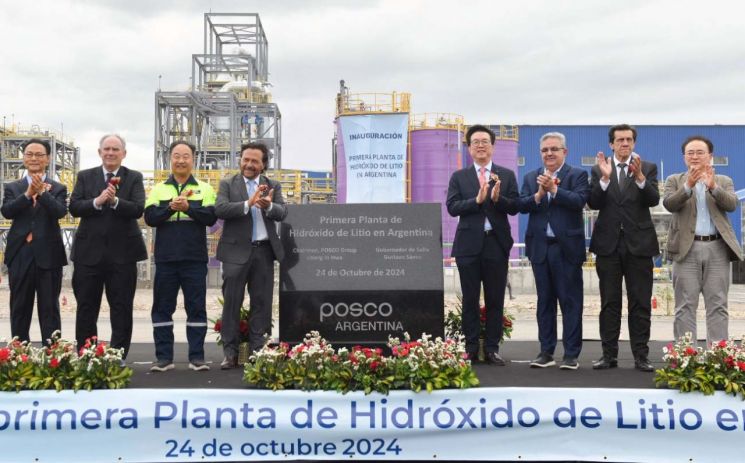 At the completion ceremony of the 25,000-ton annual capacity lithium hydroxide plant held on the 24th (local time) in G?emes City, Salta Province, Argentina, attendees are taking a commemorative photo. From the left in the photo are Lee Yong-su, Ambassador of Korea to Argentina; Luis Lucero, Deputy Minister of Mining of Argentina; Kim Kwang-bok, Head of POSCO Argentina Corporation; Gustavo Saenz, Governor of Salta Province; Kim Jun-hyung, Head of Secondary Battery Materials at POSCO Holdings; Raul Jalil, Governor of Catamarca Province; Carlos Sadir, Governor of Jujuy Province; and Lee Cheol-mu, Head of Plant Business Division at POSCO E&C. Photo by POSCO Holdings
POSCO Holdings has become the first domestic company to complete a factory capable of producing lithium hydroxide for secondary battery materials from overseas lithium brine lakes. This achievement is seen as the result of steady investment in raw materials, stabilizing the domestic supply chain and yielding results in the materials sector.
On the 24th (local time), POSCO Holdings held a completion ceremony for a lithium hydroxide plant with an annual capacity of 25,000 tons in G?emes, Salta Province, Argentina. This marks the completion of the first phase of POSCO Holdings' planned three-phase project. The plant utilizes brine from lithium brine lakes in Argentina, where POSCO Holdings holds 100% mining rights, and applies proprietary lithium extraction technology.
The ceremony was attended by POSCO Group officials including Kim Jun-hyung, Head of Secondary Battery Materials at POSCO Holdings; Hwang Chang-hwan, Head of Investment Engineering Team; and Kim Kwang-bok, Head of POSCO Argentina. Also present were Gustavo Saenz, Governor of Salta; Raul Jalil, Governor of Catamarca; Carlos Sadir, Governor of Jujuy; Luis Lucero, Deputy Minister of Mining of Argentina; and Lee Yong-soo, Ambassador of Korea to Argentina.
Lithium hydroxide is the main raw material for cathode materials, which are core components of secondary batteries used in electric vehicles. It represents the starting point and a key competitive pillar of POSCO Group’s full value chain in secondary battery materials, spanning "lithium-cathode material-recycling." POSCO Group secures stable supplies of lithium raw materials from overseas brine lakes and mines through ownership and equity stakes, produces lithium hydroxide at domestic and overseas sites, contributes to stabilizing the domestic critical minerals supply chain, and aims to strengthen its position as a global lithium supplier by building a secondary battery materials business portfolio that can respond to various demand conditions such as the U.S. Inflation Reduction Act (IRA).
With the completion of the local brine lithium plant in Argentina, POSCO Holdings now has a total production system of 46,500 tons of lithium hydroxide for secondary battery materials from both brine and ore resources, including the 21,500-ton ore-based lithium hydroxide plant operated by POSCO Pilbara Lithium Solutions in Yulchon Industrial Complex, Gwangyang, Jeollanam-do.
In his commemorative speech, Head Kim Jun-hyung said, "The completion of this lithium plant is an important first step for POSCO Group to produce high value-added lithium in Argentina. Through subsequent projects, POSCO Group will establish itself as a global leader in the lithium industry."
POSCO Holdings acquired mining rights to the Hombre Muerto brine lake in Salta, Argentina, in 2018 and established a 100% subsidiary, POSCO Argentina. Shortly after acquiring the brine mining rights, additional exploration confirmed lithium reserves of 13.5 million tons in lithium carbonate equivalent, about six times the initially estimated 2.2 million tons at the time of acquisition.
Following brine exploration and demo plant operations, POSCO invested approximately $830 million in 2022 to start construction of the "Brine Lithium Phase 1" upper and lower processes. The upper process of Phase 1 is located at a brine lake at an altitude of 4,000 meters in Salta, producing lithium phosphate from brine, while the lower process in the lowlands of G?emes, Salta, converts lithium phosphate into lithium hydroxide.
The Phase 1 brine lithium plant applies POSCO Group’s independently developed lithium extraction technology, which allows recovery and reuse of auxiliary raw materials needed for production, resulting in low maintenance costs. POSCO’s lithium extraction technology uses electrodialysis by stacking membranes that selectively allow certain substances to pass through, applying electricity and flowing lithium solution to produce high-purity lithium hydroxide.
The annual production capacity of 25,000 tons of lithium hydroxide from POSCO Holdings’ Phase 1 brine lithium plant is enough to produce approximately 600,000 electric vehicles. It is the first commercial lithium hydroxide production plant in Argentina and the largest single-company production capacity in South America. The construction process created over 4,800 jobs and involved more than 60 local partner companies, contributing to the development of the local economy.
Following the completion of Phase 1, POSCO Holdings is currently investing about 1 trillion KRW to build the Phase 2 upper process of brine lithium with an annual capacity of 25,000 tons in Argentina, aiming for completion in the second half of 2025. Additionally, POSCO plans to timely invest in a Phase 3 brine lithium plant with an annual capacity of 50,000 tons, securing a total brine lithium production capacity of 100,000 tons.
Moreover, POSCO Holdings is preparing to complete the second ore lithium plant with an annual capacity of 21,500 tons this year, following the first ore lithium plant of the same capacity operated by POSCO Pilbara Lithium Solutions since its completion in November last year, bringing the ore-based lithium hydroxide production system to 43,000 tons.
Meanwhile, as part of securing core competitiveness in the secondary battery materials business, one of the seven future innovation tasks, POSCO Holdings plans to continue investing in raw materials such as lithium to capture growth markets from a long-term perspective despite the electric vehicle market slowdown due to the chasm effect. To this end, POSCO is reviewing participation in brine lake development in South America, including Chile, and plans to further strengthen the critical minerals supply chain for the secondary battery materials business through active investment in high-quality resources, including collaboration with mining and resource companies in North America and Australia.
© The Asia Business Daily(www.asiae.co.kr). All rights reserved.

















