Discussion on 'China-Tajikistan-Afghanistan Connection' Economic Corridor
Interpretations Targeting Afghan Natural Resources Such as Rare Earths and Lithium
China has expanded its economic cooperation with the Taliban by applying tariff exemptions to Afghan exports starting this December.
According to Afghan state-run Bakhtar News Agency and others on the 26th (local time), Zhao Xing, the Chinese ambassador to Afghanistan, said this after meeting with Mullah Abdul Kabir, the Taliban government's Deputy Prime Minister in charge of political affairs, in Kabul, the capital of Afghanistan, on the 24th.
The Afghan government also issued a statement with the same content after the meeting with Ambassador Zhao. Bakhtar News Agency reported that if Afghan exports enter China duty-free, exports of Afghan goods to China will increase significantly, and additional jobs will be created in Afghanistan.
Ambassador Zhao also expressed optimism that Afghanistan's exports to China this year increased by 11.5% compared to the previous year, and that the growth rate will reach 25% next year. Major foreign media outlets cited Chinese customs data, reporting that Afghanistan's exports to China last year amounted to about $64 million (approximately 89 billion KRW).
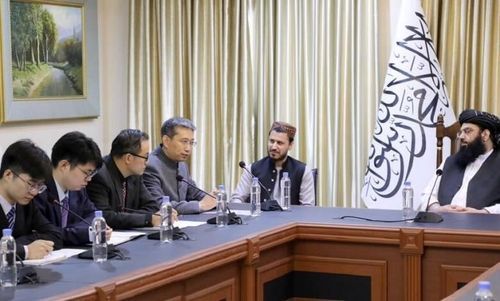 Zhao, Chinese Ambassador (fourth from the left), in talks with Kabir, Afghan Deputy Prime Minister (right). [Source=Captured from Afghan state-owned Bakhtar News Agency]
In addition to tariff exemptions on Afghan exports, Ambassador Zhao discussed the 'Wakhan Corridor,' a new economic corridor connecting China and Afghanistan through Tajikistan in Central Asia, and introduced plans for future trilateral talks among the three countries.
Deputy Prime Minister Kabir also expressed gratitude for China's decision and appealed to neighboring countries to follow China's example. He emphasized that if the Wakhan Corridor becomes operational, trade and economic activities between the two countries will increase.
There is also an interpretation that China's initiative to build the corridor targets Afghanistan's abundant natural resources such as cobalt, copper, iron, rare earth elements, and lithium. These natural resources are considered strategic resources essential for advanced industries such as semiconductors, secondary batteries, and electric vehicles.
China has maintained a special relationship with the Afghan Taliban regime, which regained power in August 2021. The Chinese government, which dispatched Ambassador Zhao in September last year, officially accepted Bilal Karimi as the new Afghan ambassador in January.
© The Asia Business Daily(www.asiae.co.kr). All rights reserved.