DeepX 1st Generation AI Semiconductor 'DX-M1'
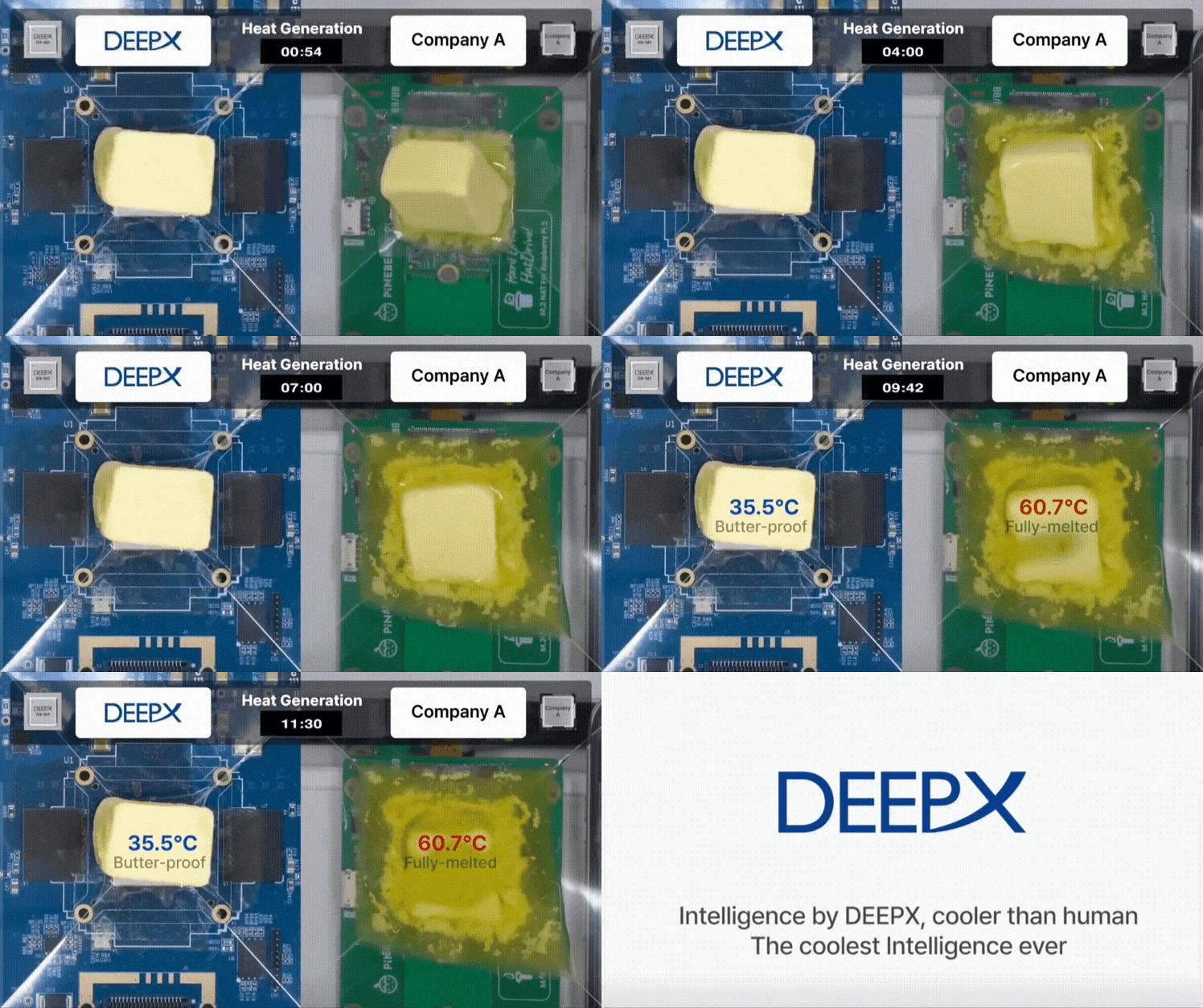 DeepX AI semiconductor DX-M1 (left) and an overseas competitor's product are compared in the 'Butter Benchmark' experiment. Butter is placed on each product, and the speed at which the butter melts over time is observed to evaluate heat dissipation performance. This experiment was devised by DeepX CEO Kim Nok-won to easily explain the product's excellence to clients. [Video source=DeepX]
"At the end of December this year, DeepX will release the first mass-produced wafer of its first-generation artificial intelligence (AI) semiconductor, and the final product will be launched in January next year. More than 20 companies, including Hyundai Motor Robotics Lab, POSCO DX, and LG Uplus, are developing mass-produced products using our semiconductor, and we are in discussions with over 140 global companies such as HP."
Kim Nok-won, CEO of DeepX, a domestic fabless (semiconductor design specialist) company, introduced the AI semiconductor ‘DX-M1’ his company developed during a recent interview with reporters at the ‘Semiconductor Exhibition (SEDEX 2024)’ held at COEX in Seoul.
CEO Kim emphasized the wafer because it is an important indicator to check the stability and efficiency of the product before mass production. He said, "We received a prototype from Samsung Foundry in June this year, and it sufficiently proved mass production feasibility in terms of performance and power consumption," adding, "We secured both yield and quality in the 5 nm (nanometer, one billionth of a meter) process."
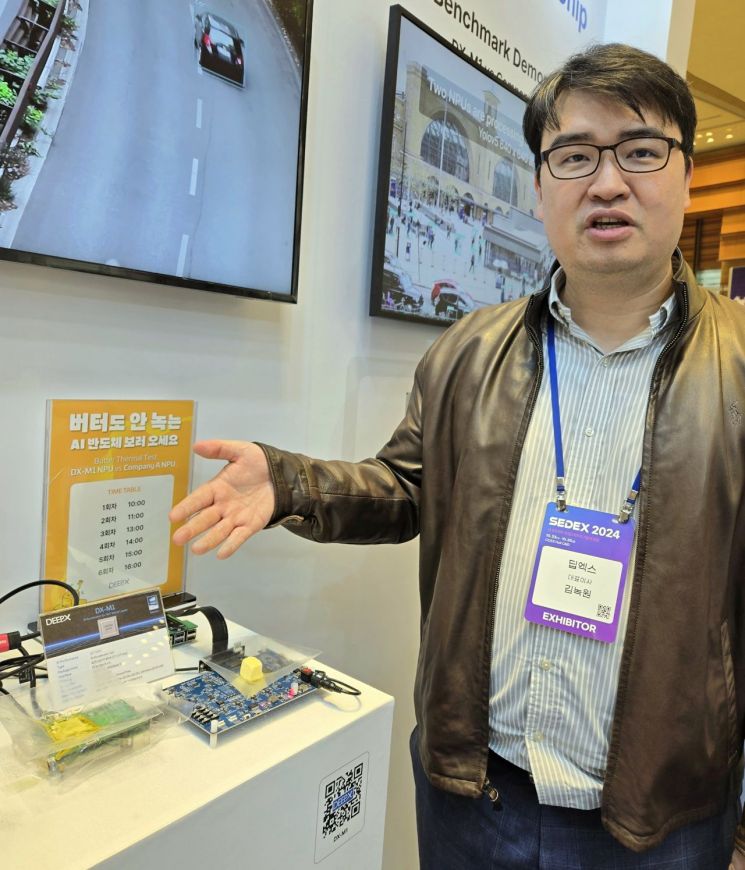 On the 23rd, at the DeepX booth of the 'Semiconductor Exhibition (SEDEX 2024)' held at COEX in Gangnam-gu, Seoul, Kim Nok-won, CEO of DeepX, is explaining the 'Butter Benchmark,' an experiment on heat control and low power performance of the DX-M1. This experiment was devised by CEO Kim himself to effectively communicate low power performance to client company executives. Photo by Choi Seo-yoon
The DX-M1 is a semiconductor for edge computing that can process AI tasks quickly and efficiently. It can be used in everything from home appliances like electric rice cookers to all systems equipped with cameras, and data center servers. He said, "The number of robots will explode within the next 10 years," adding, "The applicable applications are endless."
For example, in an unmanned checkout system, consumers must select agricultural products like apples or bell peppers themselves and enter the price. By applying DeepX’s AI technology, the system can automatically recognize products and assign accurate price tags, enabling 100% automation. CEO Kim said, "By introducing such a system, a checkout system can be built with only about 100 dollars worth of AI semiconductors, achieving both labor cost reduction and efficiency improvement."
At this event, DeepX conducted an experiment placing butter on top of the chip (semiconductor) to observe melting. Since AI semiconductors applied to home appliances require low power consumption and heat suppression, this was a comparison with competitor products. In the ‘butter benchmark’ experiment, competitor products reached 60 degrees Celsius in 10 minutes, melting the butter, but the DX-M1 maintained its shape for over an hour. CEO Kim explained the low power performance of the DX-M1, saying, "Butter melts at 30 to 36 degrees, but the DX-M1 suppresses heat generation." He added, "In electronic devices or robots, heat shortens battery life and degrades device performance," and "DX-M1 is a product that solves these problems."
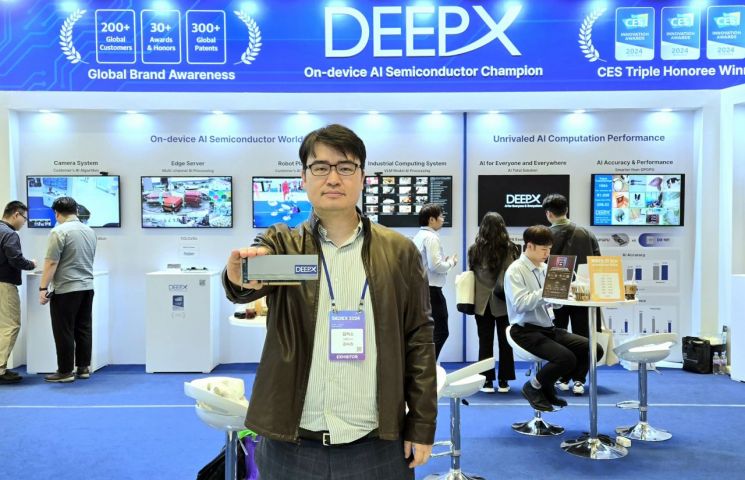
CEO Kim stated that DeepX’s low-power design differentiates it from AI semiconductor leader Nvidia. He said, "There is no absolute leader in the field DeepX focuses on in the AI semiconductor market," adding, "Nvidia’s server AI semiconductors have high power consumption and heat issues, but DeepX fills the gap with a neural processing unit (NPU) that offers excellent performance per watt."
CEO Kim expressed confidence that DeepX maintains a technological gap with global competitors through more than 300 patents. He said, "In the NPU field, we hold more patents than Nvidia, Qualcomm, and Intel," emphasizing, "Within 20 to 30 years, we will grow DeepX into the Nvidia of on-device AI semiconductors."
© The Asia Business Daily(www.asiae.co.kr). All rights reserved.



















