Infinite Refill Restaurant Search Volume Up 102%
Popular for No Price Worries Amid High Inflation
Business Struggles Due to Rising Ingredient Costs
Due to the recession and high inflation, all-you-can-eat restaurants where customers can order as much as they want at affordable prices are booming, but self-employed business owners running these establishments are complaining of management difficulties. Experts analyze that in the current situation where the prices of ingredients such as meat and vegetables have risen across the board, it has become difficult for all-you-can-eat restaurants operating on a 'large volume, ultra-low price' business model to maintain profitability.
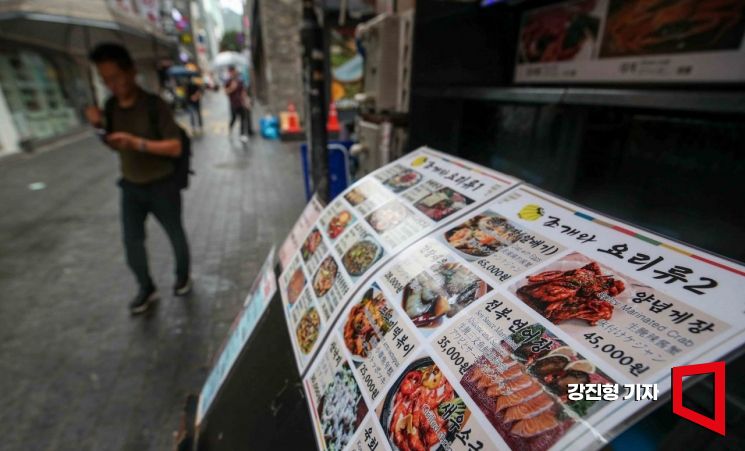 On the 27th, the meal expense limit under the Improper Solicitation and Graft Act, known as the "Kim Young-ran Act," was raised from 30,000 won to 50,000 won, and the menu and prices are displayed outside a restaurant in Seoul. Photo by Kang Jin-hyung aymsdream@
According to a survey by the search data analysis site AhaTrend on the search volume of 3,800 food franchise businesses registered with the Fair Trade Commission from January to April this year, the search volume for all-you-can-eat restaurants such as 'meat buffet,' 'Korean buffet,' and 'Japanese sushi buffet' surged by 102% compared to last year. Last month, the search volume for shabu-shabu franchise restaurants offering unlimited beef upon paying an entrance fee also increased by 89% compared to the previous year.
On the afternoon of the 24th, an all-you-can-eat Korean restaurant in the restaurant district of Mapo-gu, Seoul, was noticeably crowded compared to nearby eateries. A signboard reading "Unlimited refills of ramen noodles, steamed rice, and side dishes when ordering kimchi hot pot or army stew" had a long line of office workers coming for lunch. Choi (34), who visited the restaurant, said, "These days, just ordering kimchi stew, steamed rice, and a drink costs over 10,000 won for lunch. It's nice to be able to eat ramen noodles as well at this price," adding, "I think I visit all-you-can-eat restaurants more often than before because I can eat as much as I want without worrying about the price."
Self-employed restaurant owners complain that management difficulties have worsened due to the burden of ingredient costs. They say it has become difficult to maintain profitability as the prices of ingredients for not only the main dishes but also unlimited items provided to customers, such as salad and tteokbokki, have risen one after another. The nature of all-you-can-eat restaurants, which are mostly operated as franchises rather than individual startups, has also had an impact. In the case of individual restaurants, when ingredient prices rise, the increased costs are passed on to consumer prices to protect profitability, but franchisees find it difficult to raise prices because the headquarters uniformly decides consumer prices.
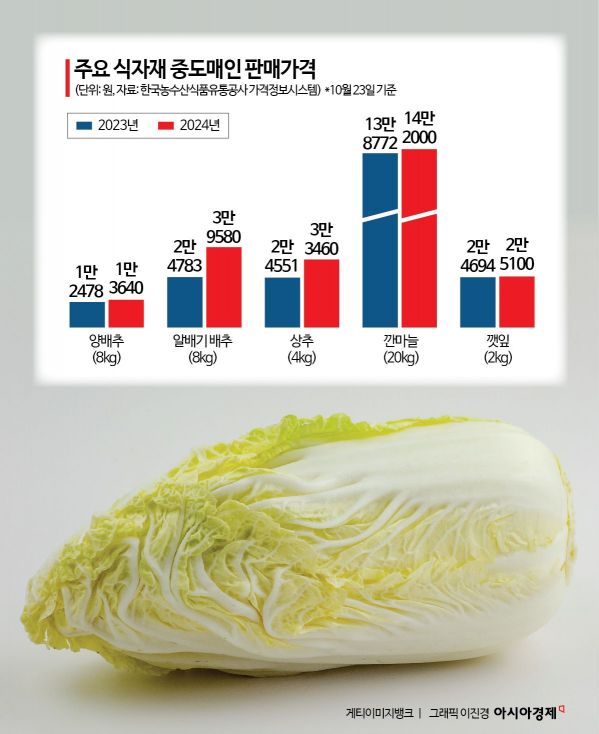
According to the Korea Agro-Fisheries & Food Trade Corporation's price information system, the price of albae-gi cabbage (8 kg) on the 23rd was 39,580 won, a sharp increase of 59.7% compared to last year (24,783 won). Prices of vegetables such as lettuce (35.9%), cabbage (9.3%), peeled garlic (2.3%), and meats such as pork belly (1.02%) and pork neck (0.81%) also rose.
In response, self-employed business owners are preparing countermeasures such as raising alcohol prices or imposing environmental fees on leftover food. Han (43), who operates a franchise meat all-you-can-eat restaurant in Eunpyeong-gu, Seoul, said, "The profitability of all-you-can-eat restaurants depends on the quality of meat used and what foods are provided at the 'self-bar,' but meat prices have risen, and the ingredient costs for side menus like cabbage salad, bean sprouts, green onion kimchi, and tteokbokki at the self-bar have all increased, so there is nothing left," adding, "Looking at other owners around me, they have given up on making a profit from food and are rather considering raising alcohol prices."
Experts analyze that the management structure of all-you-can-eat restaurants is facing difficulties in the current situation. Professor Seo Yong-gu of the Department of Business Administration at Sookmyung Women's University said, "The volume business of all-you-can-eat restaurants, which is based on 'mass consumption, low-cost price,' will not be easy due to inflation," adding, "If this price structure cannot be sustained, management difficulties will inevitably arise." Professor Seo Ji-yong of the Department of Business Administration at Sangmyung University explained, "All-you-can-eat restaurants must have secured low-cost ingredient channels to reduce costs, but if there is a disruption in this area, profitability will inevitably be affected."
© The Asia Business Daily(www.asiae.co.kr). All rights reserved.


















