Humanities Korea Plus (HK+) Project Team
Exploring a Model for Establishing Busan Landmarks
The Humanities Korea Plus (HK+) Project Group at Pukyong National University (Director Kim Chang-kyung) recently published the planned book "East Asian Maritime Cities and Urban Regeneration" (Happy Book Media).
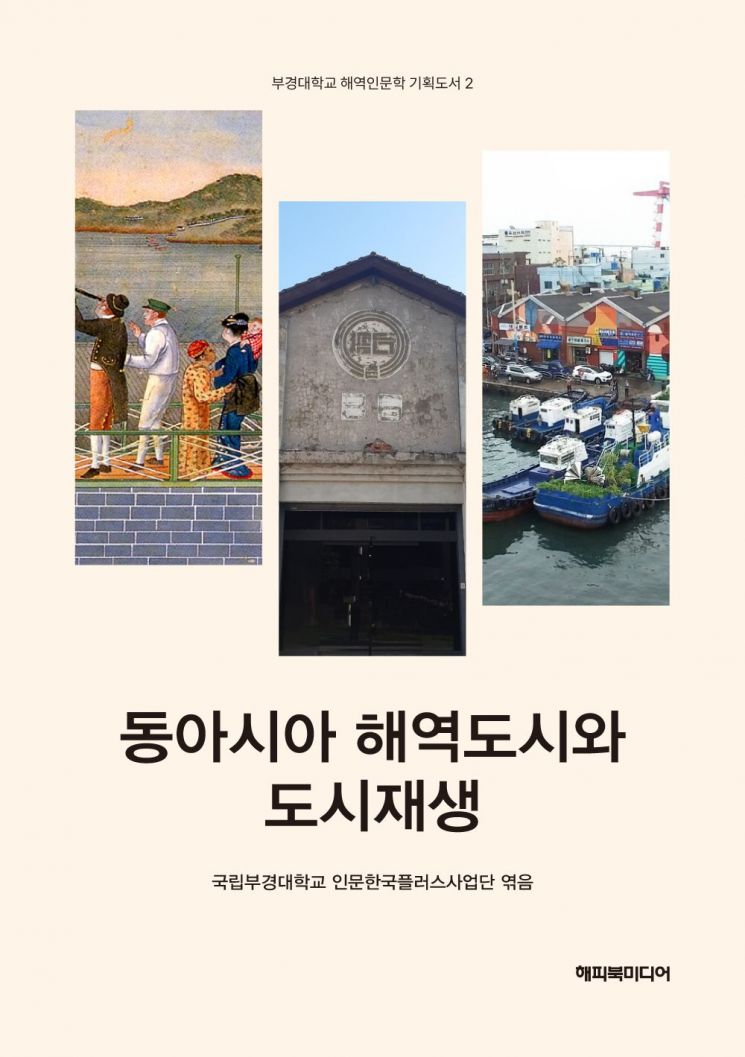
This book proposes applicable measures for the redevelopment of Busan North Port through case studies of urban regeneration in East Asian maritime cities. It is based on the planned series "North Port as a Global Hot Place," jointly reported by HK+ Project Group professors at Pukyong National University (Seo Gwang-deok, Gong Mi-hee, Kim Sung-min) and Busan Ilbo journalists (Lee Seung-hoon, Lee Sang-bae).
Composed of 11 chapters, this book introduces successful cases of urban regeneration centered on cities located in the East Asian maritime region and aims to explore models that can establish unique landmarks specific to Busan.
The authors focus on the fact that urban regeneration centered on ports plays an important role in transforming deteriorated port areas into new urban functions, thereby enhancing the competitiveness of the entire city. The book contains reflections on how urban regeneration has been carried out and what changes it has brought about in ongoing cases such as Busan, Incheon, Kobe, Sasebo, Yokohama, Xiamen, Hong Kong, Kaohsiung, Tainan, and Singapore, as well as the implications thereof.
The contents include △Prologue △Between Urban Development and Regeneration of the Maritime City Busan (Professor Seo Gwang-deok) △From a ‘Declining’ City to a ‘Recovering’ City: On the Direction of Urban Space Regeneration in Incheon (Professor Lee Bo-go) △Coexistence of Earthquake Disaster Recovery and Urban Regeneration: Redevelopment Case of Kobe Port Waterfront Space (Professor Gong Mi-hee) △Practice and Challenges for the Transition of the Naval City Sasebo (佐世保) to a Peace Industry Port City (Professor Lee Sang-won) △Successful Model of Urban Regeneration, Yokohama Minato Mirai 21 (Professor Gong Mi-hee) △Gulangyu Urban Renovation Project (Professor Lee Min-kyung) △Urban Changes in Hong Kong and the Establishment of Hong Kongers’ Identity (Professor Seo Gwang-deok) △From ‘Cultural Desert’ to ‘Cultural Oasis’ ? The Story of Kaohsiung’s Pier-2 Art District (Professor Kim Sung-min) △Where Locality Meets Art ? The Story of Tainan Yanshui, a City of Historical Culture (Professor Kim Sung-min) △Singapore Chinatown, Conflicted Redevelopment Losing Its Old Appearance (Professor Hong Chang-yu), etc.
Kim Chang-kyung, director of the HK+ Project Group, said, “This book comprehensively addresses the economic, social, and cultural aspects of urban regeneration. Through this book, we hope to enhance understanding of urban regeneration in East Asian maritime cities and further contribute to solving urban issues in our society.”
© The Asia Business Daily(www.asiae.co.kr). All rights reserved.
![Clutching a Stolen Dior Bag, Saying "I Hate Being Poor but Real"... The Grotesque Con of a "Human Knockoff" [Slate]](https://cwcontent.asiae.co.kr/asiaresize/183/2026021902243444107_1771435474.jpg)
















