Accumulated Listings Due to Desired Price Gap
Reduced Increase in Jeonse Market in Seoul Metropolitan Area
"Declining Transactions in Some Outskirts and Older Buildings"
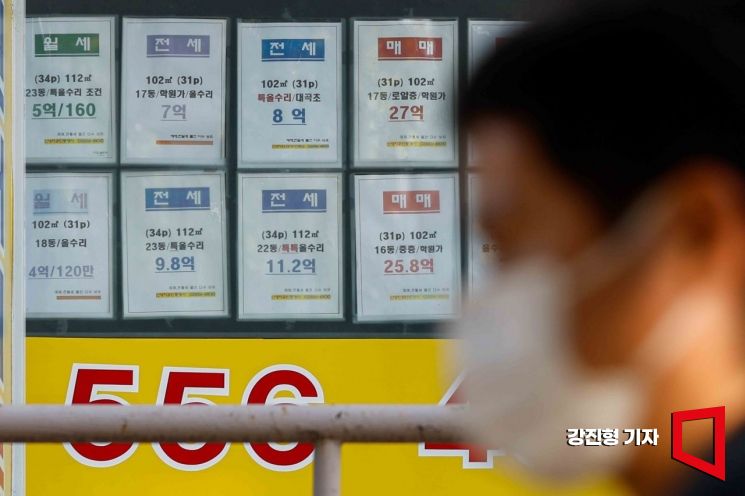 On the 24th, as apartment transactions shrink due to loan regulations and other factors, listings continue to accumulate. A real estate agency in Gangnam, Seoul, has flyers for sale and jeonse listings posted. Photo by Kang Jin-hyung
As loan regulations dampened buyer sentiment, the rate of increase in apartment prices in Seoul slowed down. According to the 'Weekly Apartment Price Trends for the Third Week of October' released by the Korea Real Estate Board on the 24th, Seoul apartment prices rose by 0.09% compared to the previous week, continuing an upward trend for the 31st consecutive week.
However, the rate of increase decreased compared to the previous week (0.11%). A Korea Real Estate Board official explained, "While demand for transactions in some preferred complexes remains, the impact of loan regulations has led to a noticeable weakening of buyer sentiment, as detected in field surveys."
The Korea Real Estate Board stated, "A gap has appeared between the asking prices of sellers and buyers, causing a backlog of listings." According to the real estate data provider 'Asil', the number of listings in Seoul as of that day was 87,184 units, an increase of about 3,000 units compared to 84,214 units on the 24th of last month.
Looking at the rate of increase in apartment prices by district in Seoul, Gangnam-gu (0.23%), Seongdong-gu (0.19%), Yongsan-gu (0.18%), Mapo-gu (0.14%), Seocho-gu (0.11%), and Yeongdeungpo-gu (0.11%) showed above-average increases. Gangnam-gu rose mainly in redevelopment complexes such as Gaepo and Apgujeong-dong. Yongsan-gu saw increases mainly in large complexes in Hangang-ro and Ichon-dong.
In the metropolitan area, the rate of increase in Gyeonggi-do decreased from 0.06% to 0.04%. Incheon maintained its rate of increase at 0.06%. Accordingly, the overall rate of increase in the metropolitan area slightly decreased from 0.07% last week to 0.05% this week.
Apartment prices in provincial areas fell by 0.02%, continuing the downward trend. All regions including the five major metropolitan cities (-0.03%), Sejong (-0.01%), and the eight provinces (-0.01%) experienced declines.
The jeonse (long-term lease) market also saw a slight reduction in the rate of increase. Both Seoul (0.10% to 0.09%) and the metropolitan area (0.12% to 0.10%) maintained upward trends, but the rate of increase decreased. A Korea Real Estate Board official explained, "In Seoul, the shortage of listings continues mainly in complexes preferred by demanders such as those near subway stations and newly built apartments, but some outer areas and older buildings have seen falling transactions, reducing the rate of increase."
By district in Seoul, Seongdong-gu rose by 0.25%, showing the highest rate of increase among the 25 districts. Gangnam-gu (0.15% to 0.16%), Yeongdeungpo-gu (0.10% to 0.13%), and Yangcheon-gu (0.09% to 0.12%) increased their rates of rise compared to the previous week.
Provincial areas (0.01% to 0.01%) maintained the previous week's rate of increase, while the five major metropolitan cities (0.00% to 0.01%) and Sejong (0.00% to 0.02%) saw an increase in the rate of rise.
© The Asia Business Daily(www.asiae.co.kr). All rights reserved.

















