KAIST Research Team Unveils 'WalkOn F1' Wearable Robot for Fully Paralyzed Lower Body Patients
Challenging for Cybathlon 2024 Victory
Professor Kyungtaek Gong & Angel Robotics Chairman: "The Pinnacle of Wearable Robot Technology for People with Disabilities"
The research team led by Professor Gong Kyung-cheol (Chairman of Angel Robotics) from the Department of Mechanical Engineering at Korea Advanced Institute of Science and Technology (KAIST, President Lee Kwang-hyung) unveiled a new version of the wearable robot for lower limb paralysis patients, the 'WalkON Suit F1', on the 24th.
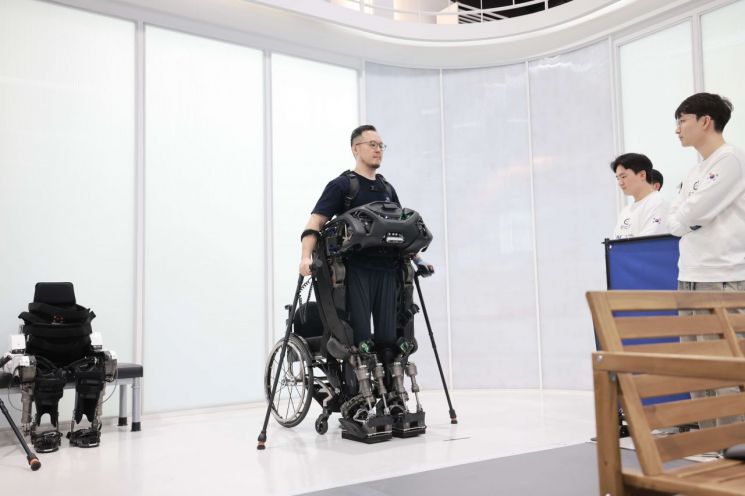 Researcher Kim Seunghwan, who is disabled and unable to use his lower body, is standing up on his own wearing the wearable robot WalkOnSuit F1. Photo by KAIST.
This robot is a masterpiece developed by Professor Gong's team to open a new era of wearable robots for people with lower limb paralysis. This new wearable robot, which can be put on immediately without needing to get off a wheelchair or assistance from others, is expected to demonstrate a technological leap in wearable robot technology.
Professor Gong said, "The name F1 itself signifies not everyday use but the intention to show overwhelming performance in competition." His team will participate in the 3rd Cybathlon, a competition for disabled robotics hosted by ETH Zurich, four years after winning the gold medal in the wearable robot category in 2020. The goal is, of course, to win. During the demonstration, the WalkON Suit F1 proudly met the standards of the Cybathlon events.
This robot targets the most severe level of lower limb paralysis, ASIA-A (complete paralysis). It differs in form and purpose from the Angelrex M20, a walking rehabilitation robot commercialized through Angel Robotics and covered by health insurance. While existing products focused on safe walking for stroke patients, the WalkON Suit F1 focuses on enabling those who cannot walk to stand up without assistance from others.
The walking speed already achieved was not the main concern. The important goal was to develop a robot that users can put on by themselves, not one that someone else has to help put on.
Dr. Park Jung-soo from KAIST, who participated in the robot development, said, "Other robots focused on continuous walking, but we concentrated on taking the first step and being able to put it on independently."
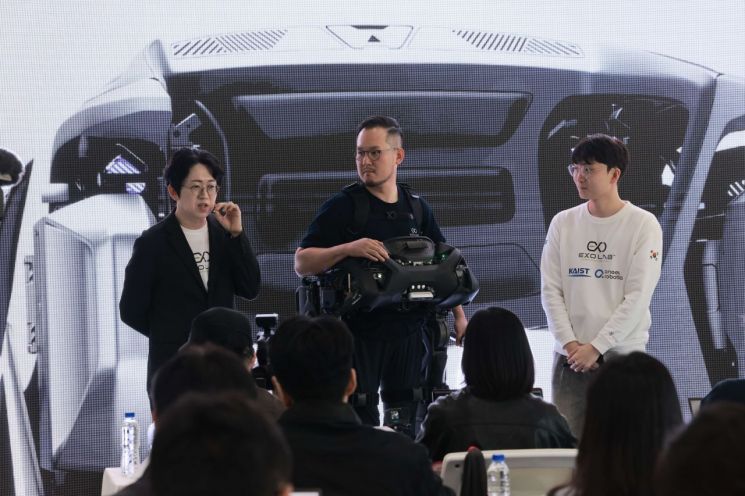 Professor Gong Kyung-taek of KAIST (left) and researcher Kim Seung-hwan (center) wearing the WalkOn Suit F1, along with researcher Park Jung-soo, are answering reporters' questions. Photo by KAIST.
The WalkON Suit F1 presents a technical solution to this fundamental issue. Instead of a rear-wearing method, it applies a front-wearing method so that users can put on the robot immediately without getting off the wheelchair or needing help from others.
Before wearing the robot, it approaches the wearer by walking autonomously like a humanoid. It also features active control of the center of gravity, enabling the wearer to maintain balance without falling even if they push the robot incorrectly. The design of the WalkON Suit F1, which bridges humanoid and wearable robots, was led by Professor Park Hyun-joon from KAIST's Department of Industrial Design.
The core functions of the wearable robot have also been significantly improved. In an upright position, users can freely use both hands, and balance control performance has been enhanced to allow walking several steps without a cane.
Through close collaboration with Angel Robotics, all core components of the robot, including motors, reducers, motor drivers, and main circuits, have been domestically produced. The output density of the motor and reducer modules has approximately doubled compared to the previous research team's technology (based on power-to-weight ratio), and the control performance of the motor driver has improved about threefold compared to the best overseas technology (based on frequency response speed).
In particular, the embedded software technology of the motor driver has been greatly enhanced to stably implement advanced motion control algorithms without using expensive high-end controllers. Additionally, vision for obstacle detection and AI boards for artificial intelligence applications have been installed.
Professor Gong explained, "WalkON Suit is the culmination of wearable robot technology for people with disabilities," adding, "Numerous components, control, and module technologies derived from WalkON Suit are setting the standards for the entire wearable robot industry."
© The Asia Business Daily(www.asiae.co.kr). All rights reserved.


















