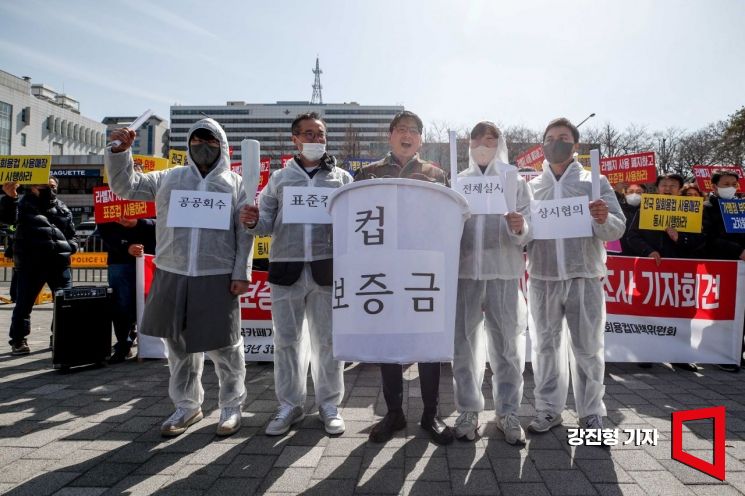
 On March 13 last year, self-employed business owners affiliated with the National Cafe Franchise Owners Association held a press conference in front of the War Memorial of Korea in Yongsan-gu, Seoul, to report on the 100-day status survey of the Sejong-Jeju disposable cup deposit system. Photo by Jinhyung Kang aymsdream@
The Ministry of Environment has announced that it will not immediately implement the nationwide expansion of the disposable cup deposit system.
On the 24th, Minister of Environment Kim Wan-seop stated during the comprehensive audit of the Ministry of Environment by the National Assembly's Environment and Labor Committee that regarding the disposable cup deposit system, "Rather than uniformly expanding the current system nationwide, it would be better to implement it gradually and step-by-step. This is our judgment."
Minister Kim also mentioned the direction for improving the system. While maintaining the policy of expanding the deposit system nationwide, local governments will be allowed to set the targets, standards, and methods according to their conditions. The plan is to allow local governments to decide independently how far to implement the deposit system in their regions and the amount of the deposit.
Minister Kim added, "We plan to finalize the plan after consultations with the National Assembly, local governments, and the industry based on the proposals currently under practical discussions."
The reason for reforming the deposit system was cited as effectiveness and cost-benefit considerations. The recycling value of disposable cups is low, at "4.4 to 5.2 won per cup," but if the deposit system is implemented, stores would have to spend 43 to 70 won per cup for disposal costs. The deposit system, where costs exceed benefits, is argued to have little effect in reducing cup usage.

The disposable cup deposit system was initially launched with the goal of introducing it to franchise stores nationwide above a certain scale. However, at the end of the year before last, the Ministry of Environment reduced the implementation to only Jeju and Sejong, citing concerns about the burden on small business owners. After the nationwide implementation became uncertain, in August last year, the Board of Audit and Inspection conducted a public audit and requested the Ministry of Environment to prepare a plan for nationwide expansion.
On this day, the Ministry of Environment also presented a plan to gradually increase the deposit system focusing on large facilities. Targets include baseball stadiums, amusement parks, airports, and universities where consumers stay for a long time and entrances are specific, making returns convenient.
The deposit refund method, which currently requires the use of a dedicated application (app) instead of cash, will also be changed. The Ministry of Environment plans to encourage point conversion by using the apps of food and beverage franchise companies. Unclaimed deposits will be invested in supporting system implementation or expanding incentives for consumers who use reusable cups.
© The Asia Business Daily(www.asiae.co.kr). All rights reserved.


















