Change in District Unit Plan... Expectation for Activation of Yangsan Mulgeum New Town
Realization of Land Use Zones... Creating Investment Conditions and Providing Opportunities for Companies
Long-term Relaxation of Urban Planning Regulations... Improvement of Inconveniences
On the 23rd, Yangsan City in Gyeongnam announced the draft revision of the 2030 Yangsan Urban Management Plan on its official website and will conduct a public opinion gathering process until November 6.
This revision draft is a statutory mid-term plan revised every five years to concretely implement the long-term urban development directions presented in the already established 2040 Yangsan Basic Urban Plan into urban spaces. The related service started in June 2023, and the process of collecting residents' opinions is currently underway.
The revision draft of the Yangsan City Urban Management Plan, targeting the year 2030, strives to systematically and rationally organize urban management plans such as land use zones, district units, urban planning facilities, and district unit plans, which are closely related to citizens' lives.
This urban management plan revision draft focuses on improving poor residential environments caused by long-standing urban planning regulations, revising land use zones and district unit plans that do not reflect current realities, incorporating urban planning facilities to provide convenience to citizens, revitalizing the city, and addressing citizen inconveniences by preparing rational urban planning revision measures considering changes in urban conditions.
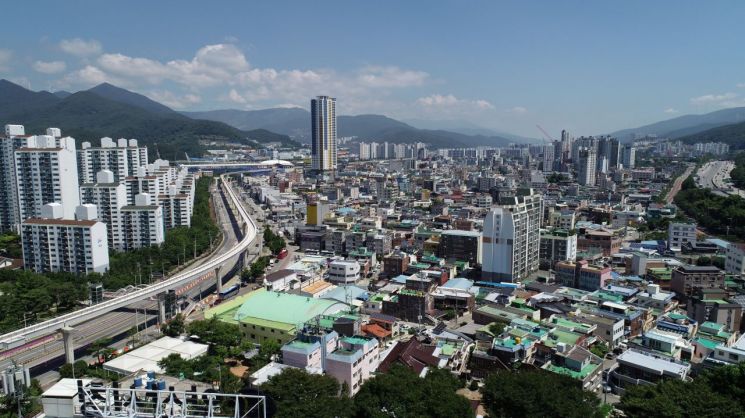
Through changes to district unit plans designed in the 1990s, the plan aims to revitalize the stagnant new town and establish management measures for temporary buildings within district unit plans to set standards for the proliferation of such structures.
The Yangsan Mulgeum District housing development project area, planned in the 1990s, suffers from low floor area ratios within detached housing lots, limited permitted uses, and many commercial areas, causing the entire new town to stagnate. To resolve this, incentives for floor area ratio (relaxed up to 120%), relaxed building height limits (from 3 to 4 floors), and parking allowances were reflected for block development within detached housing lots.
Additionally, efforts were made to revitalize the new town by adjusting the ratio of residential to non-residential uses in mixed-use residential-commercial buildings within commercial areas, relaxing maximum building height and floor area ratio limits, and permitting facilities for the elderly, children, and religious purposes.
Furthermore, due to the proliferation of temporary buildings within district unit plan areas established for housing construction projects, housing development projects, and industrial complex development projects, and the discrepancies between the Building Act and the National Land Planning Act regarding the extension of temporary building periods causing many complaints, this plan establishes systematic management standards for temporary buildings within district unit plans in the jurisdiction.
By upgrading land use zones considering new station areas due to urban railway extensions, realizing land use zones in manufacturing and factory-dense areas, changing land use zones and expanding settlement districts considering local development pressure and land use status, the plan supports the development of the old downtown and is expected to greatly contribute to resolving difficulties faced by residents and businesses.
The extension of the Yangsan Line urban railway includes upgrading land use zones around newly established stations in the areas of Singi-dong, Bukbu-dong, and Nambu-dong, increasing development potential in the old downtown area. It also improves conditions for companies by realizing land use zones in the clustered manufacturing and factory-dense areas of Junam-dong and Soju-dong in the Ulsang area.
Along with this, adjustments to land use zones considering development pressure in the Ulsang and Sangbuk areas and the establishment and modification of natural settlement districts considering land development status in natural villages were made to thoroughly improve residents' living conditions.
The plan also includes changes to the urban management plan to strengthen administrative services, enhance conditions for developing and operating public sector policy projects, and expand resident convenience facilities.
Considering the growing status of Yangsan City, the plan reflects public office sites to provide more convenient administrative services to citizens, changes to the urban management plan to promote a public rental-type Jisin Industrial Center for startup, technology support, R&D technology development, and company office spaces, changes to land use zones to respond to organic building arrangements and future administrative demand expansion, and the discovery and inclusion of sports facility sites to satisfy the rapidly increasing demand for community sports facilities, thereby enhancing citizen convenience.
In addition, the draft revision of the urban management plan reflects adjustments to unreasonable land use zones due to surrounding development, the realization of land use zones and river facilities following adjustments to river areas, and the connection of interrupted street networks due to the expiration of long-unexecuted urban planning facilities, and is currently open for public inspection.
The city will conduct public inspection of the draft revision of the urban management plan at Yangsan City Hall (Urban Planning Division) and the Ulsang Branch Office (Urban Management Division) until the 6th of next month, allowing citizens to review it. Citizens with opinions on this plan can submit written opinions to the city’s Urban Planning Division within the inspection period. The city plans to finalize the urban management plan revision draft through administrative procedures including opinion gathering, consultation with related agencies (departments), hearing opinions from the city council, and the Urban Planning Committee.
Mayor Na Dong-yeon said, “We have prepared the revision draft focusing on improving citizens' quality of life and revitalizing the city by easing unnecessary urban planning regulations due to changes in urban conditions,” and added, “We will continue to prepare rational revision measures for the urban management plan in the future.”
© The Asia Business Daily(www.asiae.co.kr). All rights reserved.
![Clutching a Stolen Dior Bag, Saying "I Hate Being Poor but Real"... The Grotesque Con of a "Human Knockoff" [Slate]](https://cwcontent.asiae.co.kr/asiaresize/183/2026021902243444107_1771435474.jpg)
















