Increase of 200,000 in One Year from Previous 2.26 Million
Gyeongbuk and Daegu Have Similar Total Populations
Jeonnam Ranks First in Growth Rate, Ansan Among the Highest Increases
The number of foreigners residing long-term in South Korea reached approximately 2.46 million as of November last year. This accounts for nearly 5% of the total population, marking the highest level since statistics were first published in 2006.
On the 24th, the Ministry of the Interior and Safety announced the "2023 Status of Foreign Residents in Local Governments" by analyzing data from the Population and Housing Census conducted by Statistics Korea.
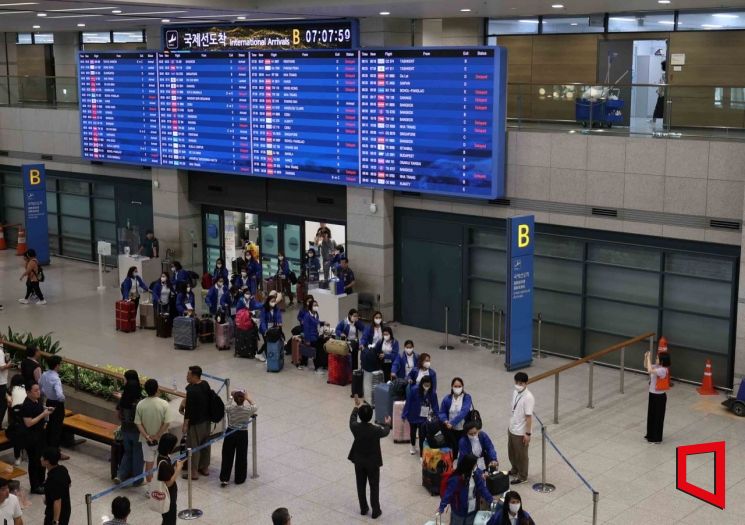 Filipino domestic workers participating in the pilot project for foreign domestic workers arrived through Incheon International Airport Terminal 1 on the morning of the 6th and are moving by bus. Photo by Airport Photographers Group
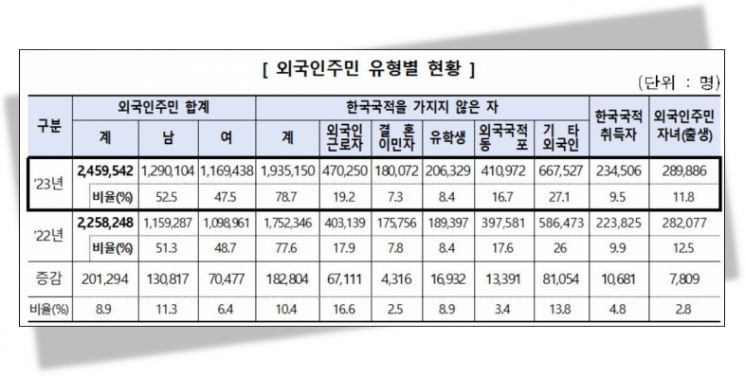
According to the analysis, as of November 1, 2023, the total number of foreign residents who have lived in South Korea for more than three months was 2,459,542. This surpassed the previous record of 2.26 million from the last survey, setting a new record for two consecutive years.
In particular, foreign residents accounted for 4.8% of South Korea’s total population (51,774,521) based on the Population and Housing Census. When compared to the population rankings of the 17 metropolitan cities and provinces nationwide, this figure falls between Gyeongbuk (2,589,880), ranked 6th, and Daegu (2,379,188), ranked 7th. However, the total population includes both nationals and foreigners by nationality and excludes foreigners residing in the country for less than three months before or after the survey date, so it differs from the resident registration population, which reflects the actual resident population.
Looking at the details, ▲ those without Korean nationality increased by 182,804 (10.4%) to 1,935,150 ▲ those who acquired Korean nationality increased by 10,681 (4.8%) to 234,506 ▲ children of foreign residents born in Korea increased by 7,809 (2.8%) to 289,886. The government’s analysis highlighted notable increases in foreign workers (+67,111, 16.6%) and international students (+16,932, 8.9%) compared to the previous statistics.
By metropolitan city and province, the number of foreign residents increased by more than 7% compared to last year in all metropolitan governments except Seoul. The increase was especially large in non-capital areas such as Jeonnam (18.5%), Gyeongnam (17.0%), Ulsan (15.6%), Chungnam (14.4%), and Gangwon (14.3%). The number of new residents increased in the order of Gyeonggi (+58,294), Gyeongnam (+21,942), Chungnam (+19,583), Incheon (+13,974), and Gyeongbuk (+13,710).
The metropolitan cities and provinces with the highest number of foreign residents were Gyeonggi (809,801), Seoul (449,014), Incheon (160,859), Chungnam (155,589), and Gyeongnam (150,643). This means that 1,419,674 foreign residents, or 57.8% of the total, live in the Seoul metropolitan area.
The cities, counties, and districts with the highest foreign resident populations were Ansan (108,033), Hwaseong (76,711), Siheung (74,653), Suwon (71,392), and Bucheon (58,632), all located in Gyeonggi Province. Additionally, the number of "foreign resident concentrated areas"?cities, counties, and districts with more than 10,000 foreign residents or where foreign residents make up more than 5% of the population?increased by 30 from 97 last year to 127, with 28 of these 30 areas located outside the capital region. Deputy Minister Kim Min-jae stated, "As foreign residents now constitute 4.8% of the total population and have become an integral part of our society, we will work together with related ministries and local governments to ensure they can settle in each region without difficulties."
© The Asia Business Daily(www.asiae.co.kr). All rights reserved.


















