Domestic Cement Shipments Down About 13% Year-on-Year in Q1-Q3
"Time to Brace for a Long Tunnel to Survival"
The cement industry is facing its greatest crisis as cement shipments this year hit the lowest point in the past decade due to the prolonged slump in the construction market, and a rebound is expected to be difficult next year as well.
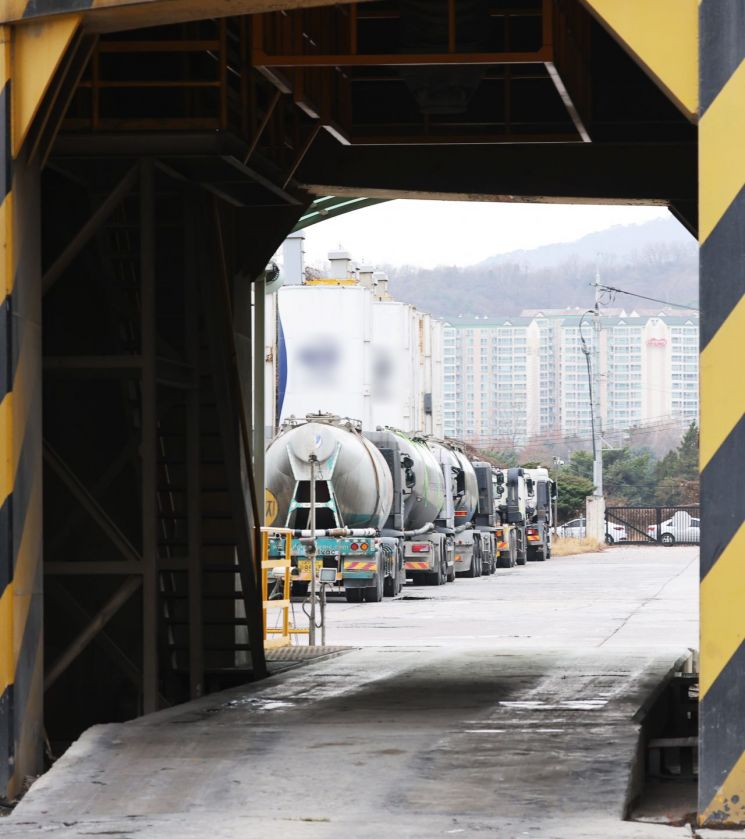 Cement transport vehicles (bulk cement trailers, BCT) are lined up in front of a cement company.
 [Photo by Yonhap News]
According to the '2024 Cement Supply and Demand Outlook' announced on the 23rd by the Korea Cement Association, which includes major domestic cement companies as members, cement shipments (domestic demand) from the first to the third quarter of this year totaled 32.22 million tons, a decrease of about 13% compared to the same period last year (a decrease of 4.76 million tons from 36.98 million tons). If this trend continues, the total domestic shipment volume for this year is expected to be around 44 million tons. This is lower than the shipment volume during the International Monetary Fund (IMF) crisis in 1998, which was 44.6 million tons.
The main reason for the decline in domestic cement demand up to the third quarter of this year is the continued slump in the construction market. Although construction orders from January to August this year amounted to about 109 trillion won, turning to an upward trend due to the government's active economic stimulus policies, the current trend suggests it will fall short of the 180 trillion won level seen in 2020.
Additionally, the housing sector (apartments, etc.), which accounts for the largest share of cement demand, saw building permits from January to August drop sharply by 55,000 units compared to the same period last year, totaling 200,000 units.
The cement industry has taken a direct hit. Sales in the peak season of the third quarter unusually dropped by nearly double digits. Some companies are reportedly considering suspending operations of certain production facilities due to increased inventory caused by sluggish domestic demand.
The cement industry is concerned that if shipments fall below 42 million tons next year, it will regress by about 35 years to the late 1980s in just two years.
Electricity rate hikes are also a blow. The Ministry of Trade, Industry and Energy and Korea Electric Power Corporation announced the day before that industrial electricity rates will be increased by an average of 9.7%. The cement industry falls under the 'Industrial (Class B)' category for large-volume customers, resulting in a 10.2% increase in electricity rates from 165.8 won to 182.7 won per kWh (kilowatt-hour).
Electricity costs account for about 25% of cement production costs, the second highest after bituminous coal in the cost of goods sold. It is estimated that the additional cost burden individual companies must bear due to the electricity rate hike is around 10 billion won.
A representative of the Korea Cement Association said, "The sharp decline in shipments has been compounded by the electricity rate hike. It is inevitable to operate with ultra-tight finances to secure funds for rising manufacturing costs and expanded investment in environmental facilities," adding, "It is time to brace ourselves to go through a long tunnel for survival."
© The Asia Business Daily(www.asiae.co.kr). All rights reserved.

















