Sullivan National Security Advisor Brookings Speech
The White House announced on the 23rd (local time) that it will address the issue of Chinese automobile companies circumventing production in Mexico during the review of the implementation status of the United States-Mexico-Canada Agreement (USMCA).
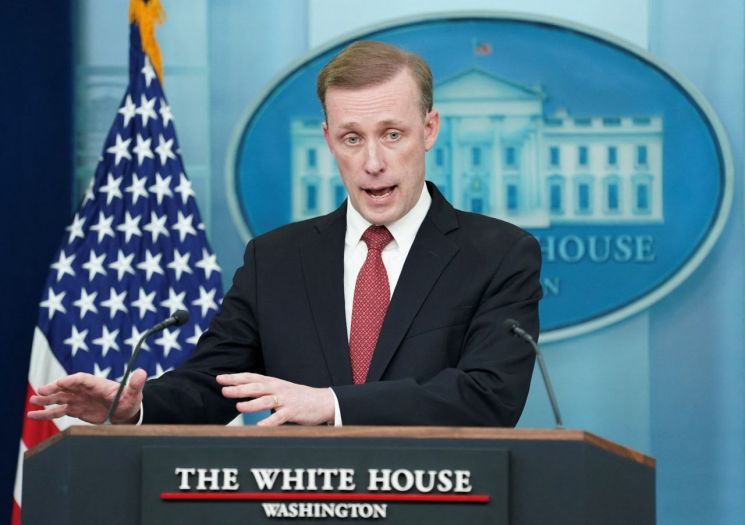
Jake Sullivan, White House National Security Advisor, said in a speech at the Brookings Institution, a U.S. think tank, on the same day, "I want to emphasize that the USMCA was passed bipartisanly (in Congress)," and made the statement.
He explained, "One of the issues to be discussed when it is time to update the USMCA in the near future will be the scope of the North American supply chain, the establishment of origin rules, and how countries like China participate in the automotive supply chain in regions like Mexico. This is an area we need to examine closely."
The USMCA, which replaced the North American Free Trade Agreement (NAFTA) and came into effect in 2020, mandates a review of the agreement's implementation every six years. The first review is scheduled for 2026. Under the USMCA, vehicles produced in Mexico can be exported to the U.S. tariff-free if certain conditions are met. However, concerns are growing that Chinese automobile companies are exploiting this by exporting vehicles to the U.S. via the Mexico route. Both the Biden administration and Republican presidential candidate former President Donald Trump have stated they will look into this issue. Former President Trump previously promised to impose tariffs of 100-200% on Chinese company vehicles produced in Mexico and expressed his intention to renegotiate the USMCA after taking office to address this.
Sullivan also reiterated that the U.S. policy toward China is based on "de-risking," not "decoupling."
He explained, "We need to invest in ourselves to avoid outsourcing high value-added manufacturing capabilities to competitors like China. We must diversify and build resilient supply chains so that countries like China cannot hold us hostage in critical supply chains." He added, "We must protect advanced technologies through a 'narrow yard, high fence' policy," and further stated, "Outside of these areas, we want to maintain broad economic relations with China, just like with other countries."
Regarding the U.S. government's ban on the use of Chinese and Russian software and components in autonomous driving and communication functions of automobiles, Sullivan explained, "In addition to export and investment controls, we are taking measures to protect sensitive data and critical infrastructure."
On the cooperation of allied countries concerning U.S. export control measures against China, he said, "Each country takes a unique approach and has different perspectives," but added, "I believe opinions are converging. Looking at the Group of Seven (G7), approaches to China differ, but there is agreement on the basic principles."
Regarding the Biden administration's imposition of high tariffs in May on semiconductors, batteries, and solar panels due to China's overproduction, he explained, "China produces far more than its domestic demand and artificially oversupplies the global market at low prices, causing manufacturers worldwide to shut down and tightening supply chains," and added, "We took action under Section 301 to prevent a second China shock."
© The Asia Business Daily(www.asiae.co.kr). All rights reserved.

















