Mayor Oh Se-hoon Announces Development Plan
Approximately 68 km, 39 Stations
Above-ground Station Sites to Be Developed as Complex Facilities
Railway Land to Be Converted into Parks
Leading Project Site Request to Ministry of Land, Infrastructure and Transport Planned
A second Yeontral Park (Gyeongui Line Forest Trail) connecting downtown Seoul from the southwest to the northeast is being created. A large-scale park will be established by undergrounding the entire section of the above-ground railway, which is approximately 68 km long and covers about 370,000 pyeong. The above-ground railway station sites will be developed as mixed-use complexes based on the premise of sale. The expected development profit from this alone amounts to 31 trillion won.
Initiation of Undergrounding the Entire Seoul Above-Ground Railway
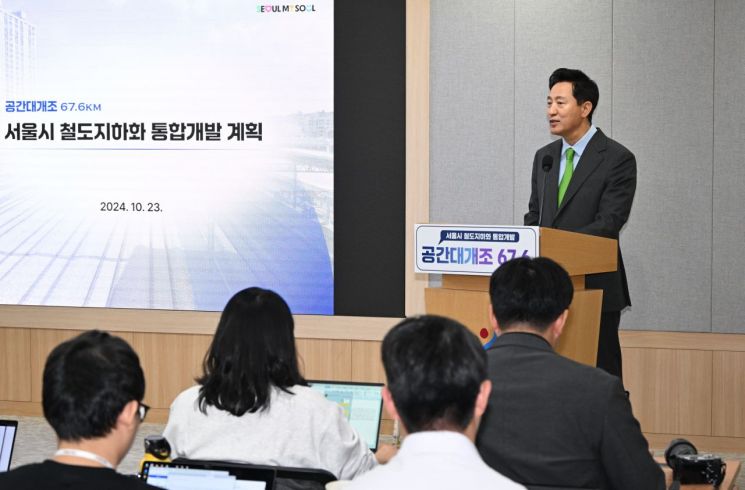 Seoul Mayor Oh Se-hoon is announcing the 'Integrated Development Plan for Railroad Undergrounding' at Seoul City Hall on the 23rd. (Provided by Seoul Metropolitan Government)
On the 23rd, Seoul Mayor Oh Se-hoon unveiled the "Integrated Railway Undergrounding Development Plan" at Seoul City Hall. Mayor Oh said, "Seoul has a stronger citizen desire for railway undergrounding than any other region, and it is a city that can greatly enhance its urban competitiveness through changes and development resulting from undergrounding. We will steadily push forward with railway undergrounding to upgrade Seoul's urban competitiveness to the next level."
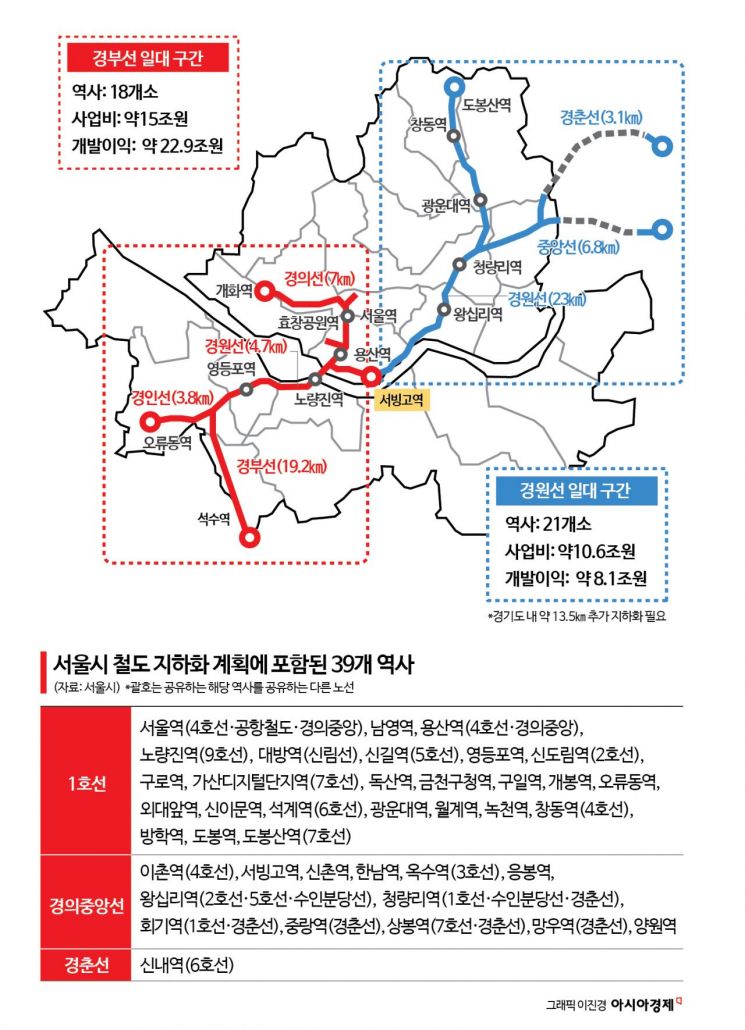
According to this plan, above-ground railways in Seoul will disappear. Instead, the railway lines connecting those sections will be linked underground. Currently, the above-ground railway sections in Seoul consist of six lines, approximately 71.6 km long, passing through 15 autonomous districts. Based on technical reviews including the complex railway network characteristics with many shared lines and the feasibility of above-ground to underground connections, the city has finalized a 67.6 km section.
The entire area is divided into the Gyeongbu Line area and the Gyeongwon Line area, centered around Seobinggo Station in the city center. It includes 39 stations on the above-ground sections of Line 1, Gyeongui-Jungang Line, and Gyeongchun Line. Major stations with multiple lines such as Seoul Station, Yongsan Station, Noryangjin Station, Wangsimni Station, and Cheongnyangni Station are also included. In the city center, it includes Ichon Station, Hannam Station, and Oksu Station. To the southwest, it extends to Doksan Station and Geumcheon-gu Office Station; to the northeast, to Chang-dong Station and Dobongsan Station; and eastward to Sinnae Station and Yangwon Station.
A Second Yeontral Park on the Surface... Mixed-Use Development through Zoning Upgrades on Station Sites
As the above-ground railway moves underground, a park will be created on the surface. The railway land will be opened as a large-scale green network similar to Yeontral Park (the park area around Yeonnam-dong created by undergrounding the Yongsan Line). The above-ground railway station sites will be developed including office, commercial, and cultural facilities based on the premise of sale. Support such as zoning upgrades will also be provided to secure project feasibility.
Mayor Oh, wearing a green tie that day, said, "Although this project was prepared by the department in charge of urban space, I hope the message to Seoul citizens is that green spaces will increase." He added, "We are already enjoying the successful example of railway undergrounding with the Gyeongui Line Forest Trail every day. Undergrounding the 68 km railway will create about 122,000 square meters of green space."
The total cost of the undergrounding project is 25.6 trillion won. The city’s position is that the project cost can be covered by development profits from the upper space, making railway undergrounding possible without separate budget input. The city expects total development profits to reach 31 trillion won. The plan is to first issue construction bonds to finance the project and then recover the costs through development profits from land sales. Cho Nam-jun, head of the Urban Space Headquarters, said, "We have estimated the project cost generously considering inflation and conservatively estimated development profits. We believe the project can proceed without national or city financial support."
Mayor Oh added, "It is also significant in that the development profits generated from large stations in the city center such as Seoul Station and Yongsan Station will be used for the development of the previously neglected and underdeveloped southwest and northeast areas."
Based on the plan announced that day, the city plans to propose to the Ministry of Land, Infrastructure and Transport to designate the entire Seoul undergrounding project as a pilot project site. According to the special law on railway undergrounding enacted in January this year, the Ministry will receive proposals from local governments by the 25th and select pilot project sites within the year. If selected as a pilot project, local governments can start basic planning before the Ministry’s comprehensive plan is established, allowing the project to proceed about a year faster. Seoul views this as a long-term project taking 20 to 30 years. Cho Nam-jun said, "If selected as a pilot project, construction is expected to start in 2028 and take about five years. The undergrounding will be completed by 2034, after which development of the upper sites will begin."
© The Asia Business Daily(www.asiae.co.kr). All rights reserved.


















