Ulleung-gun Disability Employment 1.45%
'Jara' Jumps 2.7% in One Year
Woo Jae-jun, a member of the People Power Party representing Daegu Buk-gu Gap, urged compliance with laws and overall policy improvements regarding the employment of disabled persons, who are labor-vulnerable, during the Ministry of Employment and Labor’s affiliated agencies’ audit held by the National Assembly Environment and Labor Committee on the 22nd.
He particularly revealed that foreign luxury fashion brands selling “luxury goods” employ zero disabled persons, strongly criticizing the behavior of some overseas fashion industries that shirk their social responsibilities.
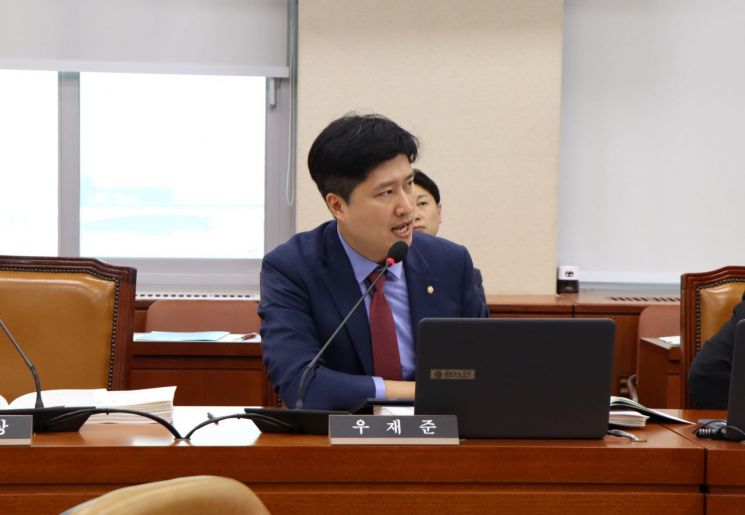 People Power Party lawmaker Woo Jae-jun is speaking at the National Assembly audit of an agency under the Ministry of Employment and Labor.
Prada Korea, with annual sales reaching 513.5 billion KRW, ranked second in disability employment surcharge among companies failing to meet disabled employment quotas. This contrasts sharply with the brand’s promotion on its headquarters’ website stating, “We strongly recognize the intrinsic value of persons with disabilities and are committed to supporting everyone within the agenda of inclusivity and sustainability,” as it has not hired a single disabled person in 10 years.
Christian Dior Couture Korea, with annual sales of 1.0455 trillion KRW, also heavily promotes its support for the Paralympics but has employed zero disabled persons. In addition, many luxury brands including Herm?s and Balenciaga pay only the non-compliance surcharge without employing disabled persons.
Conversely, mid-priced brands such as Zara have been noted as exemplary cases of disabled employment. These brands are making efforts to establish various systems such as consulting, job discovery, and partnerships with the Korea Employment Agency for the Disabled.
Woo Jae-jun of the People Power Party stated, “These are ‘counterfeit’ companies that pretend to care about disabled employment while packaging themselves as luxury brands,” emphasizing, “The problem lies in the lax attitude of ‘just paying money is enough.’”
He further pointed out that the disabled employment rate among domestic local governments is also at a serious level. As of 2023, out of 243 local governments nationwide, 122 pay surcharges due to failing to meet disabled employment quotas, exceeding 50% of the total.
Boseong-gun in Jeollanam-do, Ulleung-gun in Gyeongsangbuk-do, Jangseong-gun in Jeollanam-do, Ganghwa-gun in Incheon, Inje-gun in Gangwon, and Ongjin-gun in Incheon have disabled employment rates in the public official sector in the 1% range, paying surcharges up to 315 million KRW. There is concern over local governments, which should actively promote disabled employment, paying surcharges with taxpayers’ money.
Woo also emphasized that a significant portion of all basic livelihood security recipients are persons with disabilities and urged the Ministry of Health and Welfare to prepare measures to encourage the work willingness of disabled persons in cooperation.
Lee Jong-sung, President of the Korea Employment Agency for the Disabled, responded, “We will establish processes to expand the hiring of disabled persons and improve social awareness of disabled persons,” adding, “We will work hard through extensive promotional activities to help companies develop a positive understanding of disabled employment.”
Meanwhile, according to Article 28 of the Act on the Promotion of Employment of Disabled Persons and Vocational Rehabilitation and Article 25 of its Enforcement Decree, the disabled employment rate for national and local governments and public institutions must exceed 3.8% in 2024, and the disabled employment rate for private companies must exceed 3.1%. Failure to meet these quotas requires payment of a disabled employment surcharge pursuant to Articles 33 and 33-2 of the same Act.
© The Asia Business Daily(www.asiae.co.kr). All rights reserved.
!["The Woman Who Threw Herself into the Water Clutching a Stolen Dior Bag"...A Grotesque Success Story That Shakes the Korean Psyche [Slate]](https://cwcontent.asiae.co.kr/asiaresize/183/2026021902243444107_1771435474.jpg)
















