Hankyung Association Hosts Seminar with Former World Bank Director Hawkman
US Raises Trade Barriers Against China... Reshapes Trade Policy Focused on Supply Chains
"Discussion on CPTPP Membership Needed" Claims... Must Address Uncertainty
About two weeks ahead of the U.S. presidential election, an international seminar raised the opinion that the global trade volume decreased by $274.4 billion (approximately 380 trillion won) last year due to advanced countries' climate change responses and eco-friendly industry-centered policies. Regardless of the election outcome, as the U.S. strengthens its containment of China and trade uncertainties increase, there were suggestions to actively discuss joining the Comprehensive and Progressive Agreement for Trans-Pacific Partnership (CPTPP) to prepare for trade uncertainties.
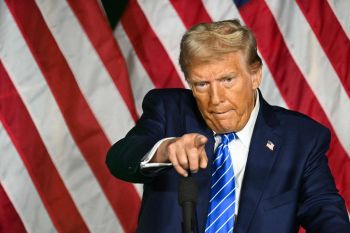 Former U.S. President and Republican presidential candidate Donald Trump is pointing straight ahead during a campaign rally in Milwaukee, Wisconsin, on the 1st (local time).
 [Photo by AFP Yonhap News]
Bernard Hawkman, professor at the European University Institute (former Director of International Trade at the World Bank), said at the seminar titled "The Spread of Global Protectionism and Response Directions," hosted by the Korea Economic Association at the FKI Tower in Yeouido, Seoul on the 23rd, "It is estimated that the global trade volume decreased by $274.4 billion last year due to global green industrial policies."
Professor Hawkman stated that advanced countries are leading the spread of protectionism. Among 1,806 global trade policies announced or implemented last year, 1,030 cases (57.0%) involved subsidies. He explained, "According to the Global Trade Alert (GTA), a trade research institute, about 1,800 trade policies last year were 70.9% implemented by advanced countries, and 47.7% were led by China, the European Union (EU), and the United States."
He noted that recent trade policies are focused on security (25.7%), advanced technology (20.6%), and low-carbon technology (15.3%). Policies driven by non-traditional motives such as climate change response (28.1%) and supply chain stability (15.2%) continue to be executed. This means that advanced countries are pursuing non-traditional trade policies rather than traditional motives like resolving trade deficits or revitalizing the domestic economy.
Professor Hawkman said, "In uncertain international circumstances, governments must clearly set policy goals and carefully analyze the ripple effects of policy implementation," adding, "Cooperation with countries holding similar positions and common interests related to non-traditional motives such as climate change response can be utilized as an alternative."
Experts forecast that regardless of the U.S. presidential election outcome, the U.S. containment of China will intensify. Lee Si-wook, president of the Korea Institute for International Economic Policy, predicted, "Regardless of the election result, U.S. containment of China will strengthen, and the scope of trade barriers will expand from export controls to include foreign direct investment and skilled labor mobility controls."
Lee said, "If Democratic candidate Harris wins, the existing trade policy stance of the Biden administration will generally continue, but trade policies related to labor, human rights, and the environment are expected to be strengthened. If Trump wins, trade pressure centered on tariffs will intensify immediately after inauguration."
There were also suggestions to discuss joining the CPTPP. Lee Tae-ho, advisor at the law firm Kwangjang, said, "The current situation, where protectionism is used as an important policy tool amid the shift from free trade to economic security, is very challenging for Korea," and suggested, "The long-stalled discussions on CPTPP membership should be actively pursued."
Yoo Myung-hee, professor at Seoul National University and former head of the trade negotiation office under the Moon Jae-in administration, emphasized the need to establish a multi-layered response system to prepare for uncertainties. Professor Yoo said, "Trade policies linked to values such as environment, labor, and human rights are emerging," and stressed, "Trade policy restructuring focused on supply chains, advanced technology, and carbon neutrality, as well as strengthening strategic cooperation with major countries, is necessary." She added, "A multi-layered response system to uncertain trade environments should be established, and expertise should be enhanced to improve risk response capabilities."
The Korea Economic Association also announced plans to release high-quality analytical reports on the ripple effects of carbon neutrality-related policies such as the EU's Carbon Border Adjustment Mechanism (CBAM) on the international trade environment. Jung Cheol, chief research officer of the Korea Economic Association and president of the Korea Economic Research Institute, said in his opening remarks, "The Korea Economic Association plans to proactively identify anticipated issues arising from the rapidly changing external trade environment and support companies' smooth response to global protectionism," adding, "We will analyze the domestic economic ripple effects of new trade environments such as the EU's CBAM and the U.S. Clean Competition Act and propose countermeasures to minimize them."
© The Asia Business Daily(www.asiae.co.kr). All rights reserved.

















