iM Securities Report Dated 23rd Criticized
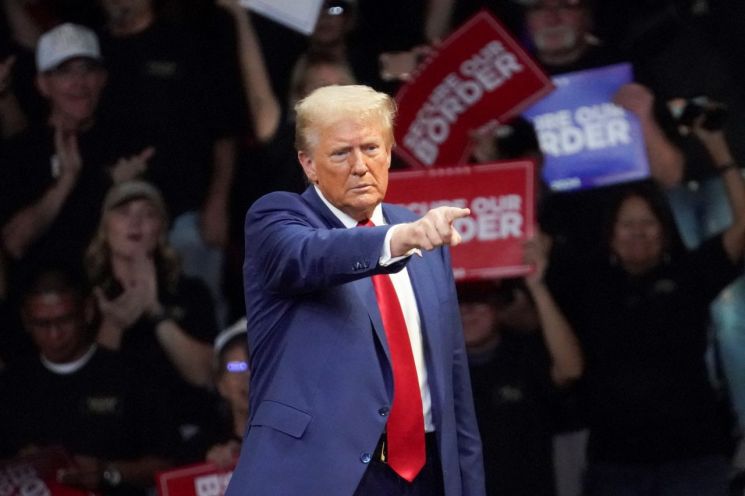
On the 23rd, iM Securities presented five anticipated Trump risks if former President Donald Trump, the Republican candidate in the U.S. presidential election, wins.
Researcher Park Sang-hyun identified the five Trump risks as ▲ tariff risk-induced shocks to the U.S. economy ▲ intensified trade pressure on major countries including Korea and shocks to global trade ▲ interest rate spike risk ▲ inflation risk and oil prices ▲ and king dollar risk.
Researcher Park stated, "Although high tariffs will have a considerable negative impact on the U.S. economy, if the focus is primarily on high tariffs against China, the scale of imports from China is about 1.5% of the U.S. Gross Domestic Product (GDP), so the short-term impact on the U.S. economy could be limited."
He also noted, "If trade pressure on major trading partners including Korea intensifies, it is highly likely to burden the Korean economy and financial markets. In particular, Korea may experience indirect effects from the slowdown in China’s exports to the U.S., which will act as a significant burden on Korean exports and the economic cycle."
Regarding the interest rate spike risk, he said, "Looking at Trump’s tax cuts and tariff pledges, there is a persistent possibility of a sudden surge in government bond yields caused by inflationary pressures, i.e., an interest rate spike. However, considering the economic cycle and the Federal Reserve’s rate cut cycle, the possibility of a sharp rise in government bond yields is expected to remain limited." He added that interest rate spikes are more of a medium- to long-term risk, with inflation trends being a crucial variable.
On inflation risk, he pointed out, "Based on former President Trump’s pledges alone, potential inflation instability risks cannot be ignored. The key will be whether inflation risks can be reduced through oil price stabilization and managing supply chain risks via geopolitical risk management." He emphasized that if geopolitical risks persist unexpectedly, and retaliatory tariffs are imposed in response to the U.S.’s high tariffs, along with renewed supply chain disruption risks, inflationary pressures could expand, leading to interest rate spikes. This could potentially trigger financial crises in countries outside the U.S.
Regarding dollar trends, he evaluated, "In the event of a second Trump administration, the king dollar phenomenon is likely to reoccur. However, given former President Trump’s preference for a weaker dollar and the increased appreciation pressure on non-dollar currencies to address the U.S. trade deficit, even if the king dollar phenomenon appears, its sustainability seems low."
Meanwhile, regarding China’s expected response, there are predictions that the U.S.-China conflict could intensify or that another compromise might be attempted.
Researcher Park said, "If high tariffs are imposed on Chinese products, it will also deal a significant blow to the Chinese economy. China’s options are either a full-scale confrontation with the U.S. or negotiating a trade agreement as during Trump’s first term."
He added, "In the first case, China would embark on large-scale economic stimulus, and in the second case, China would have to make many concessions to the U.S. in various fields compared to before. While Trump risks must be guarded against, it is also important to pay attention to how the Chinese government responds if a second Trump administration becomes a reality."
© The Asia Business Daily(www.asiae.co.kr). All rights reserved.

















