Civil Servants' Diligence Committee Approves Work Hour Exemption Limits
Final Agreement Reached Since 2022 Legislation
1-2 Full-Time Union Representatives Allowed per Civil Servants' Union
"Will Contribute to Civil Servants' Morale and Public Service Commitment"
The government and the public officials' labor union have agreed, after more than four months of discussions, to introduce paid union activity guarantees through working hour exemptions (time off). Going forward, annual exemption hour limits will be set across eight categories based on the size of the union membership. Depending on administrative negotiation circumstances, an additional time off of up to 6,000 hours per year will also be possible. Each union will mainly be able to appoint 1 to 2 full-time union officials.
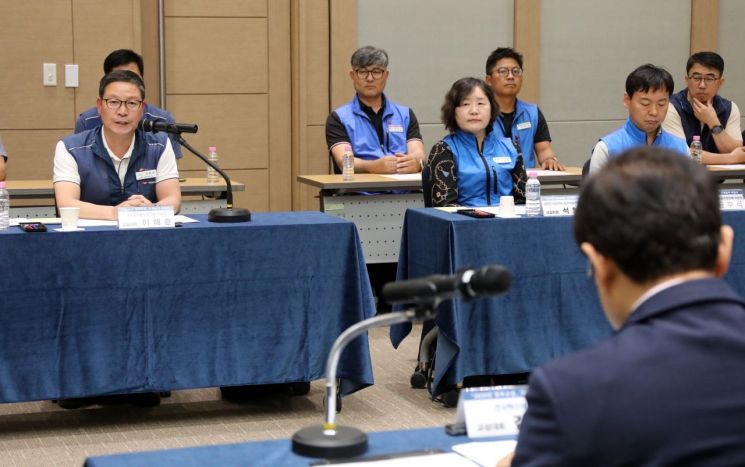 At the '2020 Government Negotiation Collective Agreement Signing Ceremony' held last June at the Government Sejong Convention Center, discussions related to the collective agreement between the government and the civil servants' union took place. [Image source=Yonhap News]
Detailed Limits Set for 8 Categories... 1-2 Full-Time Union Officials Allowed
The Public Officials Working Hours Exemption Deliberation Committee, an organization under the Presidential Committee on Economic, Social and Labor Affairs, held its 11th plenary meeting on the 22nd at the Gyeongsanowi main conference room in Jongno-gu, Seoul, and finalized the time off limits for public officials. Based on Article 7-2 of the Act on the Establishment and Operation of Public Officials' Labor Unions, discussions on 'time' and 'number of users' for working hour exemptions were conducted, resulting in this labor-government agreement.
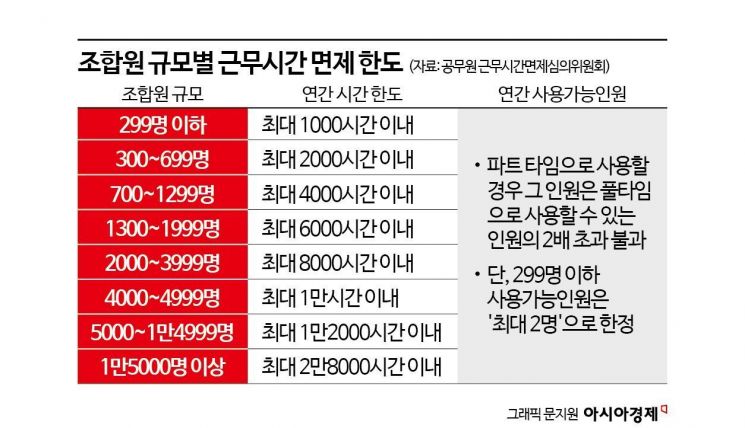
The government and public officials' labor unions have decided to classify public official unions into a total of eight categories according to the size of union membership and assign annual exemption hour limits accordingly. Additionally, if necessary for administrative negotiations, the head of the Ministry of Personnel Management may grant an additional annual working hour exemption limit of up to 6,000 hours to public official unions established at the administrative unit level.
Specifically, the smallest category with up to 299 members will have an annual limit of up to 1,000 hours, while the largest category (15,000 members or more) will have a limit of up to 28,000 hours. For the two categories with the most negotiation units (300?1,299 members), those with 300?699 members will have a limit of up to 2,000 hours, and those with 700?1,299 members will have a limit of up to 4,000 hours.
The number of users allowed annually will not exceed twice the number of full-time users. In the 300?1,299 member category, about 1 to 2 full-time union officials can be appointed. However, for categories with 299 members or fewer, the number of users is limited to a maximum of 2.
The effective date is immediate upon notification according to Article 24-2, Paragraph 4 of the Labor Union and Labor Relations Adjustment Act. The chairperson of Gyeongsanowi will immediately notify the Minister of Employment and Labor, who will then complete legal review, administrative notice, and promulgation. At the meeting, it was also agreed as a supplementary opinion that Gyeongsanowi will conduct a fact-finding survey and re-deliberation two years after promulgation.
Final Agreement After Difficult Negotiations... About 51% of Private Sector Level
Time off is a system that allows full-time union officials to engage in union activities during working hours while setting limits on such time. This enables paid union activities. Time off, which had been implemented in the private sector, became highly likely to be introduced to public officials' unions along with President Yoon Suk-yeol's campaign pledge. In May 2022, the Public Officials Labor Union Act was passed in the National Assembly plenary session, preparing the introduction of the bill.
Subsequently, detailed matters were discussed at Gyeongsanowi. Although there was an attempt to implement public officials' time off in December last year, the Korean Confederation of Trade Unions withdrew from Gyeongsanowi, and disagreements between labor and government prevented finalization. Since June, the Public Officials Working Hours Exemption Committee has conducted related deliberations for over four months, holding 11 plenary meetings along with several secretariat and public interest meetings to reconcile differences.
During this process, the union side demanded time off at 90% of the private sector level, but the government insisted on around 30%, resulting in a significant gap. The current agreement sets the time off at about 51% of the private sector level. Kwon Ki-seop, chairperson of Gyeongsanowi, emphasized, "The decision on the public officials' working hour exemption limit is significant as it is the 'first labor-management agreement result' based on mutual discussion and trust since the restoration of social dialogue at the end of last year."
The Public Officials Working Hours Exemption Committee anticipates that if unions fully utilize the time off limits, the budget required will be in the mid-20 billion KRW range. Cho Kyung-ho, chairperson of the Public Officials Working Hours Exemption Committee, stated, "(The agreement on public officials' time off) is expected to contribute significantly to national development," adding, "It is anticipated to boost morale within the public official community and enhance members' dedication to public service related to the nation."
© The Asia Business Daily(www.asiae.co.kr). All rights reserved.
![Clutching a Stolen Dior Bag, Saying "I Hate Being Poor but Real"... The Grotesque Con of a "Human Knockoff" [Slate]](https://cwcontent.asiae.co.kr/asiaresize/183/2026021902243444107_1771435474.jpg)


















