Next Year China Market Share Expected at 16%
WSJ "Not a Competitor for Now but a Concern"
The Wall Street Journal (WSJ) reported on the 21st (local time) that concerns are emerging that China's overproduction could negatively impact the memory semiconductor market. While it is not a major threat at the moment, backed by massive support from the Chinese government, it could become a market variable in the future.
Although the semiconductor rally began last year, the stock prices of memory chip manufacturers have recently fallen sharply. SK Hynix, Micron, and Samsung Electronics stocks have dropped by as much as 20-30% compared to their peak in July. The industry is reportedly very concerned about the aggressive capacity expansion of Chinese semiconductor companies, WSJ said.
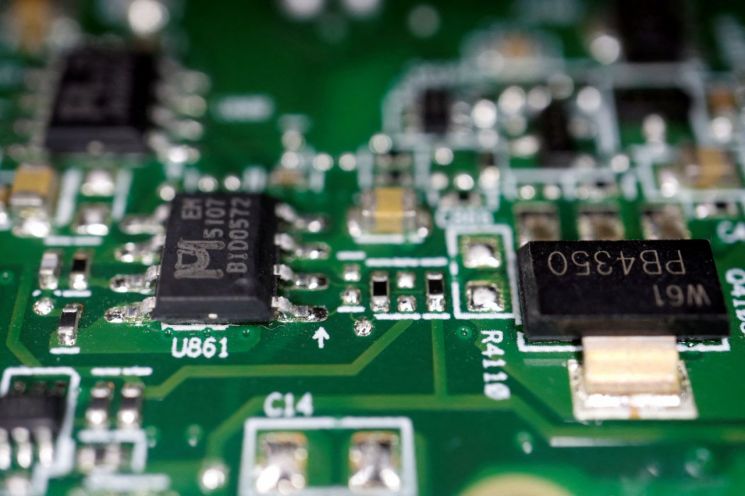
In particular, investment in the DRAM sector at China's Changxin Memory Technologies (CXMT) has increased significantly recently. With support from the Chinese government, DRAM production is rapidly expanding. According to market research firm TrendForce, Chinese manufacturers' production capacity accounted for only 4% of global production capacity in wafer terms in 2022, but this rose to 11% this year. Morgan Stanley predicts that China's DRAM production capacity will soar to 16% of the global market by the end of next year.
However, the current impact on the market is minimal. According to Bernstein, CXMT's bit density (the number of bits stored per unit area) is only 55% compared to major competitors. Production yield also lags significantly.
Advanced memory semiconductor technology is also insufficient. The market share expansion of Chinese companies is mainly concentrated in the legacy (older) chip segment. Although legacy chip prices have started to decline, they have not yet significantly affected advanced semiconductor prices. WSJ reported that small semiconductor companies focusing on legacy chips, such as Taiwan's Nanya Technology, have seen their stock prices fall by 43% this year. In contrast, the DRAM big three?Samsung Electronics, SK Hynix, and Micron?have been relatively unaffected.
There is analysis that sanctions led by the United States and the West could make it difficult for Chinese manufacturers to adopt next-generation semiconductor technologies. Bernstein estimates the technology gap between CXMT and global competitors to be about 6 to 8 years. However, Chinese authorities are pressuring smartphone manufacturers and others to use domestically produced memory chips and are providing massive support to semiconductor companies. Since China accounts for about 20-25% of global DRAM demand, WSJ analyzes that it could make faster progress in technology.
WSJ warned, "If Chinese companies begin to replace overseas firms to meet domestic demand, Korean and American competitors will have no choice but to reduce production due to overcapacity or dump products in the global market." It added, "Large memory chip manufacturers are probably safe from competition with China for now. However, they should be cautious moving forward."
© The Asia Business Daily(www.asiae.co.kr). All rights reserved.
![From Bar Hostess to Organ Seller to High Society... The Grotesque Con of a "Human Counterfeit" [Slate]](https://cwcontent.asiae.co.kr/asiaresize/183/2026021902243444107_1771435474.jpg)
















