Number of Domestic Coffee Shops Surpasses 100,000
3-Year Survival Rate Barely Exceeds Half
"Difficult to Differentiate and High Investment Costs"
Chef Seongjun Kwon, the winner of the Netflix chef survival reality show 'Black and White Chef' and the owner chef of the famous Italian restaurant 'Napolimatpia (Kwon Seongjun),' also had to face setbacks when it came to opening a cafe. Chef Kwon expressed the harsh reality of the domestic cafe market, recommending self-employed individuals considering cafe startups to "avoid it if possible."
Chef Kwon recently shared his past experience of opening a cafe during a YouTube broadcast. He once ran a cafe called 'Espresso Bar,' maintaining a faithful concept to the extent that Americano was categorized as 'non-coffee.' However, the store was soon closed down.
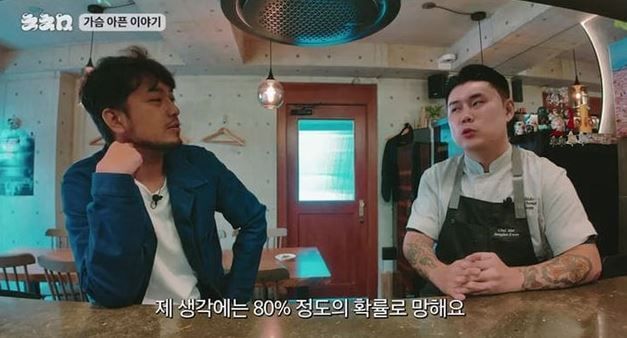 Chef Kwon Seong-jun of Napoli Matpia has warned about the risks of starting a cafe.
 [Image source: YouTube broadcast capture]
He asserted the difficulty of cafe survival by saying, "No matter how well you prepare, there is an 80% chance of failure," pointing out that "it's a business of selling drinks, competition is fierce, it's hard to differentiate, and the investment cost is high."
He added, "Even if a restaurant's interior is not great, if the food tastes good, customers will come back. Also, if the menus differ, such as Korean or Western cuisine, they are not really competitors. But cafes are all the same. So every cafe next door is inevitably a competitor."
Chef Kwon strongly advised, "If anyone wants to open a cafe, I recommend consulting with me and writer Kim Poong at least once, and please think about it three times more. Even if after thinking three times you still want to do it, I would generally recommend not to."
Self-employed individuals who watched the video also expressed agreement. One self-employed person warned, "If one cafe does well, five more open nearby. If you enter the market lightly, you will just lose your precious money."
Korean Cafes Double Convenience Stores... Survival Rate Less Than Half
As Chef Kwon said, the domestic cafe market has already reached saturation. According to the 'Service Industry Survey Report' released by Statistics Korea in June, the number of cafes in Korea surpassed 100,000 for the first time, reaching 100,729 by the end of 2022. This is about twice the total number of stores of the four major convenience store chains in Korea (approximately 55,000).
The total sales of coffee shops in the same year amounted to 15.5 trillion KRW, with 270,000 employees. Small-scale stores with 1 to 4 employees accounted for 84% of all stores, totaling 84,000 locations.
The reason why cafe startups remain popular seems to be the low 'entry barrier.' It is a small-scale startup item with relatively low initial investment costs, and if using pre-made products supplied from manufacturers, it does not require high skill levels.
However, as Chef Kwon pointed out, the 'long-term survival' of cafes appears to be separate from the initial startup difficulty. According to data from the Ministry of the Interior and Safety, while the number of new cafes increased by 45% over the past 10 years, the number of closed cafes surged by 181%.
The situation is similar in Seoul, where many office workers gather. According to the 'Seoul Commercial Area Analysis Service,' a report on Seoul's alleyway commercial districts, 5,293 new coffee and beverage shops opened last year, while 4,090 cafes closed during the same period. The survival rate of cafes in Seoul over three years was only 51.9%, about half, and the five-year survival rate dropped sharply to 34.9%.
© The Asia Business Daily(www.asiae.co.kr). All rights reserved.


















