Professor Baek Min-kyung's Lecture at Seoul National University... Contributed to Professor David Baker's Nobel Chemistry Award
First Author of Protein Structure Prediction AI 'RosettaFold' Paper
Lee Hyun-sook, Director of Seoul National University Bio-AI Research Center, "We Will Also Emerge in 10-15 Years"
Professor Min-Kyung Baek of Seoul National University, who led the development of RosettaFold, an artificial intelligence (AI)-based protein structure prediction AI, together with David Baker, a professor at the University of Washington in the United States and this year’s Nobel Prize in Chemistry laureate, expressed her ambition to challenge customized protein design that binds exactly as desired.
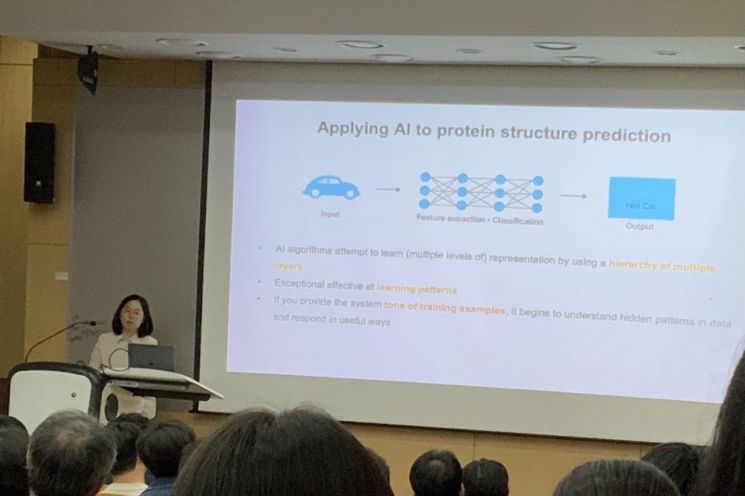 Professor Baek Min-kyung of Seoul National University is giving a lecture at the monthly seminar of the Bio Artificial Intelligence Research Group held at the Genetic Engineering Research Institute of Seoul National University on the 21st. Photo by Baek Jong-min.
On the 21st, at the monthly seminar of the Bio-AI Research Group held at the Genetic Engineering Research Institute of Seoul National University, Professor Baek stated, "Until now, AI has only understood proteins, but there is still a long way to go regarding biomolecules. The future goal is to design proteins that bind more accurately when performing gene editing or correction." She added, "It is extremely difficult to obtain proteins in the desired form using the tools we currently have," and said, "I want to take on the challenge of designing proteins that allow specific binding as desired."
Professor Baek said, "Both Professor Baker and Hevasis said they would win, but the award came faster than expected. I wondered why I was being congratulated even though I did not win the Nobel Prize myself. I realized that even contributing a little to the research is an immense honor."
The venue for Professor Baek’s lecture was filled with enthusiasm that day. Former Minister of Science and ICT Jong-Ho Lee, who returned as a professor at Seoul National University, and Ki-Hyung Lee, chairman of Gradient, also attended. Students filled the lecture hall, harboring hope that "I can do it too." Regarding the fact that a first-author paper with a Nobel laureate came out through a scholar in their early 30s, Hyun-Sook Lee, director of the Bio-AI Research Group at Seoul National University, said, "It was right to insist on creating the Bio-AI Convergence Research Group. I think we will also have (a Nobel Prize) within 10 to 15 years." Biotechnology is gaining more attention in tandem with the advancement of AI technology. Professor Baek, who majored in chemistry, achieved great results through AI by researching coding rather than working in a laboratory.
Professor Sung-Ro Yoon of the Department of Electrical and Computer Engineering at Seoul National University, who gave a lecture together with Professor Baek that day, said, "Thanks to the Bio-AI Research Group, we have been able to conduct AI research using NVIDIA’s 'H100' and the latest graphics processing units (GPUs)." It is a mutually supportive relationship. The Bio-AI Research Group at Seoul National University is accelerating research by introducing 56 'H100' GPUs based on a 20 billion KRW donation from Young-Sik Cho, chairman of SD Biosensor, and is considering additional purchases.
Director Hyun-Sook Lee also told former Minister Lee, "Electricity (to operate GPUs) is very important for research at universities now. For the first time in my life, I even filed a complaint with Korea Electric Power Corporation. Minister, please help us."
© The Asia Business Daily(www.asiae.co.kr). All rights reserved.

















