From the 28th, 6-Day Architecture Class 'Gagahoho'
Expanding Target from Elementary Students to Adults
Traveling Architecture Class, Exhibition of Excellent Buildings
Seongdong-gu, Seoul (District Mayor Jung Won-oh) will operate the architecture class ’Gagahoho‘ with architects for six days starting from the 28th.
Now in its 8th session, the ’Architecture Class‘ is an educational program prepared through a memorandum of understanding (MOU) between Seongdong-gu and the Seongdong-gu Architects Association to provide elementary school students with opportunities to broaden their understanding of cities and architecture, expand their career choices, and cultivate humanistic qualities. This year, the program has been expanded to allow participation by all Seongdong residents.
From October 28 to November 1, a ’Visiting Architecture Class‘ will be held. At 11 local Idream Nuriter elementary care centers, 167 elementary students will participate with architects in education on making architectural models using 3D printers under the theme of ’Architecture of the World‘.
From October 31 to November 2, a banner exhibition will be held on the first floor of Seongdong-gu Office, where anyone visiting the district office can view photos of Seongdong-gu’s outstanding architectural works.
Also, on November 2, the ’Architecture Class‘ will be held in the large auditorium on the 3rd floor of Seongdong-gu Office. Architect Kim Sung-il will conduct a storytelling lecture to help 25 elementary students understand the architectural process and a space-building experience using boxes.
On the same day, November 2, in Seongsu-dong, a ’Seongsu-dong Architecture Walk‘ program will be operated with 20 residents and 4 architects. The ’Architecture Walk‘ starts at Understand Avenue and offers a small group walking tour to learn about distinctive architectural sites in Seongsu-dong such as the Red Brick Village, Galbi Alley, Seongsu Art Hall, Dior and The Tambourines, and Daerim Warehouse.
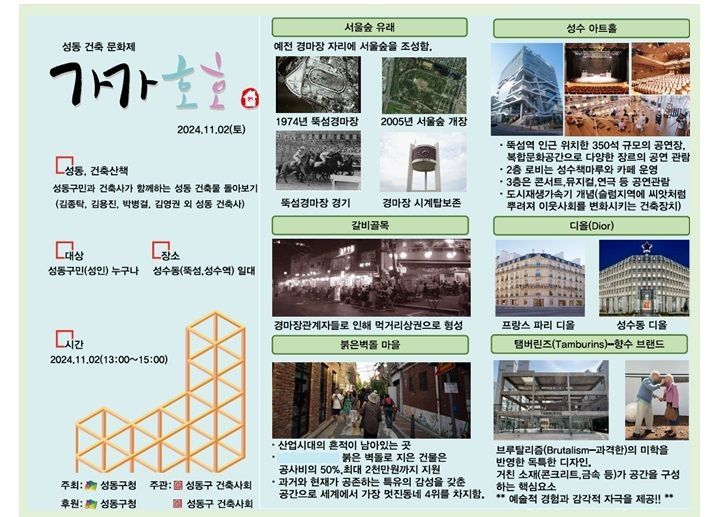
Among these, the Red Brick Village is considered the most special cluster of architectural works representing Seongdong-gu. Seongdong-gu has been making exceptional efforts to preserve the historical and cultural value of the red brick factories, warehouses, and red brick houses built in Seongsu-dong during the 1970s and 1980s.
In July 2017, the 「Ordinance on the Preservation and Support of Red Brick Buildings」 was enacted to establish an institutional framework for the preservation and support of red brick buildings with historical and cultural value. Based on this, from 2018 to 2021, a pilot project supporting red brick buildings was implemented targeting about 30 buildings around the atelier street on the north side of Seoul Forest.
Through these efforts, the ‘Red Brick Buildings’ have become a new urban landscape trend in Seongsu-dong.
Last year, about 28,000㎡ south of Ttukseom Station was additionally designated as a ‘Red Brick Building Concentration Area.’ In the future, the area will be expanded from the existing pilot project site around the atelier street north of Seoul Forest to the area around Korea National Open University and the caf? street near Seongsu Station as a ‘Red Brick Building Concentration Area.’
In addition, instead of developing the Seongsu-dong area, the district is promoting urban regeneration projects and gentrification prevention policies together to lead sustainable development.
Thanks to this, old factories and warehouses have been transformed into complex cultural facilities and cafes by young artists and entrepreneurs, becoming so-called hot places. The famous British travel culture magazine ‘Time Out’ also ranked Seongsu-dong 4th among the ‘World’s Coolest Neighborhoods’ this year.
Jung Won-oh, Mayor of Seongdong-gu, said, “I hope the architecture class ’Gagahoho‘ will be a good opportunity to broaden understanding of cities and architecture and to cultivate humanistic qualities,” adding, “We will continue the legacy of Seongsu-dong’s red brick buildings, which symbolize the harmonious coexistence of past and present and the sustainable development of Seongdong-gu, for a long time.”
© The Asia Business Daily(www.asiae.co.kr). All rights reserved.

















