Samsung Electronics DS Division Leadership Change Draws Attention to Major Overhaul
Spreading Winds of 'Innovation and Reform'... October Personnel Changes Also
Some Voices Express "Concerns Over Business Continuity"
The personnel clocks of domestic companies are speeding up. This is due to the need for a quicker response as forecasts suggest that next year's economy will be similar to or worse than this year. Companies are advancing their regular executive appointments earlier than usual and accelerating restructuring and renewal efforts, including voluntary retirement programs. However, some voices express concerns that large-scale personnel changes could disrupt the continuity of existing businesses and lead to internal instability.
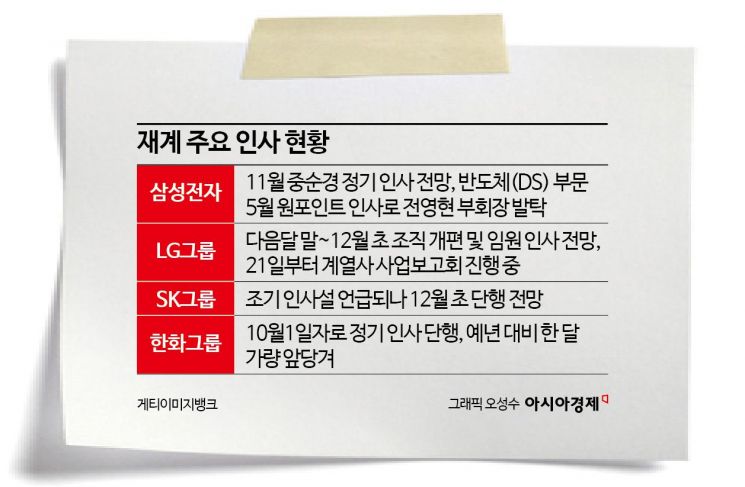
According to the business community on the 22nd, Samsung Electronics is expected to carry out a major organizational restructuring and personnel renewal this year. In particular, there is growing speculation that the regular personnel appointments will be moved up to mid-November to respond early to the 'crisis theory.' Samsung Electronics usually conducts executive appointments and organizational restructuring in early December, but last year also carried out personnel changes at the end of November, earlier than usual.
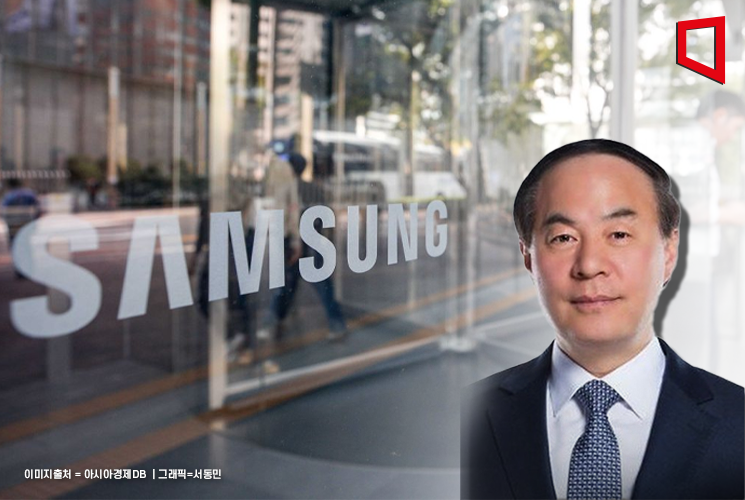
Focus on Changes in Samsung Electronics DS Division After Leadership Shift
The highlight of this year's personnel changes is undoubtedly the semiconductor (DS) division. Earlier, in a one-point personnel change outside the regular appointment season in May, the head of the semiconductor business was replaced from President Kyung Kye-hyun to Vice Chairman Jeon Young-hyun, but the division was still evaluated as lacking competitiveness, especially centered on high-bandwidth memory (HBM). Moreover, the foundry business has not shown significant results, widening the gap with Taiwan's TSMC. The System LSI division is also facing a market environment where application processors (AP) are being overlooked.
Vice Chairman Jeon hinted at changes in a reflection statement released alongside the third-quarter preliminary earnings announcement. He stated, "All responsibility lies with the management leading the business," suggesting the possibility of a large-scale replacement of executives, including the heads of the three business divisions. In this context, names such as Lee Jung-bae, President of the Memory Business Division, Choi Si-young, President of the Foundry Business Division, and Park Yong-in, President of the System LSI Business Division, are being mentioned as potential personnel targets.
There is also speculation that Samsung Electronics will significantly reduce the number of executives?more than twice as many as competitor SK Hynix?to improve organizational efficiency. According to the second-quarter business report, Samsung Electronics' DS division has 438 executives, accounting for 38% of the total 1,164 executives. Competitor SK Hynix employs 199 executives. Recently, the DS division's People Team (HR team) reportedly inquired about voluntary retirement intentions from CL4-level (department head level) executives within the DS division, suggesting the possibility of expanding the scope of targets.
‘Innovation and Renewal’ Winds Spreading Across the Business Community
LG Group has recently been holding business review meetings centered on its major affiliates. These meetings serve as a 'prelude' to the year-end executive appointments. Based on the results, LG is expected to carry out organizational restructuring and executive appointments from late next month to early December. This year, uncertainty over the performance outlook of key affiliates such as LG Electronics and LG Display has increased, and the year-end personnel tone is expected to emphasize 'innovation' rather than 'stability.' In particular, the business community is paying attention to whether there will be promotions to vice chairman, with names like Cho Joo-wan, President of LG Electronics, and Jung Cheol-dong, President of LG Display, being mentioned.
SK Group is preparing for year-end personnel appointments, starting with a 20% reduction of executives at SK Ecoplant in mid-this month. Although there were rumors of early personnel changes, the plan to implement them in early December is considered likely. Typically, executive appointments are decided after the CEO seminar scheduled in October, where agendas and plans for the next year are discussed. However, this seminar was held more than 10 days later than usual (October 31 to November 2), leaving insufficient time to review and finalize personnel decisions.
Earlier, Hanwha Group conducted its regular second-half executive appointments about a month earlier than usual on the 27th of last month. Actual transfers and promotions took place on October 1, the first business day of the fourth quarter when next year's business plans are formulated.
Hyundai Motor Group has not yet shown signs of advancing the regular personnel appointment schedule. Group executive appointments are generally conducted around late December each year, with some affiliate CEOs or CEO-level personnel changes made beforehand. A point to watch this year is whether the generational change trend will continue as it did last year. Even last year, when the finished car affiliates (Hyundai Motor and Kia) posted strong results, a considerable number of executives were replaced. At that time, there were rumors inside and outside the company that "the good performance was not due to the outstanding capabilities of specific personnel or organizations but because the surrounding environment and conditions were favorable."
Another point of interest is what kind of personnel system Kim Hye-in, who was recruited as head of Hyundai Motor's HR headquarters last year, has devised. Kim, who previously served as an HR head at a foreign company, joined Hyundai Motor last year and is the youngest among executives at the vice president level or higher. After upgrading the HR organization to a headquarters, a relatively young person was appointed, leading to views that this was a recruitment for personnel renewal. Regardless of company performance, rapid domestic and international changes are underway across the mobility business centered on automobiles, so organizational changes or personnel moves to prepare for this are also possible.
However, as Chung Eui-sun, Chairman of Hyundai Motor Group, has passed four years in office and most top executives, including major affiliate CEOs, have been replaced, there are also expectations that the group may enter a stabilization phase compared to the past. Major affiliate CEOs whose terms end early next year include Song Ho-sung, President of Kia, and Yeo Su-dong, President of Hyundai Transys.
Speeding Up Restructuring and Voluntary Retirement Led by ‘Efficiency’
The telecommunications industry, facing the change of 'artificial intelligence (AI) transformation,' is taking a more active approach to workforce reduction. SK Telecom revamped its retirement program 'Next Career' for employees nearing retirement age at the end of last month, increasing the incentive payment from 50 million won to 300 million won. Established in 2019, Next Career is a welfare program that helps prepare for life after retirement, but inside the company, it is widely analyzed as part of the group's emergency management.
KT also established a subsidiary and decided to reassign telecommunications network operation and management personnel. Those unwilling to move will become voluntary retirement candidates. The scale of transfers is estimated to exceed 3,700 people, who will receive only 50-70% of their existing base salary.
Some voices express concerns about side effects arising from the industry's haste to implement personnel changes earlier. A business community official said, "Advancing executive appointments allows for a better-prepared new start in the new year, but it may cause problems such as disruption of continuity with existing businesses and lowered internal morale." Another official explained, "Rushing personnel changes does not necessarily help overcome crises or better prepare for new businesses. It is important to find the most appropriate timing for personnel changes for each industry and individual company, considering second-half business progress and efficiency."
© The Asia Business Daily(www.asiae.co.kr). All rights reserved.
![From Bar Hostess to Organ Seller to High Society... The Grotesque Con of a "Human Counterfeit" [Slate]](https://cwcontent.asiae.co.kr/asiaresize/183/2026021902243444107_1771435474.jpg)


















