Returned Pro-Japanese Collaborator Properties Sold to Descendants by Ministry of Patriots and Veterans Affairs
At Least 12 Cases of Private Contracts Confirmed for the First Time
Descendants of Go Heung-gyeom and Shin Woo-seon Repurchase Reclaimed Land
It was recently revealed that some of the pro-Japanese collaborators' properties, which were confiscated by the state under the Pro-Japanese Property Confiscation Act enacted in 2005, were resold to the descendants of the collaborators through private contracts. On the 20th, MBC reported that according to an investigation by the office of Lee In-young, a member of the National Assembly's Political Affairs Committee from the Democratic Party of Korea, at least 12 cases were confirmed where land accumulated by pro-Japanese collaborators during the Japanese colonial period, after being confiscated by the state, were transferred back to their descendants through private contracts.
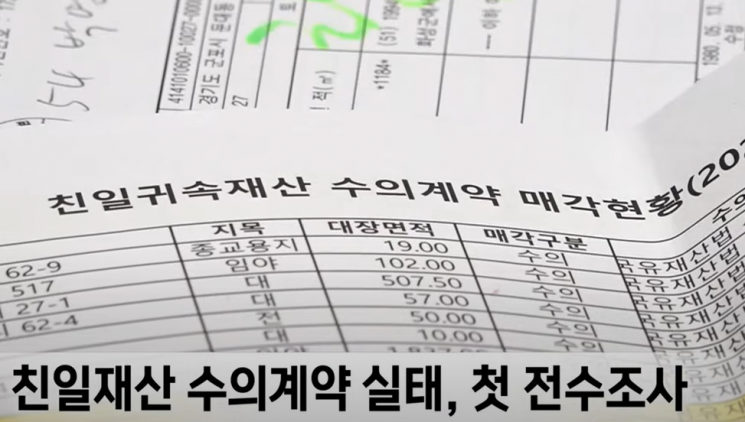 It was revealed belatedly that some pro-Japanese collaborators' properties, which were confiscated by the state under the Pro-Japanese Property Confiscation Act enacted in 2005, were resold to the descendants of the pro-Japanese collaborators through private contracts.
 [Photo by MBC News]
According to Lee In-young’s office, out of 1,418 nationwide parcels entrusted to the Korea Asset Management Corporation (KAMCO) by the Ministry of Patriots and Veterans Affairs, 575 parcels were sold, and among them, 341 parcels were sold through private contracts. Upon reviewing the buyers of the 341 parcels sold via private contracts, Lee In-young’s office identified that descendants of seven pro-Japanese collaborators purchased at least 12 parcels (approximately 13,000 square meters).
The Committee for the Investigation of Property of Pro-Japanese and Anti-National Acts, which operated for four years from 2006 after the enactment of the Pro-Japanese Property Confiscation Act, confirmed the illicit properties of 168 pro-Japanese collaborators including Lee Wan-yong and Song Byeong-jun, and confiscated them to the state. However, these properties were subsequently repurchased by their descendants. Those who reclaimed the state-confiscated properties are descendants of pro-Japanese actors whose actions rivaled those of Lee Wan-yong.
Go Heung-gyeom, grandson of Go Young-hee, one of the Seven Jeongmi Traitors, served as an officer in the Japanese Ministry of Agriculture and Commerce during the colonial period and received the Showa Ceremony Commemorative Medal, inheriting the count title from his grandfather and father. Under the Pro-Japanese Property Confiscation Act, the state confiscated 24 parcels of land in Yesan, Chungnam, owned by Go Heung-gyeom, but the Go Young-hee descendants repurchased three of these parcels from the state through private contracts. Similarly, land in Goyang-si, Gyeonggi-do, owned by Shin Woo-seon, who served as the head of the Ito Hirobumi Memorial Association and was a county governor of Gongju and Asan during the colonial period, was also confiscated by the state but partially repurchased by his descendants. Other similar cases involve descendants of Hong Jong-cheol, Jang Eung-sang, and Lee Seon-ho, who served as members of the Central Advisory Council.
Private Contracts Due to Land or Buildings on the Site... Exploiting System Loopholes
The reason pro-Japanese descendants were able to repurchase properties confiscated by the state lies in exploiting loopholes in the system. It appears that the descendants entered into private contracts citing reasons such as adjacent land or buildings on the site. According to the Enforcement Decree of the State Property Act, if a person owns a building or adjacent land on state-owned land, transactions can be conducted through private contracts rather than public bidding.
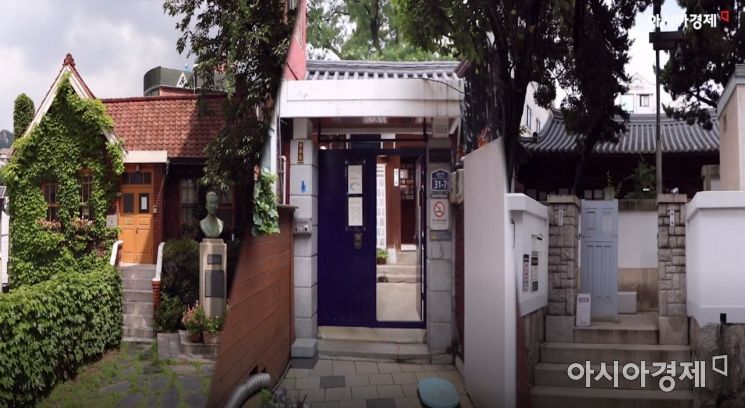 Since the enactment of the Act on the Confiscation of Pro-Japanese Collaborators' Property, the Committee for the Investigation of Pro-Japanese Anti-National Acts' Property, which operated for four years from 2006, identified the illicit assets of 168 pro-Japanese collaborators including Lee Wan-yong and Song Byeong-jun and confiscated them to the state. The photo shows the house of a pro-Japanese collaborator.
 [Photo by Asia Economy]
However, such transactions violate Article 6 of the State Property Act, which stipulates that public value and utilization value must be considered when disposing of state property. Furthermore, they contravene Article 1 of the Pro-Japanese Property Confiscation Act, which states that "the purpose is to realize justice by confiscating property accumulated through pro-Japanese and anti-national acts to the state, protecting bona fide third parties to ensure transaction safety, establishing the national spirit, and embodying the constitutional ideals of the March 1st Movement that resisted Japanese imperialism."
Despite repeated legal disputes and opposition from descendants at the time of confiscation, no measures were taken to prevent the reacquisition of confiscated properties. The contract details confirmed this time were uncovered only after the office painstakingly cross-checked the names of some direct descendants, suggesting that additional cases among the 341 private contracts may emerge, likely intensifying the controversy.
© The Asia Business Daily(www.asiae.co.kr). All rights reserved.


















