4th Population Strategy Joint Forum Held
Joo Hyung-hwan: "Golden Ticket Syndrome Acts as a Cause of Low Birthrate"
"Need to Create Good Jobs, Solve Workforce Mismatch, and Promote High School Graduate Employment"
Joo Hyung-hwan, Vice Chairman of the Low Fertility and Aging Society Committee (LFASC), stated on the 21st that "the fierce competition for good jobs, known as the Golden Ticket Syndrome, is one of the causes delaying young people's entry into society, which in turn delays the timing of marriage and childbirth," adding, "If the timing of young people's social entry can be advanced, it will greatly help alleviate the current ultra-low birthrate trend."
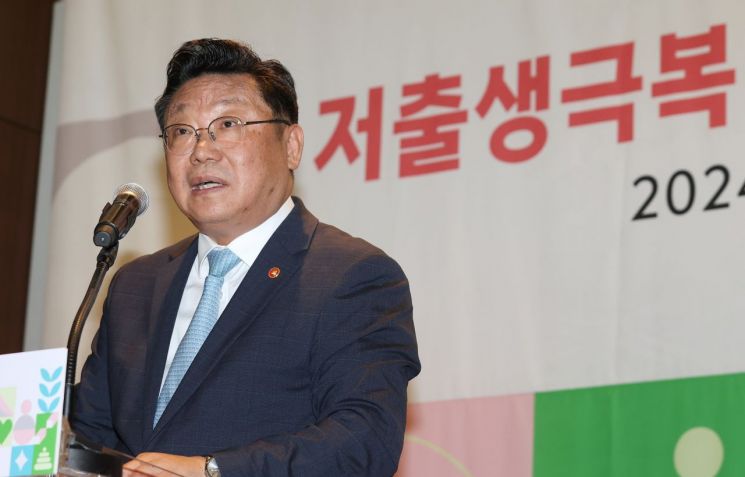
The Low Fertility and Aging Society Committee, the National Research Council for Economics, Humanities and Social Sciences, and the Korean Sociological Association jointly held the 4th Population Strategy Joint Forum on the theme of "Measures to Activate Early Social Entry of Young People" on the morning of the same day at the Korea Press Center in Jung-gu, Seoul.
The Population Strategy Joint Forum is held sequentially through collaboration among LFASC, the research council, and related academic societies, aiming to gather opinions, publicize, and seek alternatives regarding various social problems causing low birthrates and future crises brought about by demographic changes. This forum selected the theme of activating early social entry of young people as a response to the population crisis and discussed solutions.
In his opening remarks at the forum, Vice Chairman Joo said, "The Organisation for Economic Co-operation and Development (OECD) described in its 2022 Korea Economic Report the phenomenon where Korean youth fiercely compete to enter prestigious universities and secure stable jobs in the public sector or large corporations as the Golden Ticket Syndrome. Due to high university enrollment rates and other factors, the timing of young people's social entry in Korea is structurally late, and intense competition for limited jobs has lengthened the job preparation period and delayed social entry."
He continued, "If the timing of young people's social entry can be advanced, the age of marriage and childbirth will naturally decrease, helping to ease the ultra-low birthrate trend. It will also increase the economic participation rate of young people, serving as a countermeasure to adapt to the labor shortage era caused by the population cliff. It is necessary to create many good jobs that meet young people's expectations, solve labor market mismatches, and also promote employment for high school graduates."
Meanwhile, the forum's thematic presentations discussed the causes of delayed social entry among young people and measures for early social entry. The first presenter, Kim Yoo-bin, Senior Research Fellow at the Korea Labor Institute, stated, "The causes of delayed social entry among young people include high university enrollment rates, socio-cultural characteristics such as delayed economic and residential independence, and the dual structure of the labor market. To promote early social entry, it is necessary to enhance incentives for high school graduate employment and the effectiveness of employment subsidy programs, strengthen education and training programs for vulnerable youth in the labor market, support regional youth job creation, and increase labor market flexibility."
The second presenter, Lee Sang-jun, former Research Fellow at the Korea Labor Institute, noted, "Recent changes in recruitment methods, such as the decrease in regular public recruitment and increase in irregular hiring, have reduced opportunities and widened gaps for the younger generation to enter good jobs. It is necessary to expand education and training support for skill formation among new workers and increase related incentives so that companies can continuously provide quality job opportunities and experiences to new workers from a long-term investment perspective."
The final presenter, Kim Ki-heon, Senior Research Fellow at the Youth Policy Institute, proposed measures to address delayed social entry, including shortening academic periods through normalization of vocational high schools, providing tailored training and job search support for NEET (Not in Education, Employment, or Training) youth, and administrative integration of early-life policies scattered across multiple ministries.
During the comprehensive discussion session, various opinions were exchanged on strengthening incentive support for workers in response to the dual labor market structure, improving the public recruitment system and providing incentives to companies hiring regular workers, flexibilizing university curricula, and the need for tripartite agreements and public discourse to support early social entry of new workers.
© The Asia Business Daily(www.asiae.co.kr). All rights reserved.

















