Barclays Analysis: "Tariff-Induced Cost Increases Negatively Impact Companies"
With the U.S. presidential election about two weeks away, an analysis has emerged suggesting that if former President Donald Trump implements his tariff pledge after winning, the S&P 500 index could decline next year.
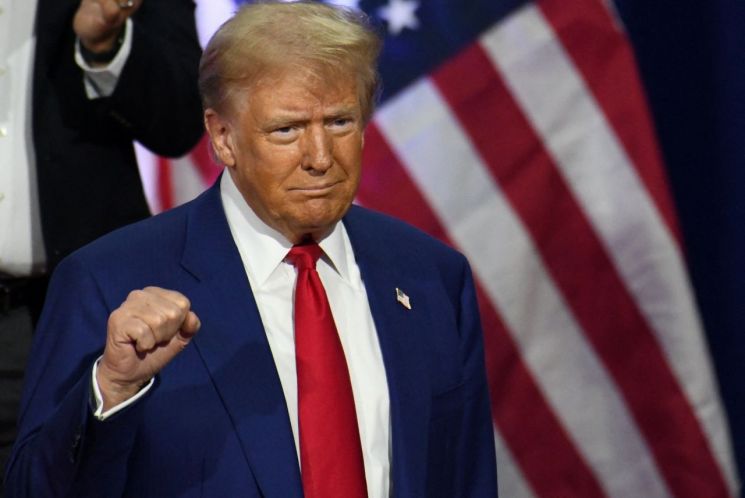
On the 20th (local time), according to U.S. economic media MarketWatch, investment bank (IB) Barclays stated in an investment memo that if the scenario of the second Trump administration imposing a 10% tariff on all imports, especially a 60% tariff on Chinese products, is assumed, the earnings per share (EPS) of S&P 500 companies in 2025 could decrease by 3.2%. Additionally, if retaliatory tariffs are imposed by opposing countries, the EPS of S&P 500 companies is estimated to decrease by an additional 1.5%.
Venu Krishna, an equity analyst at Barclays, said, “The secondary effects caused by cost inflation due to tariffs will gradually become a headwind to corporate earnings, causing damage,” and predicted that this would result in the S&P 500 index falling by 4.7% next year.
Barclays particularly forecasted that companies vulnerable to the global supply chain could be hit hard. The materials, consumer discretionary, technology, and healthcare sectors are representative examples.
MarketWatch noted that the Barclays analysis came amid a slightly increased possibility of former President Trump winning the U.S. election recently. According to the cryptocurrency-based betting site ‘Polymarket,’ as of that day, Trump’s probability of winning was 60.3%, far ahead of Democratic presidential candidate Vice President Kamala Harris’s winning probability of 39.2%. Until earlier this month, the winning probabilities of the two candidates were similar, but since then, Vice President Harris has faltered amid assessments that she has little difference in economic policy from President Joe Biden and a weak support base among Black male voters.
However, the stock market has not yet confirmed any impact from the increased probability of former President Trump’s victory. Christopher Smart, Managing Director of the Abros Group, explained, “The market expects that the second Trump administration will negotiate with China, Europe, and Mexico rather than fully implementing all the tariff increase measures promised during the campaign,” and added, “Since tariff increases are expected to be implemented gradually, it is presumed that corporate earnings next year will not be significantly affected.”
© The Asia Business Daily(www.asiae.co.kr). All rights reserved.

![Clutching a Stolen Dior Bag, Saying "I Hate Being Poor but Real"... The Grotesque Con of a "Human Knockoff" [Slate]](https://cwcontent.asiae.co.kr/asiaresize/183/2026021902243444107_1771435474.jpg)















