[2024 US Presidential Election]⑥ Calculations of Countries Worldwide
EU Watches Impact of 'Trump's Return'
Concerns over "Ishiba-Trump Friction" in Japan
To China, Anyone Is 'Two Poisoned Bowls'
Bolton: "If Trump Wins, Russia Triumphs, Ukraine Defeats"
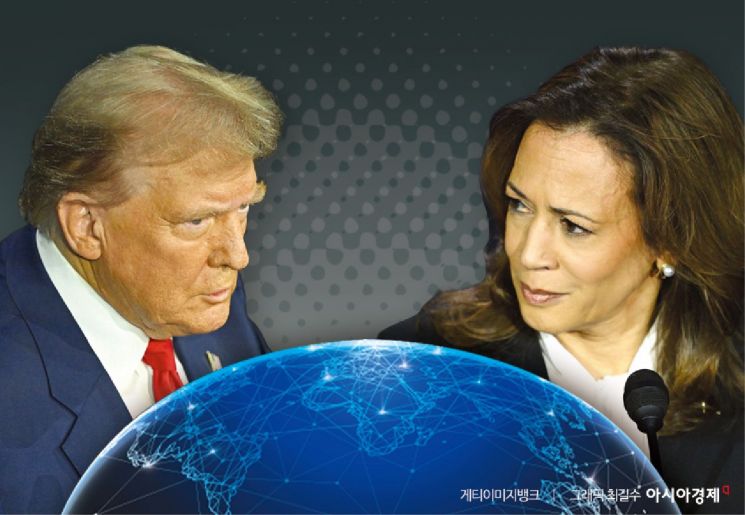
The calculations of countries around the world watching the U.S. presidential election are complex. From the perspective of existing allies, Vice President Kamala Harris, who continues the policy stance of President Joe Biden that values alliances, offers greater political stability. On the other hand, some are hoping to reset relations with former President Donald Trump and anticipate a new 'chemistry.' Each country is crunching the numbers and preparing countermeasures.
EU Forms 'Dedicated Team'... Japan Worried About Compatibility Between Ishiba and Trump
According to major foreign media, the European Union (EU) formed a dedicated team for the U.S. presidential election last August. This team is preparing to assess how the election of either Vice President Harris or former President Trump would affect the EU and how to respond to policy changes after the U.S. election. Foreign media reported that although Vice President Harris may not have complete continuity with President Biden, the EU prioritizes concerns about how a return of former President Trump would impact the EU economy.
The EU is worried that a second Trump administration might impose tariff bombs on EU exports, halt military and financial support to Ukraine, and pressure Ukraine to agree to Russia's conditions for a ceasefire. There is also concern that the U.S. might withdraw from the North Atlantic Treaty Organization (NATO) or follow through on threats against countries that do not spend enough on defense. Amid the recent rise of right-wing populism in Europe, former President Trump's close ties with leaders like Hungarian Prime Minister Viktor Orb?n are causing a sense of crisis among major EU governments.
The Harris administration's foreign policy toward Europe is expected to be a continuation of the Biden administration's approach. The EU is a key ally as it stands on the front lines of confrontation with Russia. Vice President Harris has expressed support for Ukraine multiple times and criticized former President Trump's calls for NATO withdrawal. Philip Gordon, Vice President Harris's National Security Advisor, is likely to lead foreign policy. He is regarded as the top expert on Europe and the Middle East within the Democratic Party. According to foreign media, senior EU officials have already been in contact with Advisor Gordon and others.
Japan's Ishiba Cabinet took office on the 1st of this month. Japanese Prime Minister Shigeru Ishiba plans to visit the U.S. immediately after the election results and hold early talks with the winner. Vice President Harris is expected to continue the Biden administration's policy of viewing Japan as a key ally in the Indo-Pacific region. However, there are concerns inside and outside Japan that friction could arise with Prime Minister Ishiba if former President Trump returns to power. Trump, with his America First policy, could again demand an increase in Japan's defense cost-sharing for U.S. forces stationed there and possibly renegotiate trade agreements.
Security expert Prime Minister Ishiba contributed an article titled "The Future of Japanese Foreign Policy" to the conservative U.S. think tank Hudson Institute last month. In the article, he argued for revising the U.S.-Japan Security Treaty to mutual defense and proposed stationing Japan's Self-Defense Forces in Guam. The Mainichi Shimbun reported that within the Liberal Democratic Party, concerns arose that this could instantly destroy the trust relationship built with the U.S. It was especially noted that such proposals could be used as a pretext to demand increased defense costs if former President Trump is elected.
Tobias Harris, head of Japan Foresight Risk Advisory, said, "Prime Minister Ishiba is someone who will speak directly to the U.S. If a second Trump administration takes office, no one can predict what will happen. Both leaders think the alliance is completely unfair, but for different reasons." Harvard University Professor Emeritus Joseph Nye also expressed concerns about friction between the two countries over revising the U.S.-Japan Status of Forces Agreement in a recent interview with Japan's Sankei Shimbun.
For China, 'Two Bowls of Poison'... Russia 'Prefers Harris' Joke, but Trump Is 'Close Friend'
From China's perspective, both Vice President Harris and former President Trump are formidable opponents. Neither candidate is friendly toward China. Professor Zhao Minghao of the Fudan University International Studies Institute's U.S. Research Center said, "Trump and Harris are 'two bowls of poison' for China."
It is well known that former President Trump waged a large-scale trade war against China during his tenure. In this election, he pledged to impose a 60% tariff immediately upon returning to the White House. Vice President Harris's China policy is less well known, but the Biden administration has been sanctioning and containing China's core strategic industries. Regardless of who wins, protectionism in trade is expected to increase.
However, opinions differ on the pros and cons. Chen Dungxiao, director of the Shanghai Institute of International Studies and advisor to the Chinese government, said, "If a 'second Trump term' becomes reality, greater uncertainty, instability, and unpredictability are expected." Vice President Harris is seen as offering relatively more policy continuity and predictability. On the other hand, Yan Xuetong, director of the Institute of International Relations at Tsinghua University, expects U.S.-China conflicts to intensify if Vice President Harris wins, as she aims to maintain America's global leadership, unlike Trump’s America First approach.
Taiwan is likely to be more concerned about former President Trump, who pursues America First, than Vice President Harris, who supports multilateralism. In a July interview with Bloomberg Businessweek, Trump said in response to whether he would defend Taiwan against China, "Taiwan took 100% of our semiconductor business," and added, "I think Taiwan should pay us for defense."
With the war in Ukraine dragging on, the U.S. is a difficult adversary for Russia. Kremlin spokesman Dmitry Peskov recently said when asked if Russia would congratulate the U.S. election winner, "They are an extremely unfriendly country," and "It does not seem likely." Russian President Vladimir Putin said last month that he preferred Vice President Harris among the U.S. candidates, but Foreign Minister Sergey Lavrov clarified that the remark was a joke.
Contrary to Putin's joke, many analysts believe Russia would relatively welcome former President Trump. Trump's America First policy and pragmatic approach differ from the Biden-Harris administration's collective security system through NATO that restrains Russia. If Trump succeeds in returning to the White House, Russia could have opportunities to ease sanctions that have lasted for years and establish a new relationship.
Former President Trump has also flaunted his friendship with President Putin. Bob Woodward, the Watergate scandal reporter, wrote in his recent book War that Trump spoke with Putin seven times after leaving office in 2021. During this election campaign, Trump repeatedly emphasized that he would end the Ukraine war immediately upon election. In last month's presidential debate, he avoided answering twice when asked if he hoped Ukraine would win. John Bolton, former National Security Advisor under Trump, evaluated, "If Trump is elected and intervenes, Ukraine will be the loser and Russia the winner."
Meanwhile, Ukrainian President Volodymyr Zelensky is uneasy. Last month, he met consecutively with Vice President Harris and former President Trump, requesting continued support. If former President Trump follows through on his pledge to quickly enter ceasefire negotiations, it is likely that Ukraine would have to concede some territories occupied by Russia.
© The Asia Business Daily(www.asiae.co.kr). All rights reserved.

















