Sales Volume Soars 89.1% Compared to Same Month Last Year
Hyundai Motor Targets Mass Production in 2026... Plans for Sales in US and China
Recently, Hyundai Motor officially announced plans to mass-produce 'Extended Range Electric Vehicles (EREV),' while in China, nearly 120,000 EREV units were sold in just one month.
According to data from the China Passenger Car Association (CPCA) on the 20th, 117,000 EREV units were sold in China last month. This represents an 89.1% surge in sales compared to the same month last year. Additionally, this is the first time CPCA has separately compiled and released sales figures exclusively for EREV.
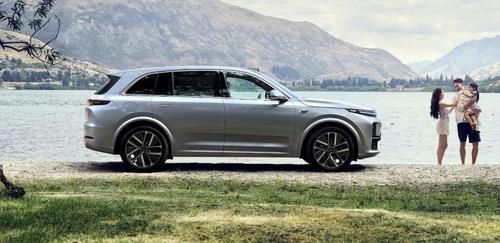 EREV model 'L7' by Chinese company Li Auto
[Image source=Li Auto official website capture, Yonhap News]
EREVs typically run solely on electric motors like electric vehicles, but when the battery charge runs low, a small engine acts as a generator to assist with electric charging. Previously, EREV sales were included in the statistics for plug-in hybrid electric vehicles (PHEVs), but as the share of EREVs has grown, a new standard appears to have been applied. PHEVs primarily use the engine as the main power source but can run on the electric motor for relatively short distances of 50 to 60 km. In contrast, EREVs use the electric motor as the main power source, with the engine used only for battery charging. While PHEVs are hybrids that can be plugged in, EREVs can be described as electric vehicles equipped with a generator.
In vast China, considering driving range and charging infrastructure, EREVs are establishing themselves alongside pure electric vehicles as mainstream eco-friendly cars. The Chinese startup automaker 'Li Auto' sold 380,000 units of its EREV model 'L7' last year. This model can travel up to 1,050 km according to Chinese government certification standards. Another Chinese electric vehicle startup, 'Seres,' which has a technical partnership with China's largest IT company Huawei, sold about 90,000 EREVs last year, and Xiaomi is also developing EREVs targeting 2026. Currently, more than 20 EREV models are known to be in mass production or development in China.
Meanwhile, in South Korea, Hyundai Motor is accelerating the launch of EREVs. Hyundai plans to begin mass production of EREVs by the end of 2026 and start full-scale sales in the United States, Canada, and China the following year. In North America, Hyundai and the Genesis brand aim to sell 80,000 mid-size sport utility vehicle (SUV) concept EREVs annually, while in China, they plan to release an economical compact EREV with a target of about 30,000 units sold per year.
EREVs are evaluated to secure price competitiveness compared to electric vehicles by maximizing the use of existing engines and reducing battery capacity?which accounts for a high portion of costs?by about 30%. They are also reported to offer similar ride comfort and quietness to electric vehicles while reducing charging stress.
At the 'CEO Investor Day' held last August, Hyundai Motor President Jang Jae-hoon explained, "EREVs allow simultaneous refueling and battery charging, reducing inconvenience in driving range, and are priced lower than electric vehicles. They combine the profitability of hybrid vehicles with the product competitiveness of electric vehicles."
Currently, the EREV market is mainly formed around China, and global automakers such as Stellantis and Ford, in addition to Hyundai Motor, are showing interest.
© The Asia Business Daily(www.asiae.co.kr). All rights reserved.
![Clutching a Stolen Dior Bag, Saying "I Hate Being Poor but Real"... The Grotesque Con of a "Human Knockoff" [Slate]](https://cwcontent.asiae.co.kr/asiaresize/183/2026021902243444107_1771435474.jpg)
















