Shine Muscat Prices Drop to Half Last Year's Level
30% Cheaper than Geobong Due to Quality and Sweetness Decline
The price of Shine Muscat, once considered a premium fruit, is steadily declining.
According to the Korea Agro-Fisheries & Food Trade Corporation (aT) on the 20th, the average wholesale price of Shine Muscat on the 17th was 10,140 KRW for 2 kg. This represents a 39.8% drop compared to a month ago, 52.9% lower than the average year, and 27.4% down from a year ago.
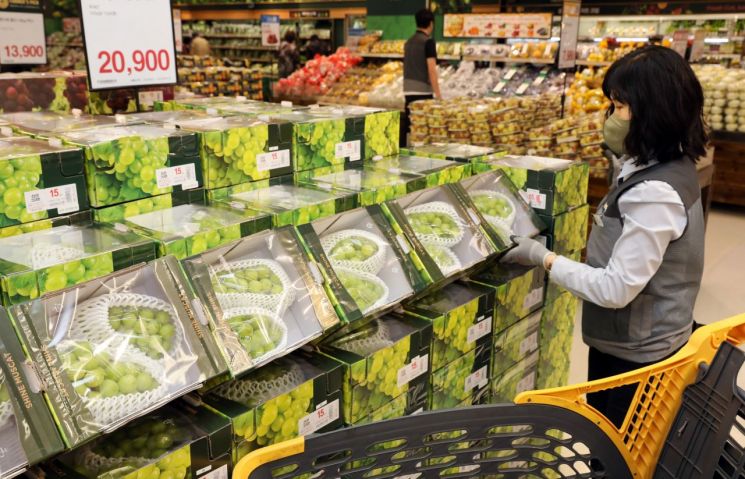
Shine Muscat has become even cheaper than Kyoho grapes. While the monthly average wholesale price of Shine Muscat was higher than Kyoho in July and August, the price reversed due to quality deterioration. According to the Korea Rural Economic Institute (KREI), last month's average wholesale price of Shine Muscat (Garak Market auction price) was 10,400 KRW for 2 kg, which is 28.8% cheaper than Kyoho grapes of the same weight (16,000 KRW). The per kilogram price of Shine Muscat has fallen to a level similar to Campbell Early. Last month, the average price of Campbell Early was 16,571 KRW for 3 kg.
The wholesale price of Shine Muscat for 2 kg, which was 24,639 KRW in September 2021 three years ago, has fallen for three consecutive years, dropping by more than half, or 54%, compared to then. Last month, the price of Shine Muscat dropped 25% compared to September last year (15,120 KRW). KREI forecasts that this month’s wholesale price of Shine Muscat will fall sharply to around 8,000 KRW, which is lower than October last year (10,900 KRW).
Shine Muscat now accounts for more than 80% of the domestic grape market. This is because many farmers have recently started cultivating Shine Muscat expecting high profits. KREI explained that the shipment volume of Shine Muscat this month is expected to increase by 6.7% compared to the previous year, and the shipment share of Shine Muscat accounts for 83.5% of all grapes. The cultivation area share of Shine Muscat among grape varieties was only 4% in 2017 but soared to 22% in 2020 and 41% in 2022, surpassing Campbell Early. Last year, Shine Muscat accounted for 44% of the grape cultivation area, much larger than Campbell Early (29%) or Kyoho varieties (17%).
When Shine Muscat first appeared, it was loved by consumers for its higher sugar content, pleasant aroma, and seedlessness compared to other grapes, but the situation has changed. Some farmers have not managed cultivation well, resulting in lower quality Shine Muscat being released to the market, leading to comments such as "not sweet" and "less tasty than before." This year, the quality further deteriorated due to the adverse effect of the heatwave, which prevented the berries from growing larger. The Korea Grape Association recommends a shipping sugar content of 18 Brix for Shine Muscat, but large supermarkets sell products with 15-16 Brix, and food material marts and traditional markets even sell products with 13 Brix.
© The Asia Business Daily(www.asiae.co.kr). All rights reserved.

















