Sangwook Park, Chief of Science and Technology, "AI Basic Act Must Be Legislated Quickly"
"Four Small Modular Reactors Included in the 11th Power Supply Plan"
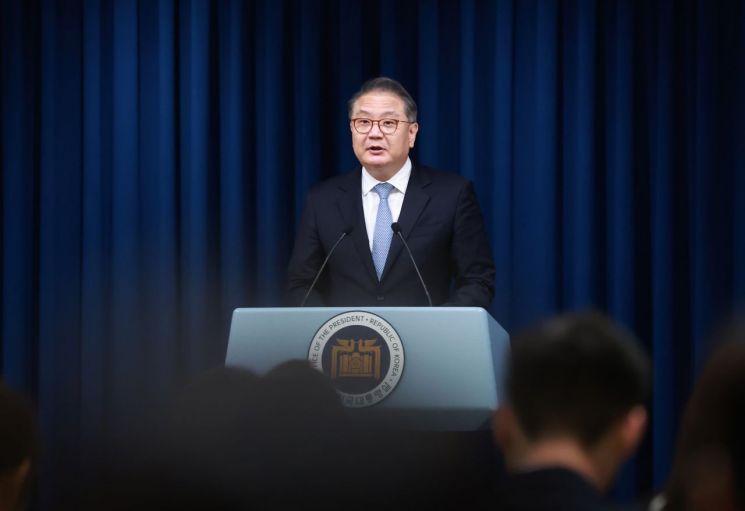
Park Sang-wook, Chief of Science and Technology at the Presidential Office, diagnosed on the 20th that the recently emerging "Samsung Electronics crisis theory" is "not just a problem of Samsung alone, but a symbolic phenomenon of a crisis facing South Korea's science and technology and industrial sectors."
On the same day, Park appeared on KBS1's Sunday Diagnosis and said, "Personally, I do not strongly agree with the term 'Samsung's crisis,' but considering the evaluations in the stock market and the emergence of crisis theories within Samsung itself, it seems to be a real crisis."
Park stated, "Semiconductors have been a grateful industry that has provided great momentum for South Korea's prosperity as a national key industry, but it also means that it is time to find the next growth engine." He added, "Based on the capabilities Samsung Electronics has accumulated so far, since the Samsung Group has successfully entered the bio industry, I believe that when the era of artificial intelligence (AI) and bio arrives, Samsung Electronics will quickly find another opportunity to leap forward by riding the big wave."
"At the Dawn of the AI Revolution... Launch of Infrastructure Expansion Promotion Committee"
In particular, Park repeatedly emphasized the importance of AI, with the government naming AI, advanced bio, and quantum as the three major game changers. He evaluated that the fact that many Nobel Prize winners in science this year are from global big tech companies like Google is "the Nobel Committee's declaration that the AI era has officially arrived," and said, "AI will flood into all fields of science and technology such as bio and materials like a tsunami, and we are at the dawn of the AI revolution."
Park said, "South Korea will also launch a Presidential AI Committee directly under the President to respond comprehensively to the AI era," adding, "All relevant ministers will attend, and subcommittees and special committees to be launched in November, along with public-private members, will lead everything related to AI."
Regarding criticism that AI infrastructure is significantly lacking compared to the U.S. and others, he responded, "Our strength is that the public and private sectors can work as one team and proceed quickly," and said, "The government will soon launch a Promotion Committee to expand AI computing infrastructure as a follow-up to the National AI Committee, with the Minister of Strategy and Finance serving as the chair." He further explained, "The reason the Minister of Strategy and Finance chairs the committee is to inject policy finance through the Korea Development Bank and the Industrial Bank of Korea, and to invest private capital, government budget, and policy finance to establish AI computing infrastructure at an appropriate level as soon as possible."
Regarding the delay in enacting the basic law for AI promotion, he said, "Although the current situation in the National Assembly is not easy, I believe that the AI Basic Act will be legislated promptly with bipartisan agreement, and I earnestly ask for this," emphasizing, "The AI Basic Act is the starting point of the AI transition, so I would like to ask that a system be established to enact and revise the AI Basic Act frequently."
Regarding the fact that South Korea has yet to win a Nobel Prize in science, unlike Japan which has won many, Park said, "It has only been about 30 years since substantial investment in basic science began, but if we strengthen investment in basic science research and development (R&D) and produce world-first research, it will be possible in the near future," and predicted, "As a global advanced technology powerhouse with increased recognition and favorability of South Korea itself, we will soon be able to receive a Nobel Prize in science."
"Four SMRs Equivalent to One Large Nuclear Reactor Output... Basic Plan to be Announced by Year-End"
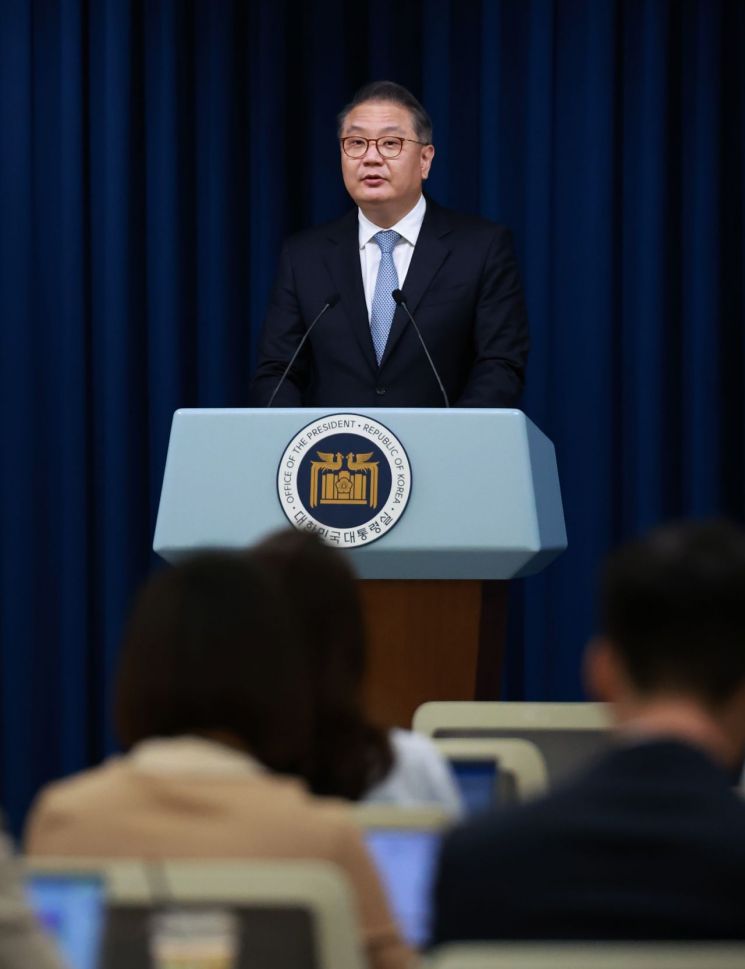
Additionally, Park explained, "The plan to build four Small Modular Reactors (SMRs) is expected to be reflected in the 11th Basic Plan for Electricity Supply and Demand to be announced by the end of the year," adding, "In terms of electricity generation capacity, about four SMRs with capacities ranging from 170 to 350 MW need to be combined to match the output of one large nuclear power plant."
Regarding the prospect of the 11th Basic Plan for Electricity Supply and Demand gaining approval from the National Assembly, he said, "SMRs are nuclear reactors that can be completed and shipped from factories, and as nuclear technology, they are next-generation growth engines and can become key export products," adding, "In this regard, there should be no partisan division." He continued, "Regarding SMRs specifically, South Korea ranks second or third in the world, and since SMRs are a technology without established standardization, we must develop technology while simultaneously creating licensing standards. We are accelerating efforts to develop Korean-style SMRs, expand specialized personnel, and ensure timely licensing of SMRs."
Regarding the nuclear alliance established through President Yoon Suk-yeol's visit to the Czech Republic, he said, "It means expanding the existing Korea-U.S. nuclear alliance to Korea-U.S.-Czech," emphasizing, "Nuclear power is not just a single power plant but an applied technology of nuclear science, so the nuclear alliance means cooperation at the alliance level in almost all fields of science and technology."
Regarding the Constitutional Court's ruling of constitutional inconsistency on the Carbon Neutrality Basic Act, Park said, "I believe the ruling is not that the Carbon Neutrality Basic Act itself is unconstitutional, but a stern warning from the Constitutional Court against not setting specific reduction targets and shifting carbon emission responsibility to future generations," and stated, "We will promptly set national carbon reduction targets for 2031 to 2035 within a few months and present concrete figures with guaranteed implementation for 2036 to 2050 in a second phase to change it to constitutional."
© The Asia Business Daily(www.asiae.co.kr). All rights reserved.


















