AI Safety Research Institute Established within ETRI... Office in Pangyo
450 Billion KRW AI·SaaS Innovation Fund Created
Promoting Private Cloud Adoption in Public Sector
The government will open an AI Safety Research Institute in November to prepare for potential risks in the artificial intelligence (AI) era. It will also consider tax credits for investments in the cloud sector to foster the cloud industry, a core AI infrastructure, and establish a fund worth 45 billion KRW.

On the 18th, the Ministry of Science and ICT announced that it held the 17th Information and Communication Strategy Committee (hereinafter referred to as the Strategy Committee) at 2 p.m. in the National Science and Technology Advisory Council's main conference room in Jung-gu, Seoul. The Strategy Committee is a policy decision-making body in the information and communication sector based on the Special Act on the Promotion of Information and Communication and Convergence Activation, consisting of 25 members including the Prime Minister, ministers of related ministries, and private members.
The Strategy Committee shared the establishment and operation plans of the AI Safety Research Institute and deliberated and approved the 4th Basic Plan for Cloud Computing, which includes a three-year policy direction for cloud computing, an essential AI infrastructure.
The government has set AI as a core agenda of national policy, established the 'AI-Semiconductor Initiative' in April, held the AI Seoul Summit the following month, and produced the 'Seoul Declaration,' a global AI governance summit declaration. Last month, it also established the Presidential Commission on National AI. The discussions at this Strategy Committee are a continuation of the government's AI policy.
Minister Yoo Sang-im of the Ministry of Science and ICT stated, "The next one to two years are a golden time that will determine whether South Korea can leap forward as a leading country in AI and digital fields," adding, "It is time for the government and the private sector to join forces and concentrate all capabilities." He further said, "We will actively cooperate with related ministries to swiftly implement the discussed matters."
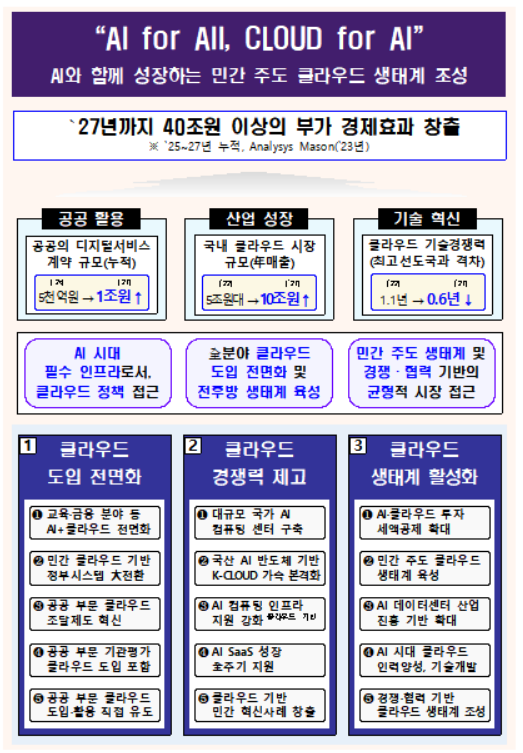 Government's Vision and Promotion Strategy for the Digital Era / Data provided by the Ministry of Science and ICT
AI Safety Research Institute to Open in November... Safety Evaluation and Research
The government will establish a new organization, the AI Safety Research Institute, within the Electronics and Telecommunications Research Institute (ETRI). The institute is scheduled to open in November.
Previously, the government conducted in-depth analyses of the roles and characteristics of AI safety research institutes by visiting major countries such as the UK, the US, and Japan. Subsequently, through advisory committees and a preparatory committee, it derived the institute's vision, detailed functions, and operational plans.
The AI Safety Research Institute will operate three research divisions: safety policy, evaluation, and technology, with offices located on the 4th floor of the Pangyo Global R&D Center.
Procedures are underway to hire the inaugural director with expertise in the AI field. Immediately after opening, the institute will be operated by 10 ETRI personnel and staff seconded from other institutions, but after 2025, it plans to add about 20 new personnel to the 10 ETRI staff.
The institute has set the vision of becoming "a global AI safety hub representing the Asia-Pacific region" and established three core goals: ▲ enhancing scientific understanding of AI safety ▲ advancing AI safety policies and establishing safety systems ▲ supporting domestic AI companies in securing safety.
To achieve these three goals, it will promote △ defining AI risks and safety evaluation △ AI safety policy research △ building AI safety partnerships through domestic and international cooperation △ research and development (R&D) to prepare for AI risks such as deepfakes and ensure safety.
After its launch, the AI Safety Research Institute plans to attend the International AI Safety Research Institute Network event held in the US on November 20-21 to discuss synthetic content, foundational model evaluation, and risk assessment methods.
Strengthening Private-led 'Cloud' Competitiveness... Expansion of Tax Credits Under Review
Efforts will also be made to strengthen cloud competitiveness, which has become a core AI infrastructure. Although the government enacted the first Cloud Act in 2015 and has been promoting industrial development policies, the overall cloud utilization rate in South Korea remains low.
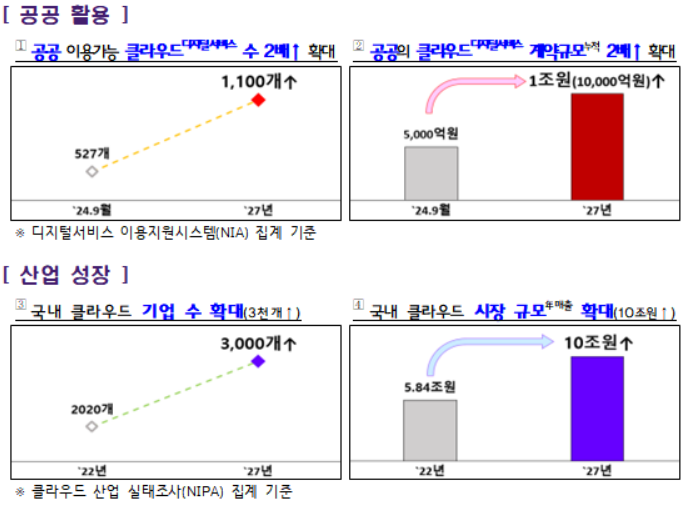 Expected Effects of the Government's Cloud Industry Activation Policy / Source: Ministry of Science and ICT
Accordingly, the government will shift its policy direction toward activating a private-led cloud ecosystem.
First, to promote private investment, it will consider expanding tax credits for investments in AI and cloud sectors. The specific areas, scope, and levels of tax credits will be finalized through consultations with related agencies.
Additionally, it will establish a 45 billion KRW AI and Software as a Service (SaaS) innovation fund and create a SaaS transition support center to build a private-led SaaS ecosystem. Platform as a Service (PaaS) will also transition to a private-led commercial PaaS ecosystem.
Cloud workforce development will be strengthened for not only new hires but also current employees and experienced workers, aiming to produce more than 1,400 talents annually. The government currently designates the Busan Information Industry Promotion Agency (BIPA), Korea Cloud Computing Cooperative Research (CCCR), Gangwon Technopark (Gangwon TP), and Cheongju University Industry-Academic Cooperation Foundation as cloud specialized workforce training institutions.
It will also consider improving the Cloud Supplementary Authentication Program (CSAP) to harmoniously support domestic and international clouds when fostering global SaaS.
Support will be provided to core upstream and downstream cloud industries. The government will develop domestic AI semiconductors and apply them to data centers to actively advance the K-Cloud project. It has already passed a budget of 400 billion KRW to build the K-Cloud software ecosystem.
Promising SaaS will be selected to support AI SaaS development, advancement, commercialization, and global expansion. Cloud vouchers will be gradually restructured from broad, small-scale support of about 10 to 20 million KRW annually to concentrated support of 60 to 80 million KRW annually. The main point is to limit the support targets to provide larger amounts.
To activate AI and cloud adoption, innovative cases in education (AI digital textbooks), finance (expanded use through network separation relaxation), and defense (building soldier-experience service platforms) will be created.
Furthermore, three major systems will be reformed: ▲ including cloud adoption in institutional evaluations ▲ prioritizing the use of private cloud and SaaS when newly building or rebuilding information systems ▲ improving the entire process (review, contract, dissemination) of the digital service specialized contract system.
© The Asia Business Daily(www.asiae.co.kr). All rights reserved.
![Clutching a Stolen Dior Bag, Saying "I Hate Being Poor but Real"... The Grotesque Con of a "Human Knockoff" [Slate]](https://cwcontent.asiae.co.kr/asiaresize/183/2026021902243444107_1771435474.jpg)


















