The price of gold, a representative safe-haven asset, has hit an all-time high. This is due to the impact of the U.S. presidential election less than three weeks away and prolonged uncertainty stemming from the Middle East.
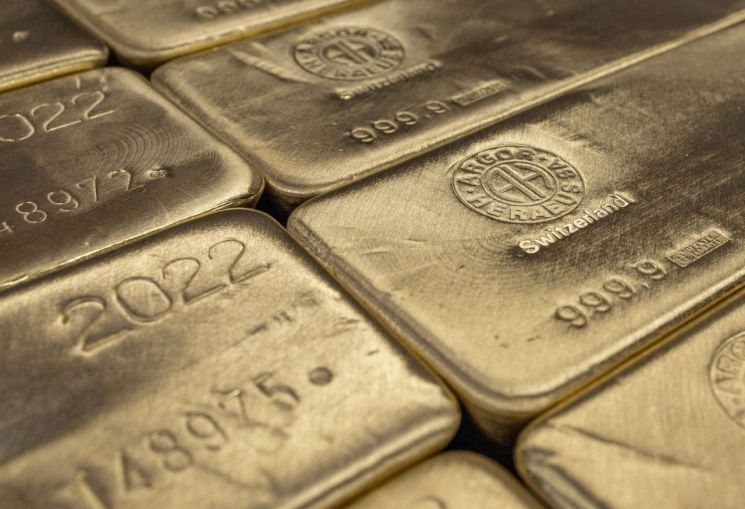
On the 17th (local time) at the New York Commodity Exchange (COMEX), the December gold contract closed at $2,707.5 per ounce, up 0.6% from the previous session. In the spot market, gold closed at $2,692.04 per ounce, up 0.7% from the previous session, surpassing the intraday all-time high of $2,685.42 recorded in September. At one point during the morning session, spot gold even reached $2,696.62 per ounce.
Gold prices have surged more than 30% over the past year. This is due to the full-scale interest rate cut cycles by major central banks such as the U.S. Federal Reserve (Fed) and the European Central Bank (ECB) this year, as well as increased geopolitical risks from the Middle East. Gold, regarded as a means of diversified investment for asset protection, tends to attract investors as a representative safe haven whenever market uncertainty rises. Since it does not pay interest, it is also an investment asset that can yield higher returns during periods of falling interest rates.
In the Middle East, the death of Yahya Sinwar, the leader of the Palestinian armed faction Hamas, was confirmed on the same day, leading to speculation that this could be a turning point in the previously deteriorating situation. However, Israeli Prime Minister Benjamin Netanyahu stated, "The war is not over yet," and concerns about escalation have not easily subsided.
Moreover, with the U.S. presidential election in November approaching and the race remaining extremely close, gold prices are being further pushed upward. Analysts suggest that regardless of who wins, the expansion of the U.S. fiscal deficit is inevitable, which will inevitably stimulate gold demand. Nitesh Shah, a commodity strategist at WisdomTree, said, "In addition to concerns about the Middle East, the U.S. election is approaching. A very fierce election is expected, so uncertainty is high. Gold is a product that investors turn to when uncertainty increases."
Accordingly, the market is flooded with analyses predicting that the upward trend in gold prices will continue for the time being. Officials from the London Bullion Market Association (LBMA), which controls trading trends in the global gold market, predicted at their annual meeting this week that gold prices could rise to the $2,941 per ounce range over the next year. GSC Commodity Intelligence analyzed, "Gold prices are exploding by breaking all-time highs in 2024," adding, "This is a sign that we are in the early stages of a new historic supercycle for gold."
On the same day, gold prices closed lower than the intraday all-time high after U.S. retail sales and unemployment figures showed stronger-than-expected resilience. This was due to economic indicators supporting U.S. economic growth, slightly raising short-term expectations that the Fed might hold interest rates steady at the upcoming Federal Open Market Committee (FOMC) meeting. Regarding this, Bob Haberkorn, chief market strategist at RJO Futures, said, "It was a good data point," but added, "The Fed wants to cut rates. An additional 0.25 percentage point cut will follow within the year. Ultimately, interest rates will fall and gold prices will rise." On the same day, the ECB also continued its monetary easing stance by cutting key policy rates by 0.25 percentage points, marking the third rate cut this year.
Meanwhile, international oil prices rebounded after five days due to renewed Middle East uncertainty following Prime Minister Netanyahu's remarks. At the New York Mercantile Exchange, the near-month November delivery West Texas Intermediate (WTI) crude oil closed at $70.67 per barrel, up 0.40% from the previous session. The global benchmark Brent crude for December delivery rose 0.31% to $74.45 per barrel.
© The Asia Business Daily(www.asiae.co.kr). All rights reserved.
!["The Woman Who Threw Herself into the Water Clutching a Stolen Dior Bag"...A Grotesque Success Story That Shakes the Korean Psyche [Slate]](https://cwcontent.asiae.co.kr/asiaresize/183/2026021902243444107_1771435474.jpg)
















