U.S. Treasury Secretary Janet Yellen criticized former President Donald Trump, the Republican presidential candidate, on the 17th (local time) for his pledge of a 'universal tariff,' saying, "Broad tariffs without targets will raise prices for American households and weaken corporate competitiveness."
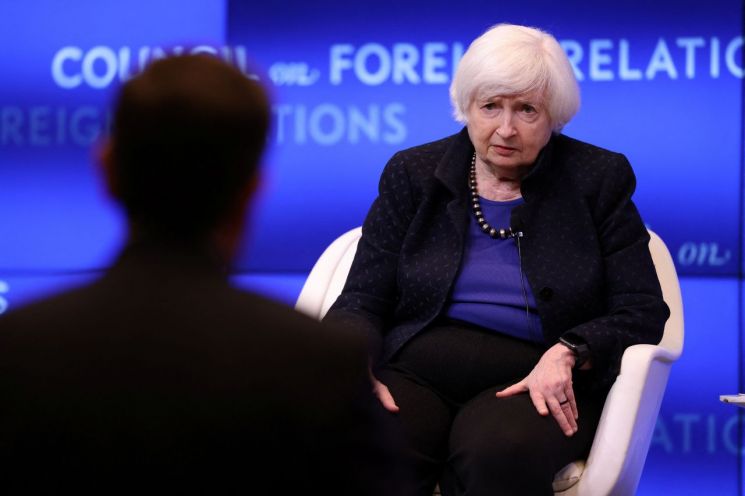
At an event hosted by the Council on Foreign Relations (CFR) in New York that day, Secretary Yellen stated, "The idea of imposing high tariffs on both allies and competitors, or treating even our closest allies as mere trading partners to isolate the U.S. from the world, is deeply misguided." This was interpreted as a direct criticism of former President Trump's pledge to impose a universal tariff of up to 20% on all products imported into the U.S. during his administration. Two days earlier, at an event in Chicago, Trump had claimed, "The most beautiful word in the dictionary is 'tariff.'"
Secretary Yellen said, "If the United States were alone, we could not even hope to advance our economic and security interests, just as we oppose Russia's illegal invasion of Ukraine," and "The challenges we face today?such as supply chain disruptions, climate change, global pandemics, and China's overproduction?mean we cannot simply follow the old ways."
That day, Secretary Yellen opposed halting trade and investment with China but emphasized the necessity of creating a fair trade competition environment. She said, "Trade and investment with China can provide significant benefits to American businesses and workers and must be maintained," but added, "However, we need to build a healthy economic relationship based on a 'level playing field.'" She also pointed out, "China's market entry barriers and unfair trade practices create difficulties not only for American companies and workers but also for other foreign companies trying to do business in China," noting that such policies lead to overproduction in key industries, threatening the survival of U.S. companies and causing supply chain problems. This, she diagnosed, ultimately weakens global economic resilience.
Secretary Yellen's criticism of high tariffs drew attention as it came less than three weeks before the November presidential election. Local media, including The New York Times (NYT), noted that although Yellen usually refrains from political statements, she has long criticized tariff policies as a "tax on consumers." During her speech, Yellen did not directly mention former President Trump by name. The NYT reported, "It is clear that she fears a second Trump administration would undo her efforts to strengthen economic ties with allies," adding, "Trump has threatened to change his approach with comprehensive tariff policies and has claimed to have been targeted by allies including the European Union (EU)."
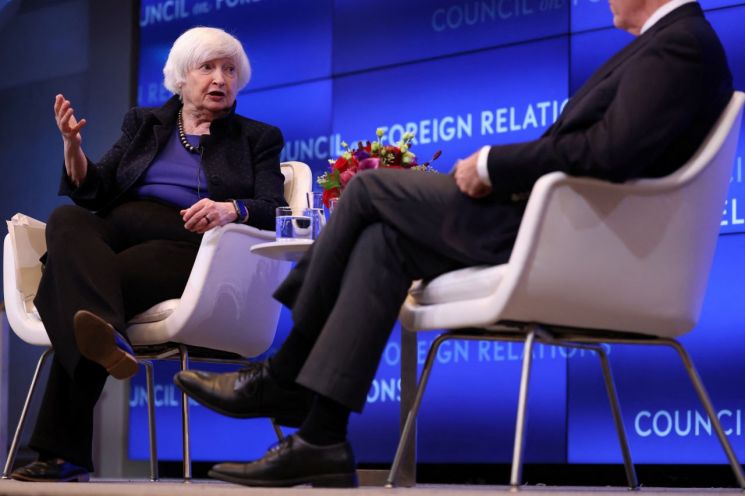
On the same day, Secretary Yellen defended the Biden administration's tariffs targeting Chinese electric vehicles and semiconductors. She said, "These are strategic and targeted measures," emphasizing, "The EU and emerging market countries have taken or are considering similar actions. The growing international consensus means China must change its practices."
Regarding the U.S. economic situation, she assessed, "U.S. GDP growth is robust, unemployment is at historic lows, and inflation has significantly decreased." She emphasized, "We are doing everything possible to lower prices for American households," and added, "We are pursuing a strategy called 'modern supply-side economics,' which aims to reduce inequality while expanding productive capacity."
Meanwhile, analyses have emerged suggesting that even partial implementation of former President Trump's economic pledges, such as universal tariffs, could trigger a more destructive trade war globally than during his first term. The Washington Post (WP) reported that Trump's tariff increase pledges would not only raise prices but also spark trade conflicts with countries worldwide. For the U.S., which imports over $1 trillion annually in products directly related to consumers' lives?such as low-cost Chinese electronics, food from South America and Canada, and pharmaceuticals from India and Mexico?the imposition of retaliatory tariffs would inevitably exacerbate inflation. Major companies are also expected to be hit, as they rely on supply chains involving overseas subsidiaries and retail businesses.
Previously, former President Trump had announced plans to impose a universal tariff of up to 20% on all imports to improve the U.S. trade deficit, a 60% high tariff on Chinese products, and up to 1000% tariffs on Chinese electric vehicles imported through Mexico.
© The Asia Business Daily(www.asiae.co.kr). All rights reserved.
![Clutching a Stolen Dior Bag, Saying "I Hate Being Poor but Real"... The Grotesque Con of a "Human Knockoff" [Slate]](https://cwcontent.asiae.co.kr/asiaresize/183/2026021902243444107_1771435474.jpg)

















