Kristalina Georgieva, IMF Managing Director
"Economic Shock Is Inevitable... Debt Must Be Reduced"
Although prospects for a soft landing of the global economy are increasing, the International Monetary Fund (IMF) has warned that major countries' monetary easing and rising trade barriers could hinder future economic growth.
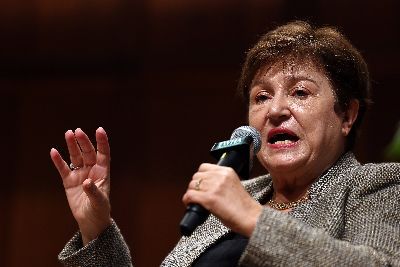
Kristalina Georgieva, Managing Director of the IMF, stated on the 17th (local time) ahead of the IMF·World Bank (WB) Annual Meetings to be held next week in Washington D.C., "The massive wave of inflation is retreating without a global recession or large-scale unemployment."
She expressed concern that while the global economy is on a soft landing trajectory, governments' fiscal expansion policies and the building of trade barriers could become headwinds. She urged debt restraint and the easing of trade tensions.
Managing Director Georgieva said, "A future with low growth rates and high debt, which is hard to accept, is predicted," adding, "Public debt in many countries is much higher than before the COVID-19 pandemic and continues to increase."
Earlier, the IMF forecasted in a report released on the 14th that the global public debt will surpass $100 trillion for the first time ever by the end of this year. Not only developing and low-income countries but also advanced economies like the United States are currently paying a significant portion of their tax revenues as interest on debt repayments.
Georgieva pointed out, "Politicians prefer fiscal expansion over fiscal consolidation, making debt control difficult," and added, "Even fiscally conservative parties have developed a habit of borrowing money." She warned that a potential economic shock "will definitely come and could arrive sooner than we expect," urging the reduction of debt and rebuilding of fiscal buffers to respond to it.
She also reiterated the need to lower trade barriers being erected by countries including the United States.
Georgieva warned, "(Trade barriers) are like pouring cold water on an already lukewarm global economy," and cautioned that rising trade tensions, including tariff increases, will reduce growth rates. She further suggested, "We should not take global tensions for granted," and proposed, "Let us lower geopolitical temperatures and focus on challenges we can solve together."
This statement came amid growing concerns that global trade conflicts will intensify ahead of the U.S. presidential election on November 5. Donald Trump, the Republican presidential candidate and former president, has pledged to impose a universal tariff of up to 20% on all imports worldwide and a 60% tariff on Chinese goods if he wins the election. The Biden administration has maintained the previous administration's tariff hikes on China and additionally imposed high tariffs. In May, tariffs on strategic industrial items such as Chinese electric vehicles and solar panels were raised to as high as 100%.
Meanwhile, U.S. Treasury Secretary Janet Yellen criticized former President Trump's universal tariff pledge, saying, "Broad tariffs without (specific) targets will raise costs for American households and weaken corporate competitiveness." In a speech distributed ahead of her participation in a Council on Foreign Relations (CFR) discussion held in New York that day, she stated, "The idea of imposing high tariffs on both allies and competitors, or viewing even our closest allies as trading partners to isolate the U.S. (from the world), is fundamentally wrong," adding, "It means that the problems we face?such as supply chain disruptions, climate change and global pandemic preparedness, and China's overproduction?cannot be addressed in the same way as in the past."
© The Asia Business Daily(www.asiae.co.kr). All rights reserved.

















