September Retail Sales Up 0.4% MoM, Exceeding Expectations
"Low Recession Risk... Year-End Santa Rally Anticipated"
Unemployment Claims Decrease by 19,000 from Previous Week
Semiconductor Stock Rally Boosts Investor Sentiment
The three major indices of the U.S. New York stock market showed strength in early trading on the 17th (local time). Robust retail sales data raised expectations for a soft landing of the U.S. economy, and semiconductor stocks, which had recently plunged, rallied, pushing the S&P 500 index to an intraday record high.
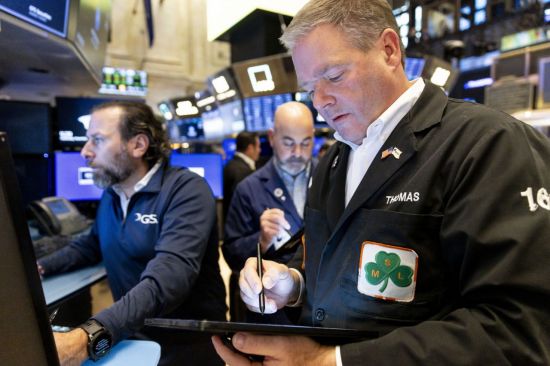
As of 9:58 a.m. in the New York stock market on that day, the blue-chip-focused Dow Jones Industrial Average was trading at 43,210.66, up 0.31% from the previous trading day. The large-cap-focused S&P 500 index briefly surpassed an all-time high during the session and was trading 0.31% higher at 5,860.33. The tech-heavy Nasdaq index was up 0.44% at 18,448.56.
By individual stocks, semiconductor shares were strong. Taiwan's TSMC surged 10.93% after posting nearly 14 trillion won in net profit for the third quarter this year. TSMC's surprise earnings triggered a semiconductor stock rally. AI leader Nvidia rose 2.63%, AMD climbed 1.01%, and Qualcomm was up 0.91%.
The retail sales data released that morning also stimulated investor sentiment. According to the U.S. Department of Commerce, September retail sales totaled $714.4 billion, up 0.4% from the previous month. This exceeded both August's figure (0.1%) and the Dow Jones forecast (0.3%). Among 13 retail categories, 10 showed increases, including general merchandise stores (4%), clothing and accessories stores (1.5%), and health and personal care stores (1.1%). Conversely, sales declined at electronics stores (-3.3%), gas stations (-1.6%), and furniture stores (-1.4%). Retail sales account for two-thirds of the U.S. economy. The better-than-expected retail sales data last month suggest that the U.S. economy continues to maintain solid growth.
Ian Ringen, Head of U.S. Interest Rate Strategy at BMO Capital Markets, noted, "The increase in consumption reinforces investors' perception that the U.S. real economy was strong in September."
Employment data also eased concerns about a cooling labor market. According to the U.S. Department of Labor, initial jobless claims last week fell by 19,000 to 241,000 (October 6?12), matching market expectations. Continuing claims, representing those claiming unemployment benefits for at least two weeks, were 1.867 million for the week of September 29 to October 5. This exceeded the revised prior week's figure (1.858 million) but was below market forecasts (1.87 million).
David Russell, Global Market Strategist at TradeStation, analyzed, "Thanks to U.S. consumers, the economy continues to accelerate, and with lower fuel prices, the improvement effect will be even greater. Today's data show that the likelihood of a recession has decreased." He added, "Santa might come to the stock market this year. In fact, he might already be here."
As the U.S. economy appears robust, expectations for interest rate cuts have diminished, causing bond yields to rise. The U.S. 10-year Treasury yield, a global bond yield benchmark, rose 7 basis points (1 bp = 0.01 percentage points) to 4.09%, while the 2-year Treasury yield increased 5 basis points to 3.98%.
International oil prices are moving sideways. West Texas Intermediate (WTI) crude oil was down $0.02 from the previous trading day, trading at $70.37 per barrel, while Brent crude, the global oil price benchmark, fell $0.04 to $74.18 per barrel.
© The Asia Business Daily(www.asiae.co.kr). All rights reserved.

















